
Union Cabinet Approves Kharif MSP 2026-27: Major Boost for Oilseeds and Pulses to Reduce Import Dependence
The Union Cabinet has approved the Minimum Support Prices (MSP) for Kharif Marketing Season 2026-27, introducing significant increases for oilseeds and pulses. With the highest hike awarded to sunflower seed, followed by cotton and tur/arhar, the policy signals a strategic shift toward reducing edible oil imports, improving farmer profitability, and encouraging crop diversification beyond traditional paddy cultivation.
Union Cabinet Approves Landmark 2026-27 Kharif MSP to Drive Oilseed and Pulse Transitions
Introduction
India's agricultural policy landscape witnessed a major development with the Cabinet Committee on Economic Affairs (CCEA) approving the Minimum Support Prices (MSP) for Kharif Marketing Season 2026-27. The announcement goes beyond a routine MSP revision and reflects a strategic attempt to reshape cropping patterns across the country.
For decades, India's dependence on imported edible oils has placed significant pressure on foreign exchange reserves. Simultaneously, large-scale concentration in paddy cultivation has led to concerns related to groundwater depletion, regional imbalances, and market distortions. The latest MSP adjustments indicate a deliberate policy move to encourage farmers toward oilseeds and pulses while maintaining support for food security crops.
Why the 2026-27 MSP Announcement Matters
Addressing India's Edible Oil Import Challenge
India remains one of the world's largest importers of edible oils. Despite favorable agro-climatic conditions, domestic oilseed production has not kept pace with rising consumption.
The government's latest MSP structure aims to improve the profitability of oilseed cultivation and encourage farmers to allocate more acreage to these crops.
Encouraging Crop Diversification
Many agricultural regions continue to rely heavily on paddy cultivation due to established procurement systems and predictable market returns.
The revised MSP structure creates stronger economic incentives for farmers to diversify into:
- Sunflower
- Groundnut
- Soybean
- Sesamum
- Tur/Arhar
- Other pulse crops
Diversification can improve soil health, reduce water stress, and create more resilient farming systems.
Key MSP Highlights for Kharif 2026-27
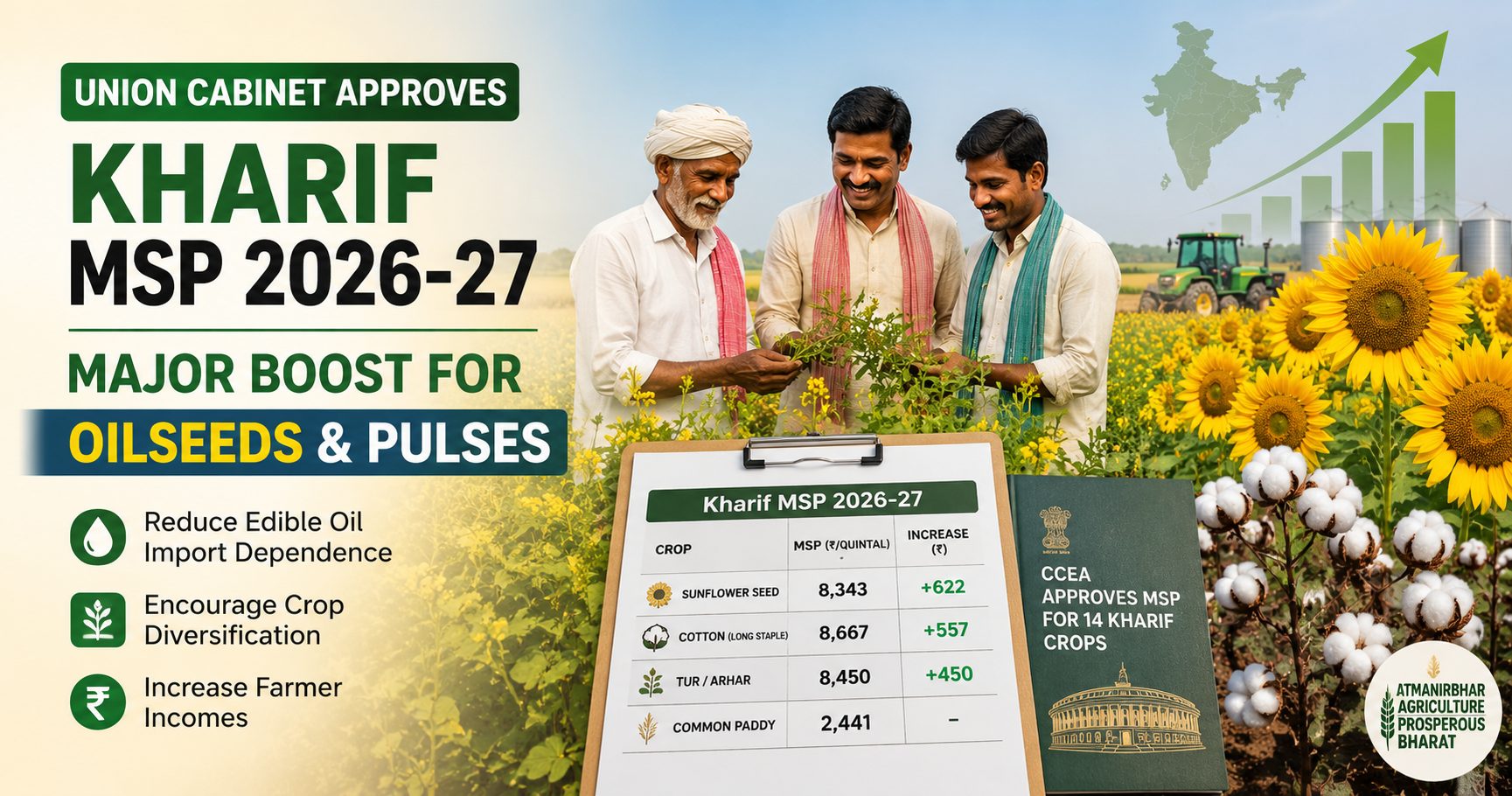
Sunflower Seed Receives the Highest MSP Increase
The biggest winner in the MSP announcement is sunflower seed.
Key change:
- Previous MSP: ₹7,721 per quintal
- New MSP: ₹8,343 per quintal
- Increase: ₹622 per quintal
This substantial increase reflects the government's commitment to boosting domestic edible oil production and reducing import dependence.
Strong Support for Cotton Producers
Cotton long staple also received a major increase.
Key change:
- New MSP: ₹8,667 per quintal
- Increase: ₹557 per quintal
The enhanced MSP is expected to strengthen cotton economics and support farmers in major cotton-growing regions.
Significant Increase for Tur/Arhar
Tur remains one of India's most important pulse crops.
Key change:
- New MSP: ₹8,450 per quintal
- Increase: ₹450 per quintal
The move is designed to stimulate pulse production and reduce supply shortages.
Modest Increase for Paddy
Common paddy witnessed a relatively moderate revision.
Key change:
- New MSP: ₹2,441 per quintal
The measured increase aligns with the government's broader objective of avoiding excessive incentives that could further encourage paddy monoculture in water-stressed regions.
Strategic Policy Objectives Behind the MSP Revision
Reducing Import Bills
India spends billions annually importing edible oils.
Increasing domestic oilseed production can:
- Reduce foreign exchange outflows
- Improve self-reliance
- Strengthen food security
- Support rural incomes
Improving Farmer Profitability
Higher MSPs offer farmers better price assurance and lower market risk.
Farmers can make cropping decisions with greater confidence when minimum returns are protected.
Supporting Sustainable Agriculture
Oilseeds and pulses often require less water compared to paddy.
Greater adoption can contribute to:
- Improved water-use efficiency
- Better soil fertility
- Reduced environmental stress
- More balanced crop rotations
Impact on Farmers
New Revenue Opportunities
Farmers evaluating crop choices for upcoming seasons may find oilseeds and pulses increasingly attractive due to improved price realization prospects.
Better Risk Distribution
Diversified cropping systems help reduce dependency on a single commodity and improve resilience against market fluctuations.
Potential Expansion of Oilseed Acreage
States with suitable agro-climatic conditions may witness greater sunflower, soybean, and groundnut cultivation as MSP incentives improve.
Impact on India's Agricultural Economy
Strengthening Domestic Supply Chains
Higher production of oilseeds and pulses can stimulate:
- Processing industries
- Value addition businesses
- Storage infrastructure
- Rural employment
Supporting Atmanirbhar Agriculture
The MSP strategy aligns with broader national goals of reducing import dependency and strengthening domestic agricultural production systems.
Opportunities for Agripreneurs
Processing and Value Addition
Growing oilseed production creates opportunities in:
- Oil extraction units
- Seed processing
- Storage facilities
- Branding and packaging
Market Intelligence Services
Farmers increasingly require:
- Crop planning insights
- MSP tracking
- Market forecasting
- Input optimization guidance
Digital agriculture platforms can play a crucial role in supporting these decisions.
Conclusion
The 2026-27 Kharif MSP announcement represents a significant policy shift aimed at encouraging oilseed and pulse cultivation while balancing food security objectives. With sunflower seed, cotton, and tur/arhar receiving substantial MSP increases, the government is sending a clear market signal toward crop diversification and import substitution.
For farmers, agribusinesses, and agricultural entrepreneurs, the revised MSP framework opens new opportunities to improve profitability and align production strategies with emerging national priorities.
Explore the Agriculture Intelligence Platform of Bharat - AGRIBOZ
CTA
Transform Agricultural Decisions with AGRIBOZ
Stay ahead of policy changes, market trends, MSP updates, crop intelligence, training opportunities, and agribusiness innovations through AGRIBOZ.
Explore the Agriculture Intelligence Platform of Bharat - AGRIBOZ
Register on https://www.agriboz.com Explore the Agriculture Intelligence Platform of Bharat - AGRIBOZ
Stay updated with MSP announcements, government policies, crop profitability trends, market intelligence, expert-led workshops, agricultural training programs, and agribusiness opportunities.
Whether you are a farmer, FPO, agripreneur, consultant, trainer, or agriculture investor, AGRIBOZ helps you make smarter and more profitable decisions.
Register on https://www.agriboz.com Q1. What is the MSP for Sunflower Seed in Kharif 2026-27? A. The MSP for Sunflower Seed has been increased to ₹8,343 per quintal, representing the highest absolute increase among Kharif crops.
Q2. Which crop received the highest MSP increase in 2026-27? A. Sunflower Seed received the highest increase of ₹622 per quintal.
Q3. What is the new MSP for Tur/Arhar? A. The MSP for Tur/Arhar has been fixed at ₹8,450 per quintal for the Kharif Marketing Season 2026-27.
Q4. Why is the government increasing MSPs for oilseeds and pulses? A. The objective is to reduce dependence on edible oil imports, encourage crop diversification, improve farmer incomes, and strengthen domestic agricultural production.
Q5. What is the MSP for Common Paddy in 2026-27? A. The MSP for Common Paddy has been fixed at ₹2,441 per quintal.
Q6. How can farmers benefit from crop diversification? A. Crop diversification can improve profitability, reduce market risks, enhance soil health, and improve water-use efficiency.
Q7. How does this MSP revision support India's economy? A. Higher domestic production of oilseeds and pulses can reduce import bills, strengthen rural economies, and improve agricultural self-reliance.
Q8. Where can farmers stay updated on MSP policies and market opportunities? A. Farmers can access agricultural intelligence, policy updates, market insights, workshops, and opportunities through AGRIBOZ by registering at https://www.agriboz.com.