
Post-Crisis Fertilizer Recovery: How India’s 100% Gas Restoration and Record Urea Output Are Reshaping Smart Farming
India’s fertilizer sector has entered a new phase of stability following the restoration of 100% natural gas supplies to domestic fertilizer plants. With Q1 FY 2026-27 urea production reaching 71.55 LMT—exceeding targets by 3.69 LMT—and more than 51% of the national annual requirement already stocked, the government is shifting focus from supply security to nutrient efficiency, balanced fertilization, and data-driven agricultural management under Khet Bachao initiatives.
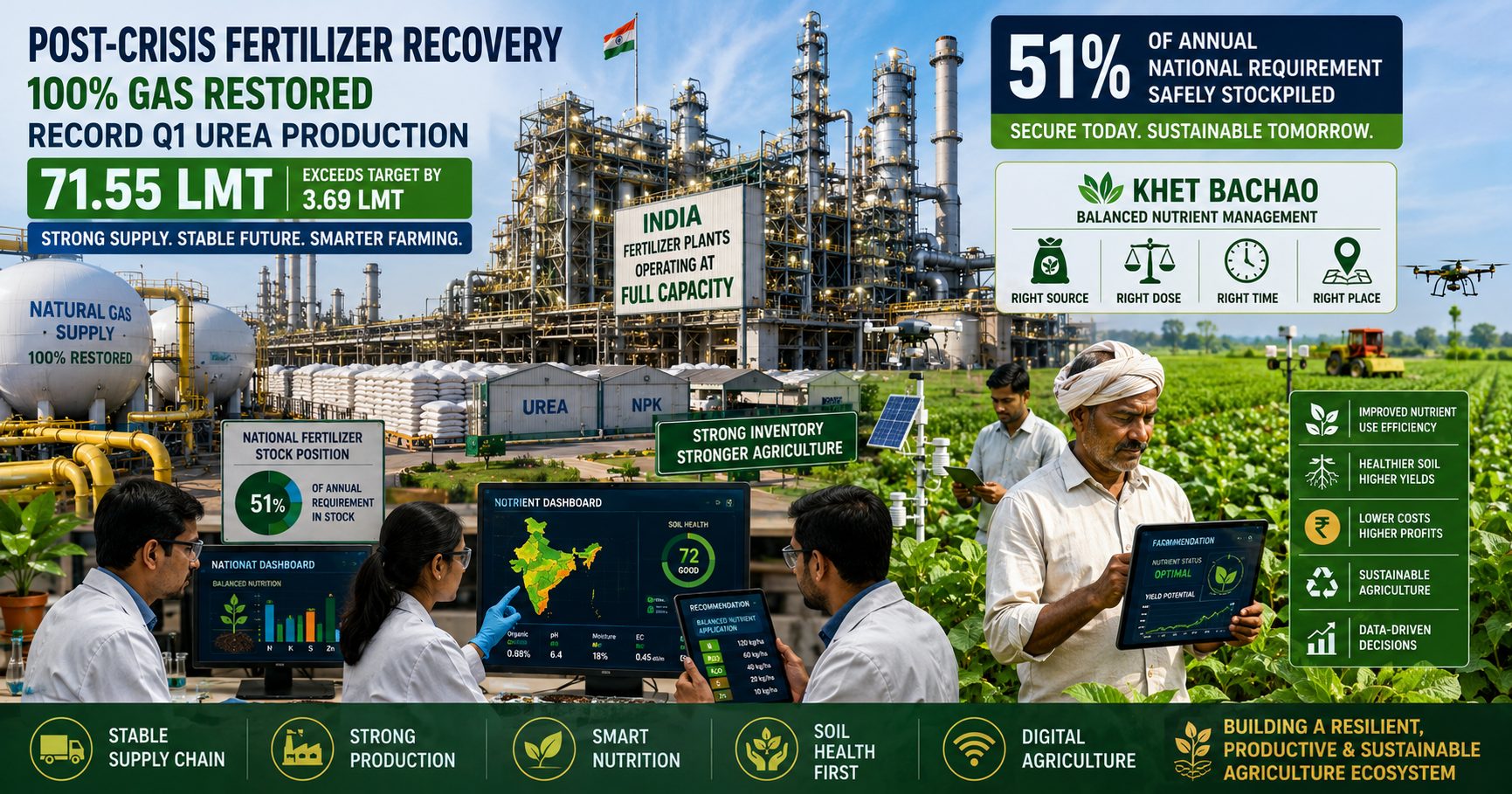
Post-Crisis Fertilizer Recovery: India’s Shift from Supply Security to Nutrient Intelligence
Introduction
For much of the past decade, fertilizer discussions in India revolved around availability, imports, subsidies, and supply disruptions.
In 2026, the conversation is changing.
The Ministry of Chemicals and Fertilizers has confirmed that natural gas supplies to domestic fertilizer plants have been restored to 100%, allowing the sector to return to full operational efficiency. As a result, Q1 urea production has reached 71.55 Lakh Metric Tonnes (LMT), exceeding production targets by 3.69 LMT.
More importantly, approximately 51% of the country's annual fertilizer requirement has already been secured through strategic inventory positioning.
This development signals a major transition.
India is moving from crisis management toward agricultural efficiency management.
Understanding the Importance of Gas Restoration
Why Natural Gas Matters
Natural gas is the primary feedstock used in urea manufacturing.
Any disruption affects:
- Domestic production
- Import dependency
- Fertilizer availability
- Farmer confidence
- Agricultural productivity
The restoration of full gas allocation has strengthened production stability across fertilizer manufacturing facilities.
Domestic Capacity Is Delivering Results
The latest production figures demonstrate that domestic manufacturing systems are operating efficiently.
Key outcomes include:
- Production above targets
- Improved inventory levels
- Reduced supply uncertainty
- Enhanced seasonal preparedness
This provides confidence ahead of major crop seasons.
Q1 Production Performance Signals Stability
Surpassing Production Targets
Achieving 71.55 LMT of urea production in Q1 while exceeding targets by 3.69 LMT reflects strong operational performance.
For agriculture, this means:
- Better fertilizer availability
- Reduced risk of shortages
- Improved supply chain planning
- Stronger seasonal preparedness
Strategic Stock Building
The reported stock position covering more than 51% of annual national requirements significantly strengthens supply resilience.
Benefits include:
- Buffer against global disruptions
- Better monsoon season preparedness
- Improved distribution flexibility
- Enhanced farmer confidence
The Next Phase: Nutrient Intelligence
Supply Is No Longer the Only Goal
Historically, agricultural success focused on ensuring fertilizer availability.
Today the challenge is different.
The focus is shifting toward:
- Efficient nutrient use
- Soil health preservation
- Balanced fertilization
- Yield optimization
- Environmental sustainability
This is where data becomes critical.
The Rise of Khet Bachao Parameters
The Khet Bachao approach emphasizes responsible nutrient management through monitoring and balanced application practices.
The objective is simple:
Apply the right nutrient.
At the right time.
In the right quantity.
At the right location.
This represents a major shift from volume-based farming to precision-based farming.
Why Balanced Nutrient Tracking Matters
Excessive Urea Use Creates Problems
Many farming systems continue to rely heavily on nitrogen application while underutilizing:
- Phosphorus
- Potassium
- Sulphur
- Micronutrients
This imbalance can result in:
- Reduced nutrient efficiency
- Soil degradation
- Lower profitability
- Environmental stress
Data Helps Optimize Decisions
Modern nutrient management increasingly relies on:
- Soil testing
- Farm records
- Satellite insights
- Nutrient dashboards
- Recommendation engines
The future of fertilizer use is intelligence-driven rather than quantity-driven.
Opportunities for FPOs and Agri-Tech Platforms
Nutrient Advisory Services
Farmer Producer Organizations can create value by offering:
- Soil testing support
- Nutrient planning
- Input advisory
- Crop nutrition monitoring
Digital Agriculture Expansion
Technology companies have opportunities to develop:
- Nutrient tracking platforms
- Soil health analytics
- Fertilizer optimization tools
- Farm intelligence systems
The fertilizer sector is becoming a data sector.
What This Means for Farmers
More Stable Input Availability
With production exceeding targets and inventories strengthening, farmers may experience improved access to critical fertilizer supplies.
Better Decision-Making Tools
The emphasis on balanced nutrient management will encourage wider adoption of:
- Soil testing
- Farm analytics
- Precision agriculture
- Nutrient efficiency monitoring
Higher Resource Efficiency
Balanced fertilization can improve:
- Yield performance
- Input efficiency
- Soil productivity
- Long-term sustainability
Strategic Implications for Indian Agriculture
Moving Beyond Subsidy-Centric Thinking
The next generation of agricultural growth will depend on:
- Nutrient efficiency
- Resource optimization
- Data-driven recommendations
- Soil health management
Agriculture Intelligence Becomes Essential
The most successful agricultural ecosystems will increasingly rely on:
- Real-time data
- Predictive analytics
- Nutrient intelligence
- Farm monitoring systems
Information is becoming as important as inputs.
What AGRIBOZ Users Should Watch
The fertilizer sector is entering a new era where supply security is improving and optimization is becoming the priority.
Key trends to monitor include:
- Nutrient management policies
- Soil health initiatives
- Digital agriculture adoption
- Precision farming technologies
- Balanced fertilization programs
These developments will influence farm profitability over the next decade.
Conclusion
The restoration of 100% natural gas supplies and record Q1 urea production mark an important milestone for Indian agriculture.
However, the larger story is not merely fertilizer availability.
It is the shift toward nutrient intelligence.
As India strengthens supply security, attention is increasingly turning toward balanced fertilization, soil health preservation, and data-driven decision-making under emerging frameworks such as Khet Bachao.
The future belongs to farmers, FPOs, and agribusinesses that combine inputs with intelligence.
Explore the Agriculture Intelligence Platform of Bharat - AGRIBOZ
Register on https://www.agriboz.com
CTA Section
Explore the Agriculture Intelligence Platform of Bharat - AGRIBOZ
Stay ahead with fertilizer intelligence, nutrient management insights, agricultural policy updates, market intelligence, FPO opportunities, workshops, and precision farming innovations.
Register on https://www.agriboz.com
FAQ Section
What was the major fertilizer sector development announced in July 2026?
Natural gas supplies to domestic fertilizer plants were restored to 100%, improving production capacity and supply security.
How much urea was produced in Q1 FY 2026-27?
Domestic production reached 71.55 LMT, exceeding targets by 3.69 LMT.
Why is balanced nutrient management important?
It improves fertilizer efficiency, supports soil health, and helps maximize crop productivity.
What is the significance of the 51% stock position?
It indicates that more than half of the national annual fertilizer requirement has already been secured, strengthening supply resilience.
How can technology support nutrient management?
Through soil analytics, nutrient tracking systems, precision agriculture tools, and farm intelligence platforms.
Explore the Agriculture Intelligence Platform of Bharat - AGRIBOZ
Access fertilizer intelligence, nutrient optimization strategies, agricultural policy updates, precision farming insights, FPO growth opportunities, and agri-business intelligence.
Register on https://www.agriboz.com
Q1. What caused the improvement in domestic urea production?
The restoration of 100% natural gas supply to domestic fertilizer plants improved manufacturing capacity.
Q2. How much did production exceed targets?
Q1 production exceeded targets by 3.69 LMT.
Q3. What does balanced nutrient management mean?
It refers to applying nutrients according to crop needs rather than relying excessively on a single fertilizer source.
Q4. Why is nutrient tracking becoming important?
It improves fertilizer efficiency, lowers costs, supports soil health, and enhances productivity.
Q5. What opportunities does this create for agri-tech companies?
Development of nutrient advisory systems, soil analytics platforms, farm intelligence tools, and precision agriculture solutions.