

Digital Fertiliser Tracking in India: How DBT Can Curb Black Marketing and Protect Farmers
Fertiliser availability and pricing directly affect farm cash flow. India’s digital fertiliser ecosystem now connects Aadhaar-authenticated Point of Sale transactions, Direct Benefit Transfer, the Integrated Fertilizer Management System and supply monitoring to improve transparency. But digital tracking alone is not enough. The real test is whether farmers consistently receive urea, DAP and other subsidised fertilisers at the intended price and in the right quantity, without diversion, hoarding or artificial shortages.
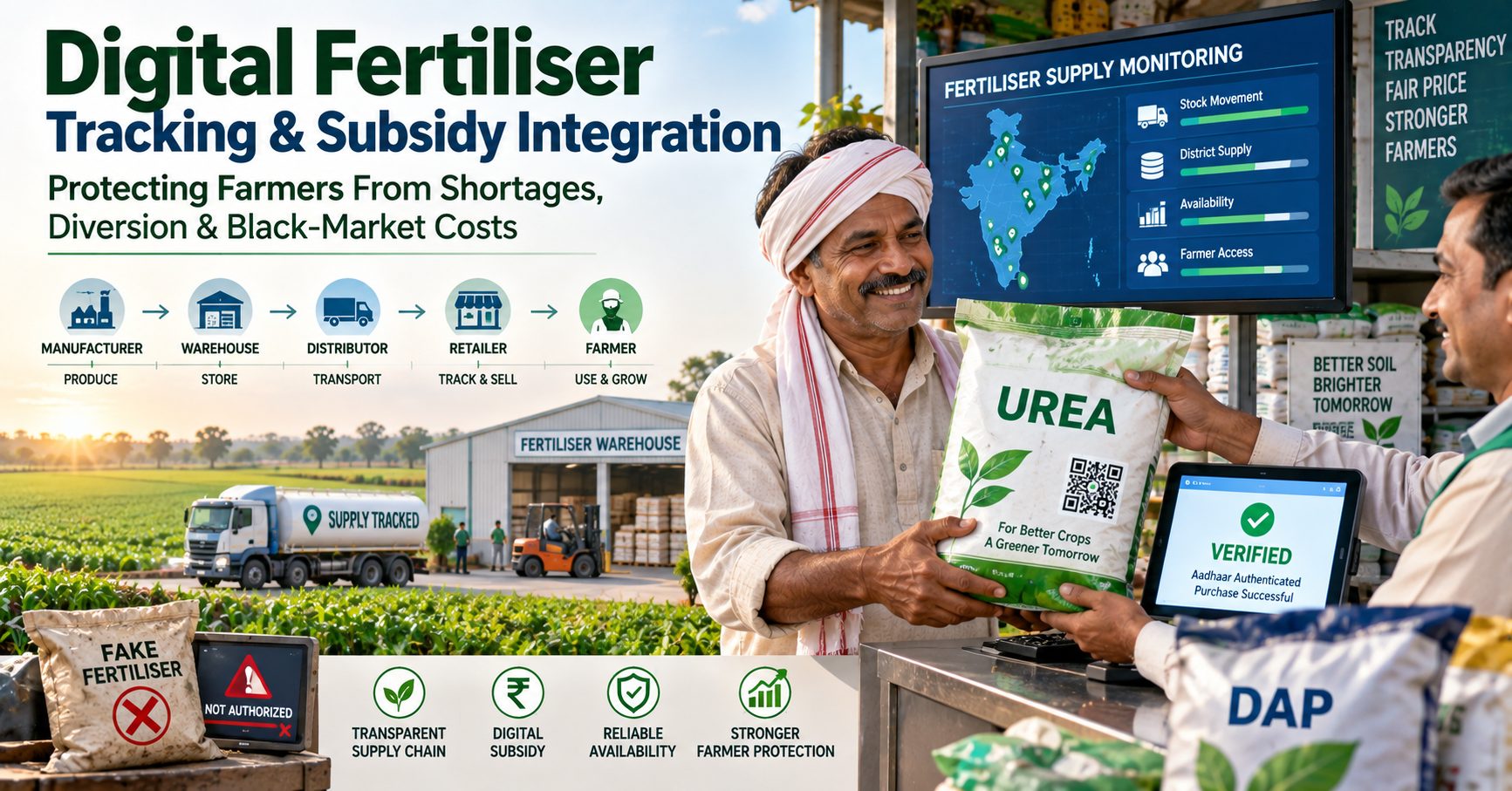
Digital Fertiliser Tracking & Subsidy Integration: Protecting Farmers From Supply Shocks
Introduction
For a farmer, fertiliser is not simply an agricultural input.
It is a financial commitment made at a specific point in the crop cycle.
When fertiliser is unavailable, unexpectedly expensive or diverted from the intended supply chain, the farmer can face a difficult choice: delay application, purchase from another source at a higher price, reduce application or compromise the crop plan.
That is why fertiliser availability and pricing are closely connected to farm cash flow.
India has already built a substantial digital architecture around subsidised fertiliser distribution. Aadhaar-authenticated Point of Sale transactions, Direct Benefit Transfer, the Integrated Fertilizer Management System and e-Urvarak monitoring are designed to improve transparency and track fertiliser movement and sales.
The next challenge is making this digital infrastructure work even more effectively at the last mile.
Why Fertiliser Supply Is a Farm-Cash-Flow Issue
Farmers often purchase fertiliser during a narrow application window.
If supply is disrupted during that period, the economic damage can extend beyond the price of one bag.
A shortage can create multiple costs
When fertiliser is not available when required, farmers may experience:
- Delayed nutrient application
- Additional transport costs
- Higher transaction costs
- Unplanned purchases
- Production uncertainty
- Potential yield losses
- Pressure to purchase from unauthorised channels
The timing matters because crop nutrient requirements are linked to crop stage and agronomic recommendations.
Price stability matters too
Subsidised fertilisers are intended to remain affordable to farmers.
If diversion, hoarding or black marketing pushes farmers toward unauthorised purchases, the economic advantage of the subsidy can be undermined at the point where the farmer actually needs the product.
How Digital Fertiliser Subsidy Tracking Works
India's fertiliser subsidy architecture is built around the principle that subsidy support should be linked to actual sales.
Under the DBT in Fertilizers system, subsidised fertiliser sales are recorded through Aadhaar-authenticated Point of Sale devices at retail outlets.
The subsidy is released to fertiliser companies based on actual sales to beneficiaries rather than being handed directly to farmers as a cash transfer.
This distinction is important.
The subsidy follows the verified transaction
The digital transaction creates a record of the fertiliser sale.
That can help connect:
Manufacturer or importer → Supply movement → Retailer → Farmer transaction → Subsidy claim
The stronger this chain becomes, the harder it becomes to hide unexplained movement or sales.
What Is the Integrated Fertilizer Management System?
The Integrated Fertilizer Management System, commonly known as iFMS, is an online system used to monitor the movement of major subsidised fertilisers.
It supports supply and logistics monitoring across the fertiliser chain.
Why iFMS matters
A digital monitoring system can provide authorities with information needed to identify potential mismatches between:
- Planned requirement
- Allocated quantity
- Supply movement
- Available stock
- Sales
- Regional demand
This is important because a national surplus does not automatically mean every district or retail point has adequate stock at the exact time farmers need it.
The e-Urvarak Dashboard and Last-Mile Visibility
The Government has also developed the e-Urvarak dashboard to improve visibility into fertiliser requirement, supply and availability.
The system has been designed to provide information at national, state and district levels.
Why district-level visibility is critical
Fertiliser demand is not evenly distributed.
Crop patterns differ between districts. Sowing dates differ. Irrigation conditions differ. Weather conditions differ.
Therefore, a supply system must detect local pressure rather than relying only on national-level availability.
A district-level dashboard can help decision-makers identify emerging supply gaps and take corrective action.
Direct Benefit Transfer Creates a Digital Accountability Layer
The DBT system has fundamentally changed how fertiliser subsidy transactions are monitored.
The farmer purchases subsidised fertiliser through an authorised retailer.
The transaction is recorded through the PoS system.
The resulting sales information supports subsidy settlement with the fertiliser company.
What this changes
A traditional supply chain can be difficult to monitor once the product moves through multiple intermediaries.
A digitally recorded transaction creates a data trail.
That trail can help authorities analyse:
- Who purchased fertiliser
- How much was purchased
- Which retailer recorded the transaction
- Where unusual purchasing patterns occur
- Whether supply and sales patterns match expected demand
Digital records do not automatically eliminate fraud.
They make detection and investigation more feasible.
Black Marketing and Diversion Remain an Enforcement Challenge
Technology is only one part of the solution.
Fertiliser diversion, hoarding and black marketing require enforcement.
The Government has stated that fertilisers are treated as essential commodities and that State Governments have powers under the Essential Commodities Act and Fertilizer Control Order to take action against violations.
In 2026, the Government reported extensive enforcement activity against hoarding, diversion and black marketing.
This matters because a digital system is valuable only when abnormal transactions lead to investigation and corrective action.
Why "Adequate National Stock" Is Not Enough
This is where agricultural supply-chain intelligence needs to become more sophisticated.
Suppose the country has adequate fertiliser availability overall.
That does not guarantee that:
- A farmer's district has enough DAP
- A particular retail outlet has stock
- Supply arrives before the crop reaches a critical nutrient stage
- The farmer can access the product without unnecessary delay
Availability must be measured at the point of need
The real metric should increasingly move from:
"How much fertiliser exists nationally?"
to:
"How much fertiliser is available to the farmer, where and when it is needed?"
That is a much more useful agricultural intelligence question.
Urea and DAP Need Different Policy Understanding
Farmers often treat fertiliser availability as a single issue.
Policy mechanisms are more complex.
Urea
Urea is supplied to farmers at a statutorily notified Maximum Retail Price, with the Government compensating manufacturers and importers through the urea subsidy framework.
DAP and other P&K fertilisers
DAP falls under the Nutrient Based Subsidy framework applicable to phosphatic and potassic fertilisers.
The subsidy structure is therefore different from the urea subsidy mechanism.
This distinction matters when discussing fertiliser prices, subsidy levels and policy changes.
Digital Tracking Can Help Stabilise District Supply
The most valuable use of fertiliser data is not simply recording yesterday's sales.
It is anticipating tomorrow's shortage.
From monitoring to prediction
A more advanced system could continuously analyse:
- Historical district demand
- Current stock
- Retailer-level sales
- Crop acreage
- Sowing progress
- Weather conditions
- Irrigation conditions
- Expected nutrient demand
- Supply movement
- Import schedules
- Unusual purchasing patterns
The objective would be to identify a potential shortage before farmers experience it.
Predictive supply management
Imagine a district where DAP sales suddenly rise above the normal seasonal pattern.
A predictive system could flag the district for review.
Authorities could then investigate whether the increase is caused by:
- Genuine crop demand
- Early sowing
- Stockpiling
- Diversion
- Unusual retailer activity
- Data anomalies
That is where artificial intelligence can move the system from passive monitoring toward proactive supply management.
AI Could Become the Next Layer of Fertiliser Intelligence
The existing digital infrastructure generates valuable data.
The next opportunity is to turn that data into decision intelligence.
AI-based anomaly detection
Machine-learning models could identify unusual patterns across districts and retailers.
Examples include:
- Sudden spikes in individual purchases
- Repeated purchases inconsistent with local acreage
- Retailers with abnormal sales patterns
- Unexpected divergence between allocation and sales
- Districts where demand is accelerating faster than supply
- Unusual movement patterns
An anomaly does not prove wrongdoing.
It creates a priority for human investigation.
AI-based shortage forecasting
An AI system could combine supply data with agricultural indicators to forecast where fertiliser pressure may emerge.
For example:
District demand forecast + Current stock + Incoming supply + Crop acreage + Sowing progress + Historical consumption
could produce a district-level supply-risk score.
That would be considerably more useful than reacting after farmers report shortages.
The Farmer Should Be the Final Beneficiary of the Data
There is a danger in building sophisticated government dashboards that never translate into better farmer experience.
The ultimate test is simple.
Can the farmer obtain the required fertiliser at the intended price, from a legitimate source, when the crop requires it?
Digital systems should become farmer-facing
Future systems should ideally provide farmers with simple information such as:
- Fertiliser availability near their location
- Authorised retailer information
- Indicative availability status
- Purchase history
- Applicable price information
- Official complaint channels
- Alerts about supply disruptions
- Nutrient-management guidance
The technology should reduce uncertainty, not create another layer of complexity.
Farmers Also Have a Role in Protecting the System
Digital subsidy systems work better when farmers insist on legitimate transactions.
Farmers should retain purchase records
Farmers should keep:
- Purchase receipts
- Retailer details
- Fertiliser bag information
- Quantity purchased
- Date of purchase
If a retailer demands an unauthorised premium or refuses to provide a proper transaction record, the farmer should use the appropriate official grievance or enforcement channel.
Avoid panic buying
When rumours of shortages spread, panic buying can make the problem worse.
Farmers should base purchasing decisions on actual crop requirement, agronomic recommendations and verified local availability rather than unverified messages.
Balanced Fertiliser Use Is Also Part of the Solution
Solving availability problems does not mean encouraging indiscriminate fertiliser consumption.
India's nutrient-management policy increasingly emphasises balanced fertilisation.
More fertiliser is not automatically more productivity
Crop nutrient requirements depend on:
- Crop
- Soil fertility
- Expected yield
- Available nutrients
- Moisture
- Growth stage
- Agronomic management
Farmers should follow soil-test-based and crop-specific recommendations wherever possible.
The objective should be efficient nutrient use rather than maximum fertiliser use.
What a Better Fertiliser Intelligence System Could Look Like
India already has several important components.
The next step is integration.
Layer 1: Supply data
Track production, imports, dispatches, rail movement and state allocations.
Layer 2: Distribution data
Track district stocks, retailer inventory and sales.
Layer 3: Farmer transaction data
Track legitimate PoS purchases while maintaining appropriate privacy and data governance.
Layer 4: Agricultural demand data
Connect crop acreage, sowing progress, seasonal demand and agronomic requirements.
Layer 5: AI intelligence
Identify anomalies, forecast shortages and prioritise intervention.
Layer 6: Farmer alerts
Convert complex government data into simple, actionable information.
This is the direction in which digital agriculture should move.
The Real Opportunity: Prevent the Shortage Before It Reaches the Farm
The strongest fertiliser policy is not one that reacts quickly to a shortage.
It is one that detects the probability of a shortage early enough to prevent it.
That requires moving from:
Track → Report → React
toward:
Predict → Intervene → Stabilise → Verify
This is where India's digital agricultural infrastructure can create significantly greater value.
What Farmers Should Do
Farmers can reduce fertiliser-related financial risk by following a disciplined approach:
Before the season
Check expected fertiliser requirements with the crop plan.
Before purchasing
Verify the retailer and price and avoid unauthorised premiums.
During purchase
Ensure the transaction is recorded through the authorised PoS system where applicable and retain the receipt.
During the crop
Apply nutrients according to crop and soil requirements rather than panic buying.
If a shortage occurs
Check verified local information before making an expensive purchase from an unauthorised source.
If malpractice occurs
Document the transaction and report it through the appropriate official channel.
Conclusion
India has already moved beyond a purely physical fertiliser distribution system.
Digital transactions, DBT, PoS authentication, iFMS and e-Urvarak monitoring have created a stronger foundation for transparency and supply management.
But the next leap is not simply more digitisation.
It is intelligence.
The system should be able to detect unusual demand, identify potential diversion, forecast district-level shortages and help authorities intervene before farmers face a supply shock.
For farmers, the desired outcome is straightforward: genuine fertiliser, fair access, predictable availability and protection from unnecessary black-market costs.
For policymakers, the opportunity is larger: transform fertiliser data from a reporting mechanism into a predictive agricultural infrastructure.
Explore the Agriculture Intelligence Platform of Bharat - AGRIBOZ
Register on https://www.agriboz.com
AGRIBOZ can help farmers, agriculture professionals and the wider agriculture ecosystem stay connected with agriculture intelligence, experts, opportunities, workshops and practical knowledge.
FAQ
How does DBT work for fertiliser in India?
Under the DBT in Fertilizers system, subsidised fertiliser sales are recorded through Aadhaar-authenticated Point of Sale devices at authorised retail outlets. Subsidy is released to fertiliser companies based on actual sales recorded through the system.
What is iFMS in fertiliser management?
iFMS stands for Integrated Fertilizer Management System. It is an online system used to monitor the movement and management of major subsidised fertilisers across the supply chain.
What is the e-Urvarak dashboard?
e-Urvarak is a digital dashboard developed by the Department of Fertilizers to provide visibility into fertiliser requirement, supply, availability and related information at different administrative levels.
Does DBT mean farmers receive fertiliser subsidy directly in cash?
No. Fertiliser DBT is different from a cash transfer directly to the farmer. The subsidy is linked to actual subsidised fertiliser sales and is released to fertiliser companies according to the applicable system.
Why can a fertiliser shortage occur even when national availability is adequate?
National availability does not guarantee adequate stock at every district or retailer. Differences in demand, transport, timing, crop patterns and local distribution can create temporary regional supply pressure.
How can digital tracking reduce black marketing?
Digital transaction and movement records can create a traceable data trail. Authorities can analyse unusual purchasing, sales and supply patterns and investigate potential diversion, hoarding or other violations.
Is urea subsidy the same as DAP subsidy?
No. Urea operates under the Urea Subsidy Scheme, while DAP falls under the Nutrient Based Subsidy framework applicable to phosphatic and potassic fertilisers, subject to applicable government policy.
Can AI help prevent fertiliser shortages?
Yes. AI can potentially analyse supply, sales, crop and seasonal data to identify unusual patterns and forecast potential district-level shortages. AI should support human investigation and policy decisions rather than automatically treating an anomaly as proof of wrongdoing.
What should farmers do if a retailer demands an unauthorised premium?
Farmers should preserve the relevant purchase information and use the appropriate official agriculture or fertiliser enforcement grievance mechanism rather than relying on unverified intermediaries.
Explore the Agriculture Intelligence Platform of Bharat - AGRIBOZ
Register on https://www.agriboz.com
Stay connected with agriculture intelligence, expert knowledge, workshops, opportunities and practical information that can help farmers and the agricultural ecosystem make better decisions.
- How does DBT work for fertiliser in India?
- What is iFMS in fertiliser management?
- What is the e-Urvarak dashboard?
- Does DBT mean farmers receive fertiliser subsidy directly in cash?
- Why can a fertiliser shortage occur even when national availability is adequate?
- How can digital tracking reduce black marketing?
- Is urea subsidy the same as DAP subsidy?
- Can AI help prevent fertiliser shortages?
- What should farmers do if a retailer demands an unauthorised premium?
Under the DBT in Fertilizers system, subsidised fertiliser sales are recorded through Aadhaar-authenticated Point of Sale devices at authorised retail outlets. Subsidy is released to fertiliser companies based on actual sales recorded through the system.
iFMS stands for Integrated Fertilizer Management System. It is an online system used to monitor the movement and management of major subsidised fertilisers across the supply chain.
e-Urvarak is a digital dashboard developed by the Department of Fertilizers to provide visibility into fertiliser requirement, supply, availability and related information at different administrative levels.
No. Fertiliser DBT is different from a cash transfer directly to the farmer. The subsidy is linked to actual subsidised fertiliser sales and is released to fertiliser companies according to the applicable system.
National availability does not guarantee adequate stock at every district or retailer. Differences in demand, transport, timing, crop patterns and local distribution can create temporary regional supply pressure.
Digital transaction and movement records can create a traceable data trail. Authorities can analyse unusual purchasing, sales and supply patterns and investigate potential diversion, hoarding or other violations.
No. Urea operates under the Urea Subsidy Scheme, while DAP falls under the Nutrient Based Subsidy framework applicable to phosphatic and potassic fertilisers.
Yes. AI can potentially analyse supply, sales, crop and seasonal data to identify unusual patterns and forecast potential district-level shortages. AI should support human investigation and policy decisions rather than automatically treating an anomaly as proof of wrongdoing.
Farmers should preserve the relevant purchase information and use the appropriate official agriculture or fertiliser enforcement grievance mechanism rather than relying on unverified intermediaries.