
Crackdown on Fake Seeds: What India’s Proposed Seed Bill Means for Farmers
A poor-quality seed can damage an entire crop before the farmer gets a chance to recover the investment. India is moving toward a tougher seed regulatory framework focused on quality, traceability, registration and accountability. Here’s what the proposed Seed Bill means for farmers and why seed quality is becoming the first line of defence for farm profitability.
Crackdown on Fake Seeds: What India’s Proposed Seed Bill Means for Farmers
Introduction
For a farmer, the first major investment in a crop often happens before the first plant emerges: the purchase of seed.
If that seed is fake, adulterated, poorly stored or otherwise substandard, the damage can begin before the farmer has any opportunity to correct it. Land preparation, labour, fertiliser, irrigation and crop-protection expenses may all be committed to a crop whose foundation was defective from the start.
This is why seed quality is not simply an agricultural input issue. It is a farm-income, food-security and farmer-protection issue.
India is now moving toward a significantly stronger seed regulatory framework. The Government of India has proposed the Seeds Bill, 2025, and in January 2026 the Agriculture Minister outlined proposed features of a new Seed Act, including stronger penalties and end-to-end traceability.
For farmers, the important question is not only what the law says. It is how these changes could make the seed supply chain more accountable.
Why Fake and Substandard Seeds Are Such a Serious Risk
A crop can sometimes recover from an application error, a temporary irrigation problem or a pest outbreak if the problem is detected early.
Seed quality is different.
The genetic potential, germination performance, purity and other quality characteristics of planting material influence the crop from the very beginning.
The loss starts before crop emergence
When farmers purchase seed, they are effectively purchasing future crop potential.
A poor-quality batch can result in:
- Poor or uneven germination
- Weak crop establishment
- Unwanted variation in the crop
- Lower plant population
- Higher re-sowing costs
- Wasted labour and inputs
- Reduced yield and farm income
In severe cases, farmers may lose an entire production cycle.
The scale of the problem cannot be ignored
Government data shows why seed-quality enforcement matters. During 2023–24, 133,588 seed samples were drawn for testing across the country, of which 3,630 were found to be sub-standard.
That does not mean every sub-standard sample represented a fake seed product, but it demonstrates that seed-quality monitoring is an important enforcement challenge.
India’s Seed Regulation Is Moving Toward Stronger Accountability
India currently regulates seed quality through the Seeds Act, 1966, the Seeds Rules, 1968 and the Seeds (Control) Order, 1983.
The Government has proposed the Seeds Bill, 2025 to modernise this framework.
The draft proposes regulation covering seed and planting-material quality, registration, labelling, traceability and accountability across the supply chain.
What the proposed Seeds Bill aims to address
The Government says the proposed framework is intended to:
- Improve the quality of seeds and planting material available in the market
- Curb the sale of spurious and poor-quality seeds
- Improve transparency in the seed supply chain
- Protect farmers from losses
- Establish stronger accountability among seed-sector participants
- Promote access to quality seed at affordable prices
- Modernise seed regulation
The draft was placed in the public domain for pre-legislative consultation in 2025.
From Seed Packet to Supply Chain: Why Traceability Matters
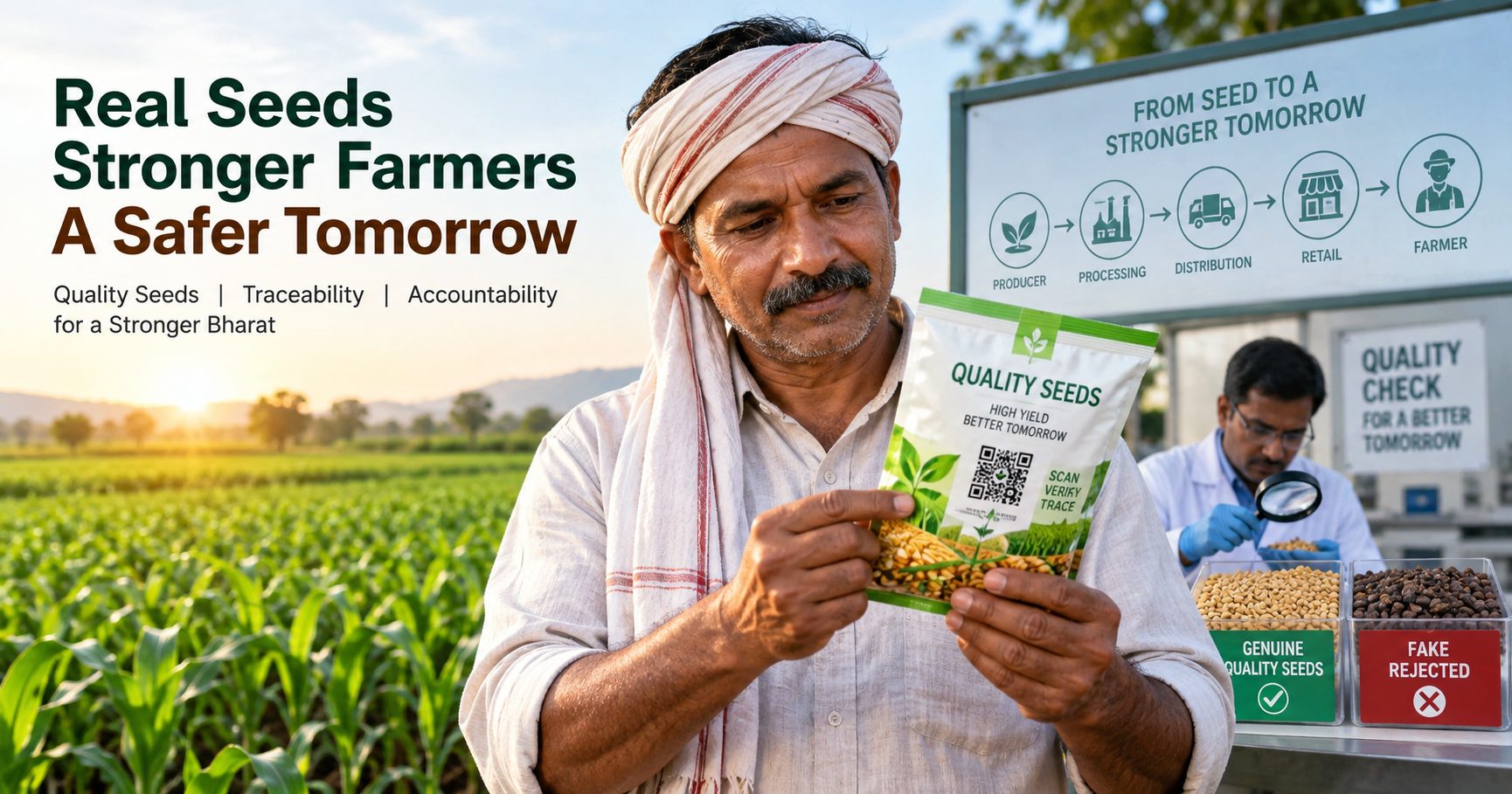
One of the biggest potential changes is the emphasis on digital traceability.
The Government has already launched the Seed Authentication, Traceability & Holistic Inventory system, known as SATHI, to strengthen end-to-end traceability in the seed supply chain.
What traceability can change
Imagine a farmer purchases a seed packet and later discovers a serious quality problem.
In a strong traceability system, authorities should be able to establish where that seed originated, who handled it and how it moved through the supply chain.
That creates a very different accountability environment from a system where responsibility becomes difficult to establish after the product reaches the farmer.
QR-based identification
The Agriculture Minister stated in January 2026 that seed packets would carry QR codes under the proposed system, allowing farmers to access information about the seed's origin and supply chain.
The larger objective is simple:
A seed should not become an anonymous product once it reaches the retail counter.
Stronger Penalties Could Change the Economics of Seed Fraud
Weak penalties can create a dangerous imbalance.
If the potential gain from selling poor-quality seed is significantly greater than the expected cost of enforcement, dishonest operators may continue taking the risk.
The Government has proposed much stronger penalties.
Proposed punishment for serious violations
According to the Agriculture Ministry's January 2026 explanation of the proposed Seed Act, deliberate production or sale of substandard seeds could attract imprisonment of up to three years and a fine of up to ₹30 lakh.
This represents a major shift from the much lower penalty framework associated with the older legislation.
The objective is not to penalise legitimate seed businesses for every minor compliance error.
The objective is to make deliberate or serious violations economically and legally difficult to justify.
What Farmers Should Understand About the Proposed Changes
Farmers should see the new framework as more than a government compliance exercise.
It has practical implications for how seed should be purchased, documented and verified.
Buy from authorised and traceable sources
A low price is not necessarily a bargain if the seed's authenticity or quality cannot be established.
Farmers should prefer authorised dealers and retain purchase documentation.
Preserve the seed packet and bill
If a crop-quality dispute develops, evidence becomes important.
Farmers should preserve:
- The original seed packet
- Lot or batch information
- Purchase bill or invoice
- Dealer details
- Photographs of the crop where relevant
- Records of sowing and crop management
- Any communication with the seller or company
These records can become valuable when seeking inspection, testing or compensation.
Check labels and authentication information
Farmers should carefully examine the information printed on the seed packet rather than purchasing solely on verbal promises.
Where digital authentication or traceability facilities are available, farmers should use them.
The Farmer’s Traditional Seed Rights Still Matter
Stronger commercial seed regulation does not necessarily mean traditional farmer seed systems disappear.
The Government has stated that the draft Seeds Bill does not apply to farmers and farmer varieties in the same manner as commercial seed-market regulation.
The Government has also said farmer rights to grow, sow, save, exchange and sell farm-saved seed are protected in accordance with the existing legal framework, including the Protection of Plant Varieties and Farmers' Rights Act, 2001.
This distinction is important.
A modern seed regulatory system must improve commercial accountability without unnecessarily weakening legitimate farmer-managed seed systems.
Enforcement Must Reach the Last Mile
A strong law on paper is not enough.
The real test will be enforcement at the point where farmers purchase seed.
Inspectors and testing systems matter
Under the existing framework, State Governments can appoint Seed Inspectors who can inspect seed outlets, collect samples and initiate enforcement action.
The Government has also been strengthening the logistics and digital process for sample collection and laboratory testing.
In February 2026, the Ministry reported a collaboration with the Department of Posts to create a standardised, traceable and tamper-resistant mechanism for transporting agricultural-input samples to laboratories.
That kind of process matters because enforcement is only as credible as the evidence and testing system behind it.
Why Seed Quality Should Be Treated as a Farm Risk-Management Issue
Farmers often think about crop risk after sowing: weather, pests, disease, irrigation and market prices.
But seed selection comes earlier.
Better seed decisions protect the entire crop investment
A farmer may spend months and substantial capital on a crop.
The seed represents only one part of that investment, but it establishes the biological starting point for everything that follows.
That makes seed verification a form of risk management.
The question should not simply be:
“Which seed is cheapest?”
A better question is:
“Which seed gives me the strongest combination of authenticity, quality, suitability and traceability?”
What Farmers Can Do Today
Even while the regulatory framework evolves, farmers do not have to wait for a new law to improve seed-related risk management.
Before purchasing
Check:
- Seed variety and crop suitability
- Packaging condition
- Labelling and required information
- Lot or batch details
- Seller credentials
- Purchase invoice
- Available authentication or traceability information
At sowing
Maintain basic records of:
- Date of sowing
- Seed variety
- Seed lot or batch
- Area planted
- Seed quantity
- Source of purchase
- Weather and major management events
If serious crop failure occurs
Do not immediately assume that poor germination or yield is proof of fake seed.
Crop performance can also be affected by soil, weather, irrigation, pests, diseases, agronomic practices and other factors.
If seed quality is suspected, document the evidence and approach the appropriate agriculture department or seed-inspection authority for testing and investigation.
Why the Proposed Seed Bill Matters Beyond Fake Seeds
The debate is bigger than counterfeit packets.
It is about creating a seed ecosystem where responsibility can be traced.
A modern system should connect:
Seed producer → Processing → Certification/quality controls → Distributor → Dealer → Farmer → Crop outcome
The stronger the traceability between these stages, the easier it becomes to identify where something went wrong.
That can improve accountability while also rewarding seed companies and dealers that consistently maintain quality.
The Bigger Agriculture Lesson: Input Integrity Determines Farm Outcomes
Farm productivity is often discussed in terms of fertilisers, irrigation, machinery, technology and market access.
But all those investments depend on the quality of the biological starting material.
If the seed fails, subsequent investment may have limited ability to compensate.
That is why seed quality deserves to be treated as foundational farm infrastructure.
Conclusion
India's proposed seed-law reforms signal a clear policy direction: fake and substandard seeds should face stronger accountability, while the seed supply chain should become more transparent and traceable.
The proposed framework includes measures such as stronger registration requirements, digital traceability, improved quality regulation and substantially tougher penalties for serious violations. The Government has also stated that farmer and traditional seed rights will continue to be protected under the existing legal framework.
For farmers, the message is equally practical: do not treat seed purchase as a routine transaction.
Verify the source. Keep the bill. Preserve the packet. Check available authentication information. Maintain crop records. And report suspected quality failures through the appropriate channels.
The first step toward a better harvest begins before the seed is placed in the soil.
AGRIBOZ CTA
Explore the Agriculture Intelligence Platform of Bharat - AGRIBOZ
Register on https://www.agriboz.com
Use AGRIBOZ to stay connected with agriculture knowledge, opportunities, experts, workshops, farm experiences and the wider agricultural ecosystem.
FAQ
Is the Government introducing a new Seed Act in India?
The Government has been working on a new seed regulatory framework. The Seeds Bill, 2025 was released for public consultation, and in January 2026 the Agriculture Minister described proposed features of a new Seed Act focused on seed quality, traceability and stronger penalties.
Why is the Government strengthening seed regulation?
The objective is to improve seed quality, curb fake and substandard seeds, increase supply-chain transparency and protect farmers from losses caused by poor-quality planting material.
What is SATHI in seed regulation?
SATHI stands for Seed Authentication, Traceability & Holistic Inventory. It is a digital system intended to improve traceability and transparency across the seed supply chain.
What penalty has been proposed for selling substandard seeds?
The Agriculture Minister stated in January 2026 that deliberate production or sale of substandard seeds could attract imprisonment of up to three years and a fine of up to ₹30 lakh under the proposed framework.
Will farmers lose their rights to save and exchange traditional seeds?
The Government has stated that the proposed Seeds Bill protects farmer rights concerning farm-saved and traditional seed varieties under the applicable legal framework.
What should a farmer do if a seed batch appears defective?
Keep the original packet and purchase bill, document the crop condition and relevant farming details, and contact the appropriate agriculture or seed-inspection authority for testing and investigation. Poor crop performance alone does not automatically establish that the seed was fake or defective.
Why is traceability important for farmers?
Traceability can help establish where seed originated and how it moved through the supply chain. This can make it easier for authorities to identify responsible parties when quality problems are confirmed.
Explore the Agriculture Intelligence Platform of Bharat - AGRIBOZ
Register on https://www.agriboz.com
Stay connected with trusted agriculture intelligence, farmer opportunities, workshops, experts, farm experiences and the growing AGRIBOZ ecosystem.
- Is the Government introducing a new Seed Act in India?
- Why is the Government strengthening seed regulation?
- What is SATHI in seed regulation?
- What penalty has been proposed for selling substandard seeds?
- Will farmers lose their rights to save and exchange traditional seeds?
- What should a farmer do if a seed batch appears defective?
- Why is traceability important for farmers?
The Government has been working on a new seed regulatory framework. The Seeds Bill, 2025 was released for public consultation, and in January 2026 the Agriculture Minister described proposed features of a new Seed Act focused on seed quality, traceability and stronger penalties.
The objective is to improve seed quality, curb fake and substandard seeds, increase supply-chain transparency and protect farmers from losses caused by poor-quality planting material.
SATHI stands for Seed Authentication, Traceability & Holistic Inventory. It is a digital system intended to improve traceability and transparency across the seed supply chain.
The Agriculture Minister stated in January 2026 that deliberate production or sale of substandard seeds could attract imprisonment of up to three years and a fine of up to ₹30 lakh under the proposed framework.
The Government has stated that the proposed Seeds Bill protects farmer rights concerning farm-saved and traditional seed varieties under the applicable legal framework.
Keep the original packet and purchase bill, document the crop condition and relevant farming details, and contact the appropriate agriculture or seed-inspection authority for testing and investigation.
Traceability can help establish where seed originated and how it moved through the supply chain. This can make it easier for authorities to identify responsible parties when quality problems are confirmed.