Smart School Bio-Hub: A Measurable CSR Model for School Kitchen Gardens
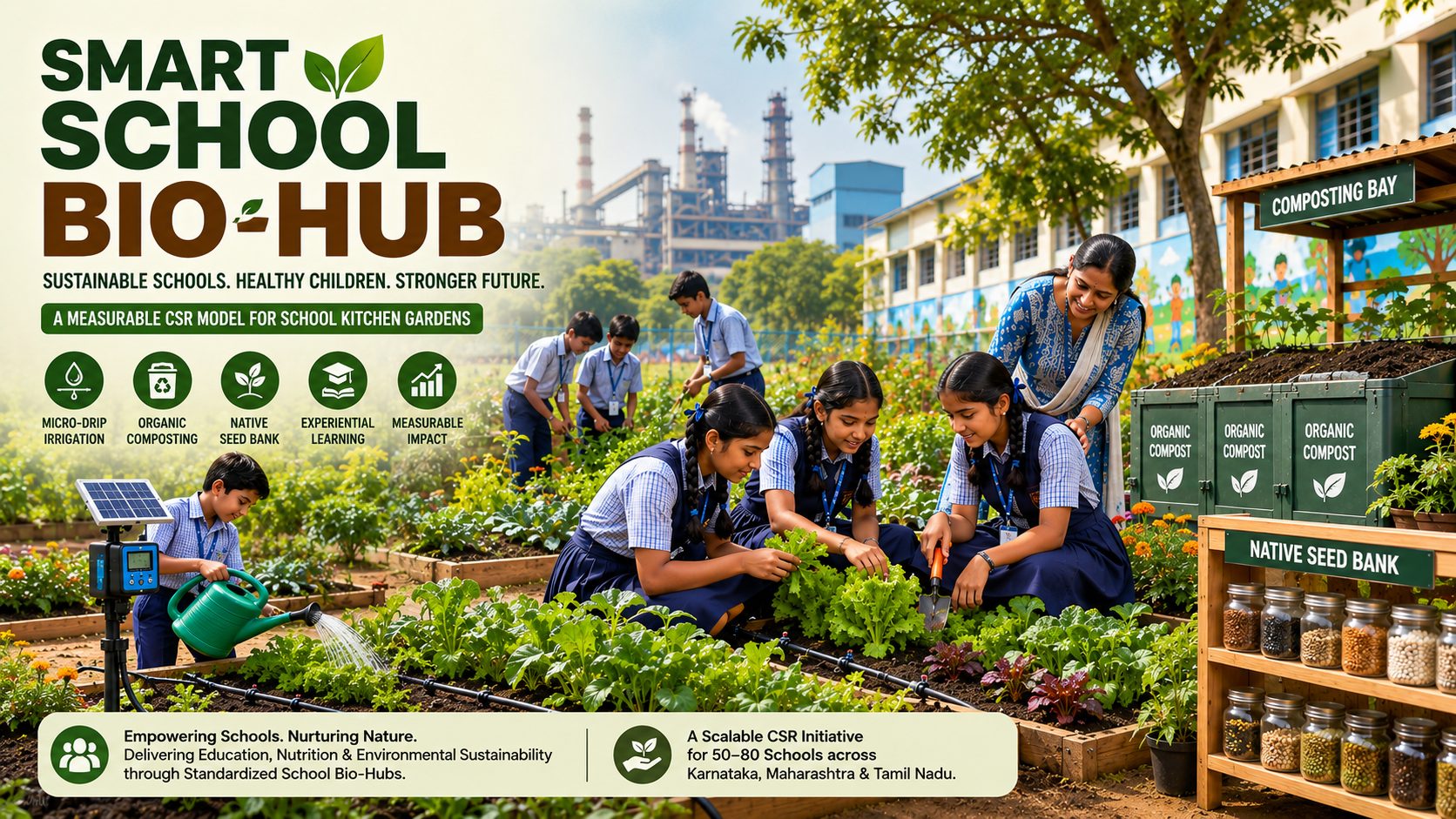
Corporate foundations can turn school kitchen gardens into measurable, scalable CSR infrastructure. The Smart School Bio-Hub combines micro-drip irrigation, organic composting, native seed banks, experiential learning and transparent impact reporting for schools across industrial belts in Karnataka, Maharashtra and Tamil Nadu.
Smart School Bio-Hub: A Measurable CSR Model for School Kitchen Gardens
Introduction
A school kitchen garden can look simple: a few growing beds, some seeds, basic irrigation and students learning to grow food.
But for a corporate foundation managing a serious CSR portfolio, the real question is bigger:
How do you turn dozens of school gardens into a standardized, measurable and reportable impact program?
This is where the Smart School Bio-Hub model creates a stronger proposition.
Instead of funding isolated garden activities, corporate foundations can support a standardized school agriculture system combining micro-drip irrigation, organic composting bays, native seed banks, student learning, teacher engagement and structured impact measurement.
For a cluster of 50 to 80 public educational facilities around heavy manufacturing belts, this creates the possibility of a common program architecture rather than 50 to 80 disconnected projects.
The opportunity is not simply to build gardens.
It is to build living learning infrastructure that connects education, food awareness, environmental stewardship and measurable community impact.
Why School Kitchen Gardens Need a Better CSR Model
Traditional school garden projects often face a predictable problem.
The garden gets created, photographs are taken, students participate in an inauguration activity, and the project gradually becomes difficult to track.
The corporate foundation may know how much money was spent.
But it may not know:
- How many schools are actively maintaining the gardens
- How many students participate regularly
- Whether teachers have been trained
- How much organic waste is being composted
- Whether irrigation systems remain functional
- Which crops are being grown
- How many learning sessions have been delivered
- Whether native seeds are being conserved
- What measurable environmental or educational outcomes have been created
For CSR leaders, this creates a reporting gap.
The solution is not necessarily more paperwork.
The solution is better program design from the beginning.
From Kitchen Garden to Smart School Bio-Hub
The Smart School Bio-Hub changes the unit of intervention.
Instead of treating a school garden as a standalone landscaping project, the school becomes a small agriculture and sustainability learning hub.
The Core Infrastructure
A standardized Bio-Hub can include:
- Micro-drip irrigation
- Defined cultivation beds
- Organic composting bays
- Native and locally appropriate seed banks
- Basic soil and garden management tools
- Crop planning
- Signage and learning materials
- Student activity modules
- Teacher orientation
- Periodic maintenance support
- Digital impact documentation
The exact infrastructure should be adapted to school size, water availability, climate and local conditions rather than imposed identically on every campus.
Why Standardization Matters
Standardization does not mean making every school identical.
It means creating a common minimum operating standard.
For example, every participating school can have a defined set of indicators covering infrastructure, participation, learning activities, maintenance and environmental practices.
This allows a corporate foundation to compare implementation across an entire cluster.
Instead of saying:
"We supported 60 school gardens."
The CSR team can report:
"We established 60 standardized school agriculture hubs, trained participating teachers, engaged students through experiential learning activities, installed water-efficient irrigation where appropriate, established composting systems and tracked implementation through defined indicators."
That is a much stronger impact story.
A Three-State Cluster Opportunity
A school agriculture program spanning Karnataka, Maharashtra and Tamil Nadu can be designed around industrial belts where corporate foundations already have significant community relationships.
The proposed cluster model can target 50 to 80 public educational facilities.
Karnataka
The program can focus on schools located within relevant industrial and manufacturing clusters, with local crop choices and water-management practices adapted to regional conditions.
Maharashtra
School hubs can be designed around local agricultural conditions, seasonal crop planning and the specific needs of participating communities.
Tamil Nadu
The model can incorporate local climate considerations, water efficiency and regionally appropriate crops and native plant material.
The key principle across all three states should be:
One measurement framework, locally adapted implementation.
Why This Can Matter to Corporate Foundations
A corporate foundation is not only looking for a visible project.
It is looking for alignment, credibility, implementation capacity and evidence.
The Smart School Bio-Hub can create value across several dimensions.
Education
Students learn through direct participation rather than only classroom theory.
They can observe germination, soil, water management, composting, biodiversity and food systems.
Nutrition Awareness
Growing food can become a practical way to introduce children to vegetables, seasonal food, food systems and healthy eating.
A garden should not be presented as a guaranteed solution to malnutrition. Its role is better framed as an education and awareness intervention unless a separately designed nutrition program establishes measurable nutritional outcomes.
Environmental Awareness
Composting, water-efficient irrigation, native seeds, soil care and biodiversity activities can make sustainability tangible.
Community Participation
School Management Committees, teachers, parents and local partners can participate in maintaining the hub and connecting school learning with community practices.
CSR Visibility With Substance
The program can generate evidence beyond inauguration photographs: school participation, infrastructure status, training records, activity logs, maintenance indicators and documented outcomes.
Designing the CSR Impact Framework
A Smart School Bio-Hub should be measurable from day one.
Input Indicators
Track what the program invests.
Examples include:
- Number of schools selected
- Number of Bio-Hubs established
- Irrigation systems installed
- Composting bays established
- Seed banks established
- Teachers oriented
- Program resources deployed
Activity Indicators
Track what actually happens.
Examples include:
- Student garden sessions
- Teacher-led activities
- Composting activities
- Seed-saving sessions
- Crop-cycle activities
- Environmental learning sessions
- School-community activities
Output Indicators
Track immediate results.
Examples include:
- Schools with functioning gardens
- Students participating
- Teachers actively using the garden
- Composting units operational
- Garden beds maintained
- Seasonal crops cultivated
- Native seed varieties documented
Outcome Indicators
Track changes that matter.
Examples can include:
- Increased student understanding of food systems
- Improved environmental literacy
- Greater student participation in experiential learning
- Improved school-level composting practices
- Increased awareness of water-efficient cultivation
- Stronger school-community engagement
Outcome indicators should be established through an appropriate baseline and measurement methodology rather than assumed in advance.
The Role of Micro-Drip Irrigation
Water availability can determine whether a school garden survives beyond the launch event.
Micro-drip irrigation can therefore be considered as part of the standardized infrastructure where technically appropriate.
The objective is not simply to install equipment.
The objective is to create a functioning irrigation system that schools can understand, operate and maintain.
A useful program design should therefore include:
- Water-source assessment
- Appropriate irrigation design
- Basic operation training
- Maintenance responsibility
- Periodic functionality checks
Infrastructure without maintenance becomes expenditure.
Infrastructure with ownership becomes an asset.
Organic Composting as a Living Classroom
A composting bay can turn everyday organic waste into a practical science lesson.
Students can learn about decomposition, organic matter, soil health and circular resource use.
The program can track:
- Composting units installed
- Schools actively using them
- Composting activities conducted
- Student participation
- Basic composting practices adopted
The objective should be education and responsible resource management rather than making unsupported claims about the quantity or quality of compost produced.
Native Seed Banks: More Than a Storage Box
A native seed bank can become one of the most distinctive components of the Bio-Hub.
Students can learn that agriculture is connected to biodiversity, local ecology, cultural knowledge and climate adaptation.
A school seed bank can document:
- Local or regionally appropriate varieties
- Seed source
- Date received or collected
- Storage practices
- Seasonal planting
- Germination observations
- Student learning activities
Seed selection should be locally appropriate and undertaken with knowledgeable agricultural or horticultural partners.
Making the Program Corporate-Foundation Ready
The strongest CSR proposal is not simply a list of materials.
It should answer five questions clearly:
1. What problem are we solving?
Schools need practical, experiential opportunities to learn about agriculture, food systems, sustainability and environmental responsibility.
2. What exactly will be built?
A standardized Smart School Bio-Hub with defined infrastructure, learning activities and implementation support.
3. Who will benefit?
Students, teachers and participating school communities.
4. How will impact be measured?
Through standardized baseline, implementation, participation, output and outcome indicators.
5. How will the foundation know what happened?
Through structured documentation, periodic monitoring and consolidated impact reporting.
This turns a garden project into a program-management proposition.
CSR Schedule VII Alignment: Get the Framing Right
The legal framing matters.
Under Schedule VII of the Companies Act, 2013, item (i) covers activities including eradicating hunger, poverty and malnutrition, while item (ii) covers promoting education, including special education, employment-enhancing vocational skills and livelihood enhancement projects.
Schedule VII also separately includes environmental sustainability, ecological balance, agroforestry, conservation of natural resources and maintenance of soil, air and water quality under item (iv).
Therefore, a Smart School Bio-Hub may have potential alignment with multiple Schedule VII themes depending on its actual design, activities and implementation.
It is not accurate to describe "education and malnutrition mitigation" as though both sit entirely under Schedule VII item (ii).
Corporate foundations should have their CSR team and legal/compliance advisers validate the final project design against the applicable CSR rules, company CSR policy and implementation structure before committing funds.
A Scalable 50–80 School Architecture
The program can be structured in phases.
Phase 1: Baseline and School Selection
Identify suitable public educational facilities and assess:
- Available land
- Water access
- Existing garden infrastructure
- Teacher availability
- School Management Committee participation
- Student participation potential
- Maintenance capacity
Phase 2: Bio-Hub Deployment
Install the agreed standard package and conduct teacher and school-level orientation.
Phase 3: Learning and Activation
Move beyond infrastructure through structured garden activities, composting, seed learning, food-system education and environmental activities.
Phase 4: Monitoring
Track implementation through standardized indicators and periodic field verification.
Phase 5: Consolidated Impact Reporting
Aggregate school-level data into a corporate foundation dashboard or annual impact report.
This creates a progression from:
Fund → Build → Activate → Measure → Report → Scale.
Why AGRIBOZ Can Be the Natural Implementation Layer
The value of a large school agriculture program depends on what happens after the funding decision.
AGRIBOZ can position the Smart School Bio-Hub as an agriculture, experiential-learning and sustainability implementation model connecting schools, trainers, corporate partners and measurable field activity.
Its institutional offering already focuses on experiential learning, school and college agriculture programs, kitchen gardens, food forests, sustainability clubs, teacher development and environmental stewardship. :contentReference[oaicite:0]{index=0}
Its corporate platform also positions CSR programs around structured implementation and impact measurement, including school agriculture programs. :contentReference[oaicite:1]{index=1}
The strongest proposition to a corporate foundation is therefore not:
"Fund school gardens."
It is:
"Fund a standardized school agriculture system with measurable implementation and transparent reporting."
What a Corporate Foundation Should Receive
A mature Bio-Hub program can be designed to provide a reporting package containing:
- School-wise implementation status
- Beneficiary and participation data
- Teacher engagement records
- Infrastructure deployment records
- Garden activity documentation
- Composting and seed-bank activity records
- Monitoring observations
- Photographic evidence
- Geographic coverage
- Expenditure and utilization documentation as applicable
- Consolidated impact indicators
- Case studies from selected schools
The reporting architecture should be agreed before implementation begins.
That is how measurement becomes part of the program rather than an afterthought.
The Bigger Opportunity
A school garden is a physical asset.
A Smart School Bio-Hub is a learning system.
At 50 schools, it becomes a cluster program.
At 80 schools, it can become a replicable CSR model.
And when the same framework can be adapted across industrial belts, corporate foundations gain something even more valuable: a repeatable architecture for school-based agriculture and sustainability programs.
The long-term opportunity is to build a network of schools where children do not merely read about agriculture, nutrition, soil, biodiversity and sustainability.
They experience them.
Conclusion
Corporate CSR can move beyond one-time school garden installations toward standardized, measurable and educationally meaningful agriculture programs.
The Smart School Bio-Hub provides a practical framework: micro-drip irrigation where appropriate, organic composting, native seed learning, school gardens, teacher engagement, experiential education and structured impact measurement.
For corporate foundations operating around industrial belts in Karnataka, Maharashtra and Tamil Nadu, a 50–80 school pilot can provide a strong starting point for testing the model, establishing benchmarks and building evidence for future scale.
The goal should not be to create the most gardens.
The goal should be to create school agriculture programs that remain active, educational and measurable after the inauguration is over.
Register on https://www.agriboz.com
AGRIBOZ CTA
Explore the Agriculture Intelligence Platform of Bharat - AGRIBOZ
If your corporate foundation is exploring a measurable school agriculture CSR program, AGRIBOZ can help translate the Smart School Bio-Hub concept into a structured implementation and impact framework.
The opportunity is to move from isolated school gardens to a standardized program that can be piloted, monitored, evaluated and scaled.
Register on https://www.agriboz.com
FAQ
What is the Smart School Bio-Hub?
The Smart School Bio-Hub is a proposed standardized school agriculture model combining school kitchen gardens with components such as micro-drip irrigation, organic composting, native seed learning, experiential education and structured impact measurement.
Can corporate foundations fund school kitchen gardens through CSR?
Potentially, depending on the project's actual design, beneficiaries, implementing structure and applicable CSR requirements. School agriculture projects may intersect with Schedule VII themes including education, malnutrition-related activities and environmental sustainability. The final CSR eligibility should be reviewed against the applicable rules and the company's CSR policy.
Is malnutrition covered under Schedule VII item (ii)?
No. Schedule VII item (i) expressly covers eradicating hunger, poverty and malnutrition. Item (ii) covers education, vocational skills and livelihood enhancement. A project can potentially address more than one Schedule VII theme, but the legal classification should be made according to the actual activities.
Why standardize school gardens?
Standardization creates a common implementation and measurement framework across multiple schools while still allowing local adaptation for climate, crops, water availability and school conditions.
What can a Smart School Bio-Hub include?
Depending on the school assessment, it can include cultivation beds, micro-drip irrigation, organic composting bays, native seed resources, learning materials, teacher orientation, student activities and monitoring systems.
How can CSR impact be measured?
Measurement can include school coverage, infrastructure status, teacher participation, student participation, garden activities, composting activity, seed-bank activity, learning outcomes and other agreed indicators supported by baseline and periodic monitoring.
Can the model be scaled to 50–80 schools?
Yes, the proposed program architecture is specifically designed around cluster-scale deployment. A phased pilot followed by measured expansion can reduce implementation risk and establish evidence before wider rollout.
Can AGRIBOZ support corporate foundations?
AGRIBOZ positions itself as a sustainability and CSR implementation partner, with offerings covering school agriculture programs, experiential learning and impact-oriented program management. :contentReference[oaicite:2]{index=2}
What should a corporate foundation do before funding?
Define the target schools, CSR objective, Schedule VII alignment, implementation responsibilities, budget, monitoring framework, data requirements and reporting expectations before approving the program.
Explore the Agriculture Intelligence Platform of Bharat - AGRIBOZ
Corporate foundations interested in funding a measurable Smart School Bio-Hub rollout can connect with AGRIBOZ to discuss school-cluster design, implementation, experiential agriculture programs and impact measurement.
Register on https://www.agriboz.com
What is the Smart School Bio-Hub?
The Smart School Bio-Hub is a standardized school agriculture model combining kitchen gardens with appropriate irrigation, composting, native seed learning, experiential education and impact measurement.
Can school agriculture projects qualify for CSR?
Potentially. Eligibility depends on the actual project design, beneficiaries, implementation arrangement and applicable CSR requirements. The final proposal should be reviewed against the company's CSR policy and applicable law.
Is malnutrition covered under Schedule VII item (ii)?
No. Malnutrition is specifically included under item (i). Education is covered under item (ii). Environmental sustainability is separately addressed under item (iv).
Why should foundations standardize school gardens?
A common framework makes it easier to compare implementation, monitor outcomes and produce consolidated CSR reporting across multiple schools.
What can each Bio-Hub contain?
Components can include garden beds, micro-drip irrigation, composting bays, native seed resources, learning materials, teacher orientation and monitoring systems, subject to local assessment.
Can this model cover 50–80 schools?
Yes. A phased pilot can establish operational benchmarks before expansion across a larger school cluster.
How can impact be measured?
Through indicators covering school coverage, infrastructure functionality, teacher and student participation, garden activities, composting, seed-bank activities, learning outcomes and other agreed program outcomes.
Who can implement the program?
Implementation can involve AGRIBOZ, School Management Committees, corporate foundations, local institutions, trainers and other qualified partners, subject to the final program structure.
What should a CSR foundation evaluate before funding?
The foundation should assess Schedule VII alignment, school selection, implementation responsibilities, budget, maintenance plan, monitoring framework, data governance and reporting requirements.