High-Value Crop Revolution 2026: How Cocoa Intercropping and Agroforestry Are Transforming Farm Income
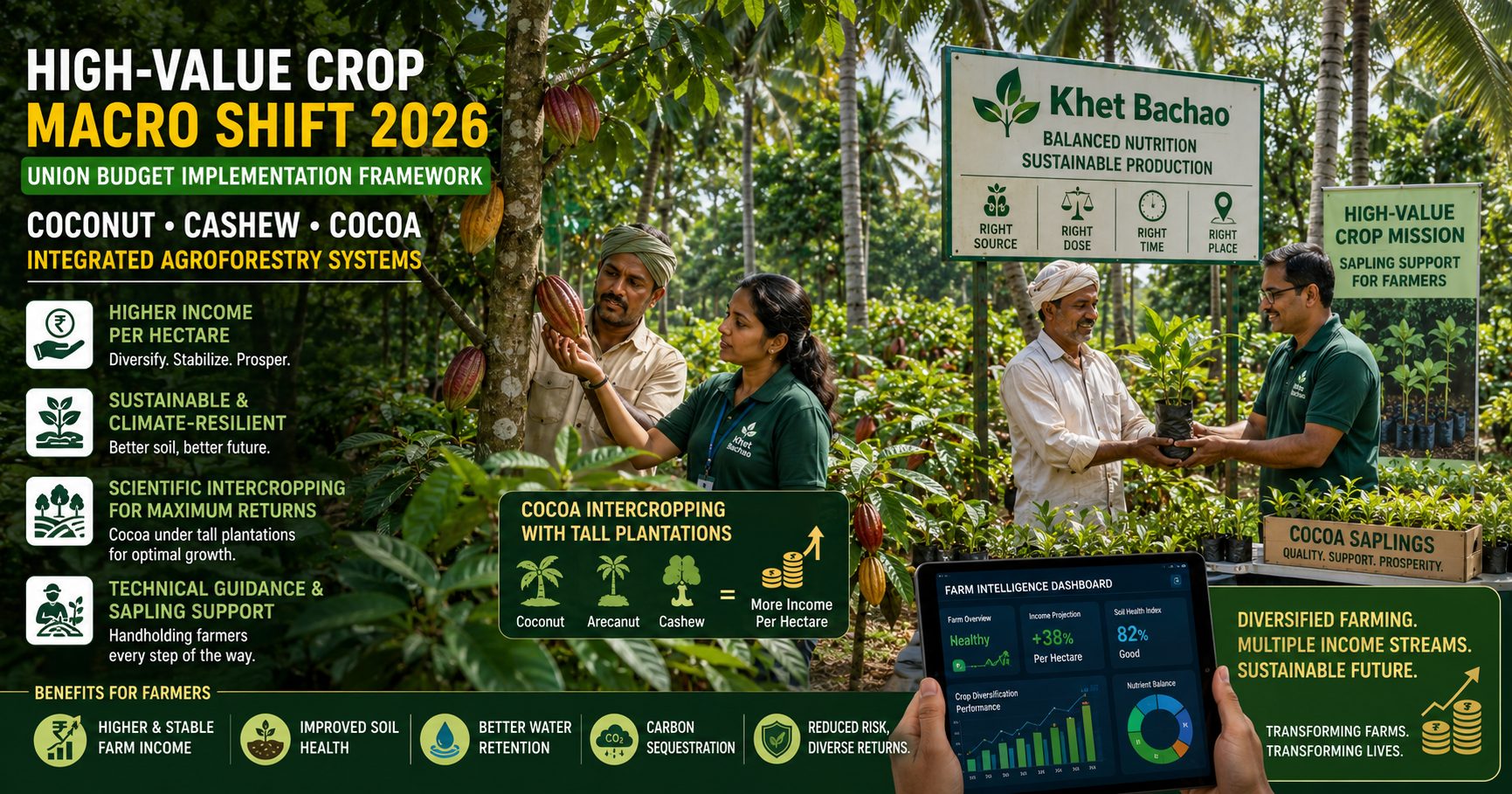
India’s agricultural policy is increasingly focused on high-value crops and integrated agroforestry systems. Under the Union Budget implementation framework, the Ministry of Agriculture is promoting Coconut, Cashew, and Cocoa cultivation through scientific intercropping models, technical assistance, and sapling support programs. This shift aims to maximize income per hectare, improve climate resilience, and create sustainable long-term revenue streams for farmers, FPOs, and agripreneurs.
High-Value Crop Revolution 2026: Why Cocoa Intercropping Is Emerging as India's Next Farm Income Multiplier
Introduction
Indian agriculture is entering a new phase where profitability, sustainability, and climate resilience are becoming as important as productivity.
Recent implementation guidelines aligned with the Union Budget framework indicate a strong policy focus on high-value crops such as Coconut, Cashew, and Cocoa. The objective is clear: increase farmer income per hectare through integrated agroforestry systems rather than expanding cultivated land.
Among these crops, cocoa is attracting particular attention due to its ability to thrive as an intercrop under tall plantation systems. Technical guidance, scientific plantation models, and sapling support initiatives are helping farmers unlock new income streams from existing land resources.
For farmers, FPOs, agribusinesses, and agricultural investors, this signals a major structural shift in Indian agriculture.
Why High-Value Crops Are Becoming a National Priority
Moving Beyond Traditional Yield-Based Farming
For decades, agricultural success was measured primarily by production volumes.
Today, profitability per hectare is becoming the more important metric.
High-value crops offer:
- Better income potential
- Export opportunities
- Crop diversification
- Reduced dependence on commodity markets
- Long-term asset creation
This transition is encouraging farmers to view agriculture as a business rather than merely a production activity.
Income Optimization Through Land Efficiency
Land availability is limited.
Therefore, future growth depends on generating more value from existing farmland.
Integrated agroforestry systems help farmers:
- Utilize vertical growing space
- Improve resource efficiency
- Diversify revenue streams
- Reduce economic risk
This creates stronger farm economics without requiring additional acreage.
The Rise of Cocoa as a Strategic Intercrop
Why Cocoa Fits Agroforestry Systems
Cocoa naturally performs well under partial shade conditions.
This makes it suitable for intercropping with:
- Coconut plantations
- Arecanut plantations
- Cashew-based systems
- Mixed agroforestry models
Instead of competing with primary crops, cocoa complements existing plantations.
Multiple Income Streams from One Farm
Traditional monocropping often exposes farmers to market volatility.
Intercropping allows:
- Primary crop income
- Secondary cocoa income
- Improved resource utilization
- Better long-term profitability
The result is a more resilient farm business model.
Understanding Integrated Agroforestry
What Is Agroforestry?
Agroforestry combines agricultural crops with trees and perennial systems to create productive and sustainable farming ecosystems.
Benefits include:
- Improved soil health
- Enhanced biodiversity
- Better water retention
- Carbon sequestration
- Long-term productivity
Climate Resilience Advantages
As weather variability increases, diversified systems often perform better than monoculture farms.
Integrated systems can help:
- Reduce heat stress
- Improve moisture conservation
- Minimize erosion
- Enhance ecological stability
This makes agroforestry a strategic climate adaptation tool.
Government Support Driving Adoption
Technical Assistance
The Ministry's focus extends beyond policy announcements.
Farmers are receiving support through:
- Plantation design guidance
- Crop management training
- Intercropping recommendations
- Scientific cultivation practices
Knowledge transfer is becoming a key driver of adoption.
Sapling Placement Support
Access to quality planting material is often a major challenge.
Targeted sapling support programs help:
- Reduce establishment costs
- Improve adoption rates
- Standardize quality
- Accelerate plantation development
This lowers barriers for farmers entering high-value crop systems.
Opportunities for FPOs
Aggregation and Market Development
As cocoa cultivation expands, Farmer Producer Organizations can play a vital role in:
- Farmer aggregation
- Input supply
- Technical support
- Market linkage development
- Value-added processing
FPOs can become central players in emerging cocoa value chains.
Processing and Branding Potential
Beyond cultivation, opportunities exist in:
- Cocoa bean processing
- Specialty product development
- Premium branding
- Export market participation
Value addition can significantly increase profitability.
Opportunities for Agripreneurs
Nursery Businesses
Demand for quality saplings is expected to increase.
Entrepreneurs can participate through:
- Certified nursery operations
- Plantation establishment services
- Advisory businesses
- Technical consultancy
Agri-Tech Integration
Technology platforms can support:
- Plantation monitoring
- Farm analytics
- Traceability systems
- Market intelligence
- Climate advisory services
The intersection of agroforestry and digital agriculture presents significant growth opportunities.
Why This Matters for the Future of Indian Agriculture
Diversification Is Becoming Essential
Farmers increasingly need multiple income sources to manage market and climate risks.
High-value crops support:
- Financial stability
- Long-term wealth creation
- Sustainable farming systems
- Improved resource efficiency
Agriculture Is Shifting Toward Value Creation
Future agricultural growth will increasingly come from:
- Specialty crops
- Agroforestry systems
- Processing
- Branding
- Market intelligence
The focus is moving from quantity alone to value generation.
Strategic Implications for AGRIBOZ Users
The expansion of cocoa, coconut, and cashew-based agroforestry systems represents an emerging opportunity area for:
- Farmers
- FPOs
- Agripreneurs
- Agri-tech innovators
- Agricultural investors
Monitoring policy support, plantation development programs, and value chain opportunities will become increasingly important as this sector expands.
Conclusion
The Ministry of Agriculture's focus on high-value crops and integrated agroforestry signals a major shift toward income-centric agriculture.
Cocoa intercropping, supported by technical guidance and sapling placement initiatives, offers farmers a practical pathway to improve profitability while enhancing sustainability and climate resilience.
The farms that generate the highest value in the coming decade may not necessarily be the largest.
They will be the most intelligently diversified.
Explore the Agriculture Intelligence Platform of Bharat - AGRIBOZ
Register on https://www.agriboz.com
CTA Section
Explore the Agriculture Intelligence Platform of Bharat - AGRIBOZ
Discover emerging crop opportunities, agroforestry intelligence, FPO growth strategies, market insights, agricultural workshops, and ecosystem partnerships designed for the future of Indian agriculture.
Register on https://www.agriboz.com
FAQ Section
Why is cocoa being promoted as an intercrop?
Cocoa grows well under shade and can generate additional income without replacing existing plantation crops.
Which crops are being prioritized under the high-value crop framework?
Coconut, Cashew, and Cocoa are among the key focus crops.
What are the benefits of agroforestry systems?
They improve income diversification, soil health, climate resilience, and long-term sustainability.
How can FPOs benefit from cocoa expansion?
FPOs can support aggregation, market linkages, processing, branding, and farmer training.
Why are high-value crops important for future agriculture?
They help maximize income per hectare and reduce dependence on low-margin commodity farming.
Explore the Agriculture Intelligence Platform of Bharat - AGRIBOZ
Track high-value crop opportunities, agroforestry developments, government initiatives, FPO growth strategies, agribusiness investments, and emerging agricultural markets.
Register on https://www.agriboz.com
Q1. What is cocoa intercropping?
Cocoa intercropping involves growing cocoa beneath taller plantation crops such as coconut or arecanut to generate additional farm income.
Q2. Why is the government promoting agroforestry?
Agroforestry improves income diversification, climate resilience, sustainability, and land-use efficiency.
Q3. What support is available for cocoa cultivation?
Technical guidance, plantation planning assistance, and sapling support are being emphasized to encourage adoption.
Q4. How does agroforestry increase farm profitability?
It creates multiple revenue streams from the same land area while improving resource utilization.
Q5. Can FPOs participate in the cocoa value chain?
Yes. FPOs can aggregate produce, support farmers, develop market linkages, and explore processing opportunities.