

Market Arbitrage in Soybean: Spot Prices Hit ₹7,587 per Quintal, Triggering a Potential Kharif Acreage Boom
Domestic soybean markets are witnessing a historic rally as spot prices touch ₹7,587 per quintal, the highest level in four years. With market prices significantly exceeding the newly announced MSP, farmers across major soybean-growing states are expected to expand Kharif acreage aggressively. This shift could reshape crop planning, farm profitability, and commodity market dynamics in the upcoming season.
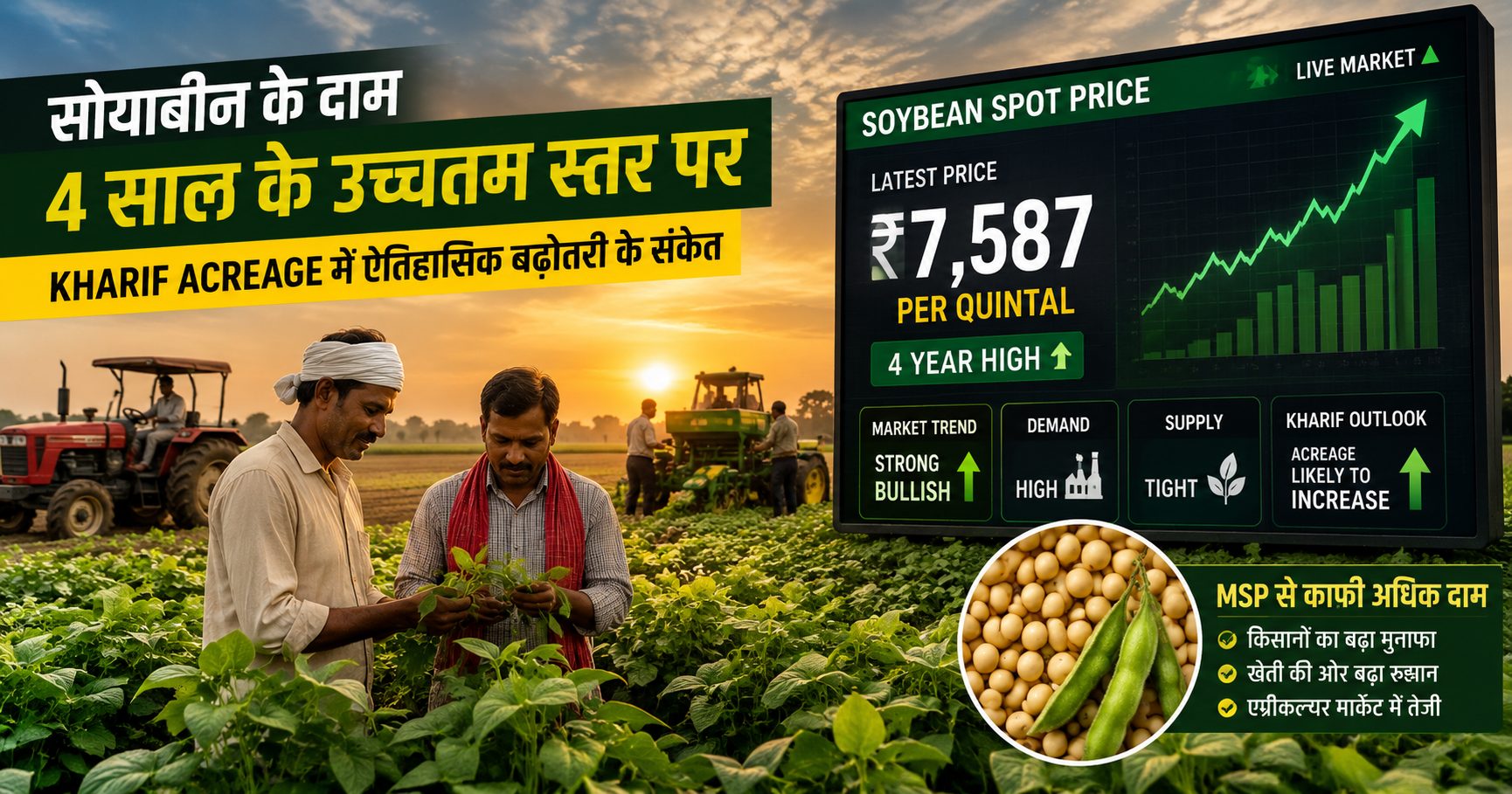
Market Arbitrage in Soybean: Spot Prices Hit ₹7,587 per Quintal, Triggering a Potential Kharif Acreage Boom
Introduction
India's soybean sector is witnessing an extraordinary market development. Domestic soybean spot prices have surged to ₹7,587 per quintal, marking the highest level seen in nearly four years. This sharp rise has created a significant gap between prevailing market rates and the newly approved Minimum Support Price (MSP).
For farmers, traders, processors, and policymakers, this market arbitrage presents both opportunities and challenges. As producers evaluate crop choices for the upcoming Kharif season, soybean is rapidly emerging as one of the most attractive options.
Understanding the Current Soybean Rally
What Is Driving Soybean Prices Higher?
Several factors have contributed to the recent price surge:
- Tight domestic supply conditions
- Strong demand from the edible oil and feed industries
- Reduced carryover stocks from previous seasons
- Global oilseed market volatility
- Expectations of stronger demand during the coming months
The result is a market where open-market prices are substantially outperforming government support levels.
Why the MSP-Market Price Gap Matters
Normally, MSP serves as a safety net for farmers. However, when market prices trade far above MSP, farmers become highly motivated to allocate more acreage to that crop.
This creates a classic market arbitrage opportunity where production decisions are driven by actual market profitability rather than guaranteed procurement prices.
How Farmers Are Responding
Shift in Crop Planning
Across soybean-growing belts, many farmers are reassessing traditional crop allocations.
Potential shifts may include:
- Cotton to soybean transitions
- Pulses to soybean diversification
- Increased soybean area in mixed-cropping regions
- Expansion into previously underutilized acreage
Farmers naturally gravitate toward crops offering stronger returns per acre, and soybean currently stands out as a leading candidate.
Profitability Calculations Favor Soybean
Higher spot prices significantly improve revenue projections.
Farmers evaluating:
- Seed costs
- Fertilizer expenses
- Labor requirements
- Irrigation availability
- Market access
are finding soybean increasingly attractive compared to several competing Kharif crops.
Expected Impact on Kharif Acreage
Possibility of Record Sowing
If current price trends remain stable through sowing season, India could witness one of the strongest soybean acreage expansions in recent years.
Major soybean-producing states expected to benefit include:
- Madhya Pradesh
- Maharashtra
- Rajasthan
- Karnataka
- Telangana
Acreage expansion could potentially reshape national oilseed production patterns.
Regional Opportunities
Certain districts with favorable rainfall forecasts and established soybean infrastructure may experience especially strong growth.
Regions with:
- Efficient mandi networks
- Better storage facilities
- Access to processing units
- Strong trader participation
are likely to attract greater soybean cultivation.
Implications for Agribusiness and Commodity Markets
Opportunities for Processors
Higher acreage can eventually improve raw material availability for:
- Oil extraction units
- Feed manufacturers
- Soy product processors
- Export-oriented businesses
While current prices are high, expanded production could stabilize supplies later in the marketing year.
Risks of Overexpansion
Commodity markets are cyclical.
If acreage increases too aggressively:
- Production could rise sharply
- Market supply may eventually exceed demand
- Prices could normalize after harvest
- Farmer margins may narrow
Balanced production planning remains critical.
What Farmers Should Consider Before Expanding Soybean Acreage
Evaluate Local Market Conditions
Price signals are important, but farmers should also assess:
- Local procurement infrastructure
- Storage availability
- Input accessibility
- Historical yield performance
Focus on Productivity, Not Just Acreage
Expanding acreage without improving productivity may limit profitability.
Farmers should prioritize:
- Quality seed selection
- Soil testing
- Nutrient management
- Pest monitoring
- Climate-resilient practices
Use Market Intelligence
Successful farming increasingly depends on real-time information.
Monitoring:
- Price trends
- Weather forecasts
- Demand indicators
- Government policies
can significantly improve decision-making.
Why Agricultural Intelligence Matters More Than Ever
Today's market environment rewards informed decisions.
A farmer who understands:
- Price cycles
- Commodity demand
- Crop economics
- Market timing
has a significant competitive advantage.
This is where agriculture intelligence platforms play a crucial role in helping farmers move beyond traditional decision-making and toward data-driven farming.
Conclusion
The rise of soybean spot prices to ₹7,587 per quintal signals one of the strongest market opportunities seen in recent years. With market rates substantially outperforming MSP levels, soybean is positioned to become a major beneficiary of Kharif sowing decisions.
However, long-term success will depend not only on acreage expansion but also on productivity, risk management, and access to reliable market intelligence. Farmers who combine strong agronomic practices with timely market insights will be best positioned to capitalize on this opportunity.
Register on https://www.agriboz.com and stay connected with the latest agricultural market intelligence, price trends, training opportunities, and farming innovations shaping the future of Indian agriculture.
CTA
Explore the Agriculture Intelligence Platform of Bharat - AGRIBOZ
Gain access to market insights, agricultural knowledge, expert networks, workshops, farm opportunities, and emerging agribusiness trends that help farmers and stakeholders make smarter decisions.
Register on https://www.agriboz.com
FAQ
Why are soybean prices rising so sharply?
Prices have increased due to strong demand, tighter supplies, lower stock availability, and supportive market sentiment in both domestic and global oilseed markets.
Will higher soybean prices increase Kharif acreage?
Yes. Higher profitability is expected to encourage many farmers to allocate additional acreage to soybean cultivation during the Kharif season.
Is soybean currently trading above MSP?
Yes. Spot market prices are significantly higher than the recently announced MSP, creating a strong incentive for farmers.
Which states are likely to see the biggest acreage increase?
Madhya Pradesh, Maharashtra, Rajasthan, Karnataka, and Telangana are among the key soybean-growing states that could witness expansion.
Can soybean prices remain at current levels after harvest?
Prices may fluctuate depending on production levels, demand conditions, imports, exports, and overall market supply during the marketing season.
Explore the Agriculture Intelligence Platform of Bharat - AGRIBOZ
Access agricultural market intelligence, price trend analysis, farmer training programs, workshops, expert guidance, farm retreat opportunities, and agribusiness networking.
Register on https://www.agriboz.com
Q1. What does market arbitrage mean in the soybean market? Market arbitrage refers to a situation where market prices are significantly higher than MSP, creating stronger profit incentives for farmers.
Q2. Why is ₹7,587 per quintal considered significant? It represents the highest domestic soybean spot price level seen in nearly four years, indicating strong market demand and supply tightness.
Q3. Will farmers increase soybean cultivation this Kharif season? Current price signals strongly suggest that many farmers may allocate more land to soybean cultivation.
Q4. Which regions benefit most from higher soybean prices? Major soybean-producing regions in Madhya Pradesh, Maharashtra, Rajasthan, Karnataka, and Telangana are expected to benefit the most.
Q5. What risks should farmers consider before expanding acreage? Potential risks include weather uncertainty, pest pressure, input costs, and possible price corrections if production increases significantly.
Q6. How can farmers make better crop planning decisions? By combining market intelligence, weather forecasts, soil health data, and profitability analysis before finalizing sowing plans.