Water Tables Crash: Southern and Eastern Reservoir Storage Falls Sharply Below Decadal Normals
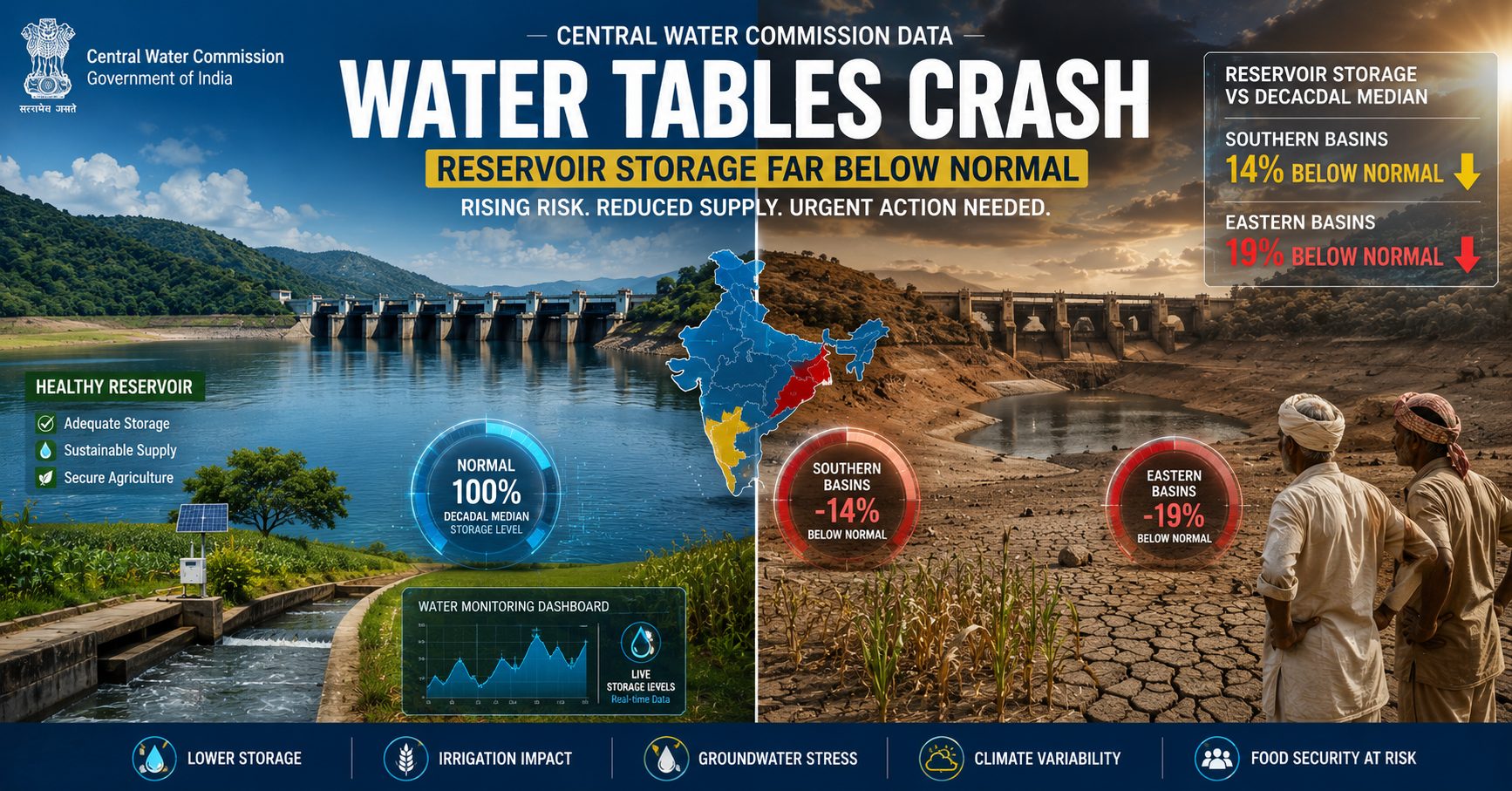
Fresh Central Water Commission data reveals that reservoir basins across Southern and Eastern India are operating significantly below normal decadal storage medians, with deficits of 14% and 19% respectively. The development raises concerns for irrigation security, crop planning, groundwater recharge, and climate resilience in the agriculture sector.
Water Tables Crash: Reservoir Storage Deficits Raise Concerns for India's Agricultural Future
Introduction
Water remains the most critical resource for agriculture, food security, and rural livelihoods. Recent data from the Central Water Commission indicates a concerning trend across India's reservoir systems. Southern reservoir basins are currently operating approximately 14% below normal decadal storage medians, while Eastern basins have fallen nearly 19% below historical averages.
These deficits are more than statistical indicators. They represent growing pressure on irrigation systems, groundwater recharge, crop productivity, and climate resilience across some of India's most agriculturally significant regions.
As weather variability increases and water demand continues to rise, efficient water management is becoming an urgent national priority.
Understanding Reservoir Storage Deficits
What Does Below-Normal Storage Mean?
Reservoir storage levels are compared against historical decadal averages to assess water availability.
When storage falls significantly below these benchmarks, it signals:
- Reduced irrigation potential
- Lower drinking water reserves
- Increased groundwater dependence
- Higher drought vulnerability
- Greater agricultural risk
The current deficits in Southern and Eastern regions indicate that available water resources are under growing stress.
Why Reservoirs Matter to Agriculture
Reservoirs support millions of farmers by providing:
- Irrigation water
- Drought protection
- Groundwater recharge support
- Livestock water supply
- Hydropower generation
Lower storage directly affects agricultural planning and production stability.
Impact on Farmers and Crop Production
Increased Irrigation Uncertainty
Farmers dependent on canal irrigation may face reduced water allocations if reservoir levels continue to remain below normal.
This could lead to:
- Delayed sowing
- Reduced cropped area
- Lower yields
- Increased cultivation risk
Greater Dependence on Groundwater
When surface water becomes scarce, farmers often turn to groundwater extraction.
Excessive groundwater pumping can:
- Lower water tables further
- Increase energy costs
- Reduce long-term water sustainability
Higher Vulnerability for Water-Intensive Crops
Crops such as:
- Paddy
- Sugarcane
- Banana
- Certain horticultural crops
may face greater production challenges in regions experiencing water stress.
Climate Change and Water Resource Stress
Extreme Weather Patterns
Climate variability is creating irregular rainfall distribution across many regions.
Common challenges include:
- Delayed monsoons
- Intense short-duration rainfall
- Extended dry spells
- Heatwave-driven evaporation losses
These factors reduce effective water storage and utilization.
Growing Water Demand
Water demand continues to increase because of:
- Expanding agricultural production
- Urbanization
- Industrial growth
- Population increases
Managing limited water resources efficiently is becoming increasingly important.
Strategies for Water Resilience
Micro-Irrigation Adoption
Drip and sprinkler systems can significantly improve water-use efficiency.
Benefits include:
- Reduced water wastage
- Better nutrient management
- Higher productivity
- Lower irrigation costs
Crop Diversification
Regions facing recurring water shortages may benefit from shifting toward:
- Millets
- Pulses
- Oilseeds
- Drought-tolerant crops
These crops typically require less water than traditional high-consumption alternatives.
Rainwater Harvesting and Storage
Strengthening local water storage systems can improve resilience.
Examples include:
- Farm ponds
- Check dams
- Community reservoirs
- Watershed development projects
Digital Water Intelligence
Advanced technologies now help farmers monitor:
- Soil moisture
- Weather forecasts
- Irrigation schedules
- Water-use efficiency
Data-driven decisions can significantly improve water management outcomes.
Policy and Infrastructure Implications
Need for Integrated Water Management
Long-term resilience requires coordinated efforts involving:
- Reservoir management
- Groundwater governance
- Watershed restoration
- Climate adaptation planning
Strengthening Agricultural Preparedness
Water security must become a central component of future agricultural policy.
Investment priorities may include:
- Irrigation modernization
- Water-efficient farming
- Climate-resilient infrastructure
- Real-time monitoring systems
Future Outlook
The reported storage deficits in Southern and Eastern reservoir basins serve as an early warning signal for policymakers, farmers, and agribusiness stakeholders.
While a single season may not determine long-term outcomes, persistent deviations from historical storage patterns could increase risks to agricultural productivity and rural livelihoods.
Building water resilience today will be critical for ensuring sustainable agricultural growth tomorrow.
Conclusion
The latest reservoir storage data highlights the growing importance of proactive water management in India's agricultural future. With Southern reservoirs operating 14% below normal decadal levels and Eastern reservoirs nearly 19% below historical averages, stakeholders must prioritize efficient water use, climate adaptation, and sustainable resource planning.
Register on https://www.agriboz.com to stay informed about water intelligence, climate developments, agricultural policy updates, and emerging solutions shaping the future of Indian farming.
CTA
Explore the Agriculture Intelligence Platform of Bharat - AGRIBOZ
Access water management insights, climate risk intelligence, agricultural innovations, expert-led learning opportunities, and strategic resources for resilient farming.
Register on https://www.agriboz.com
FAQ
What does below-normal reservoir storage indicate?
It indicates that water availability is lower than historical averages, increasing risks for irrigation, agriculture, and water security.
How much below normal are Southern and Eastern reservoirs?
Recent data suggests Southern reservoirs are approximately 14% below decadal storage medians, while Eastern reservoirs are around 19% below normal levels.
Why are reservoir levels important for agriculture?
Reservoirs provide irrigation water, support groundwater recharge, and help stabilize agricultural production during dry periods.
How can farmers adapt to water shortages?
Farmers can adopt micro-irrigation, diversify crops, improve water harvesting, and use digital advisory systems for efficient water management.
What role does climate change play in reservoir deficits?
Climate change contributes to irregular rainfall patterns, higher evaporation rates, and increased water stress, affecting reservoir storage levels.
Explore the Agriculture Intelligence Platform of Bharat - AGRIBOZ
Gain access to water resource intelligence, climate adaptation strategies, agricultural policy updates, and expert insights that help build resilient farming systems.
Register on https://www.agriboz.com
Q1. What are reservoir storage medians? A. They are historical average storage benchmarks used to assess current reservoir performance and water availability.
Q2. Why are Southern and Eastern reservoirs important? A. These reservoirs support large agricultural regions, irrigation networks, drinking water systems, and rural livelihoods.
Q3. How do low reservoir levels affect farmers? A. Farmers may face reduced irrigation supply, higher groundwater dependence, and increased production risks.
Q4. What crops are most vulnerable to water shortages? A. Water-intensive crops such as paddy, sugarcane, and certain horticultural crops are typically more affected.
Q5. What solutions can improve water resilience? A. Micro-irrigation, watershed development, rainwater harvesting, crop diversification, and digital water management tools can strengthen resilience.