
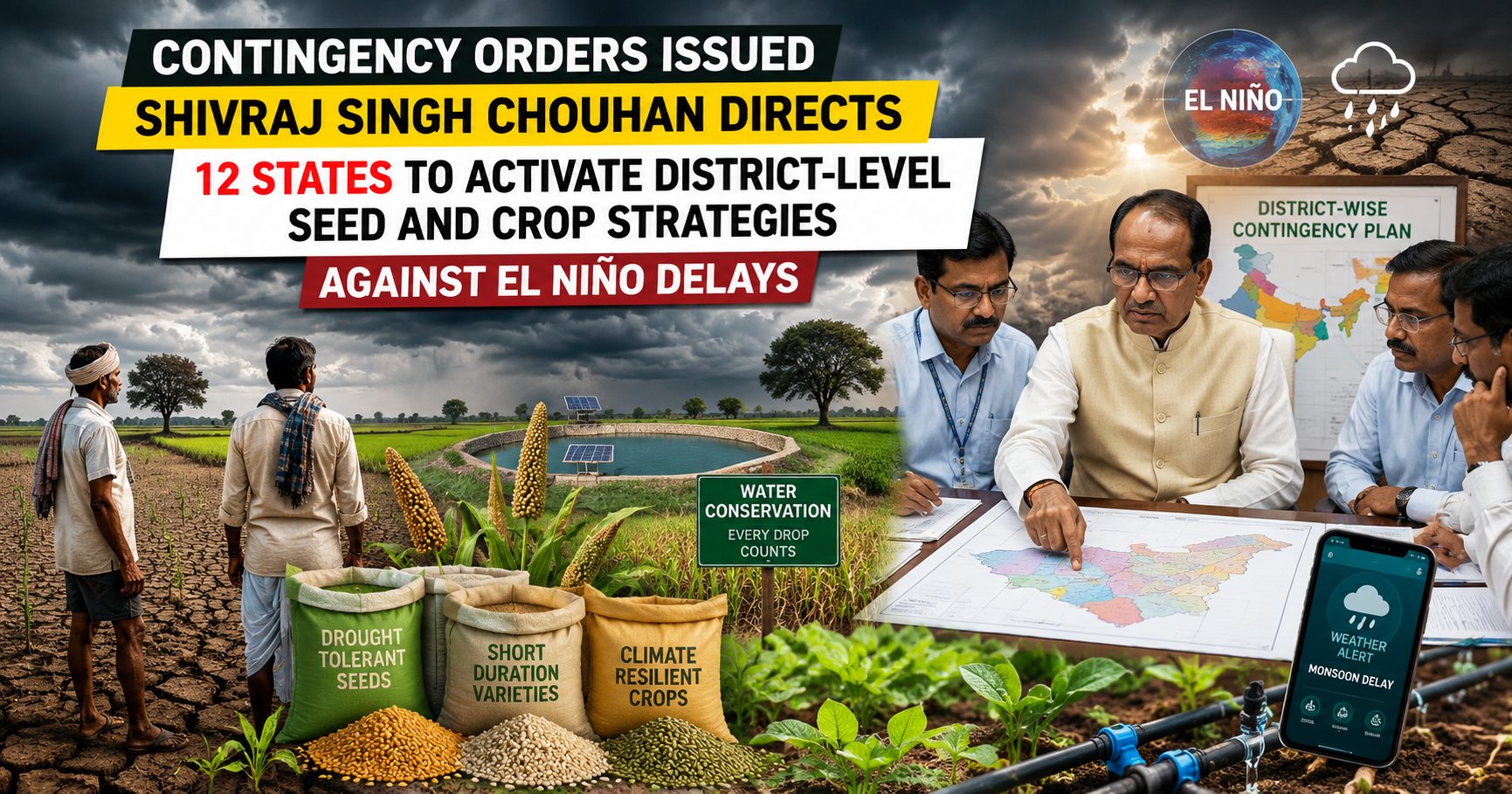
Contingency Orders Issued: Shivraj Singh Chouhan Directs 12 States to Activate District-Level Seed and Crop Strategies Against El Niño Delays
As El Niño threatens delayed rainfall and a weaker Kharif season, Agriculture Minister Shivraj Singh Chouhan has instructed 12 highly exposed states to immediately activate district-level contingency plans. The strategy focuses on drought-tolerant seeds, alternative crops, moisture conservation, and rapid farmer advisories to safeguard agricultural productivity and farm incomes.
Contingency Orders Issued: Shivraj Singh Chouhan Directs 12 States to Activate District-Level Seed and Crop Strategies Against El Niño Delays
Introduction
India's agricultural sector is preparing for one of its most critical Kharif seasons in recent years. With El Niño conditions expected to weaken monsoon performance and increase rainfall uncertainty, the Government of India has moved into proactive response mode.
Union Agriculture Minister Shivraj Singh Chouhan has instructed 12 highly vulnerable states to immediately activate district-level contingency plans aimed at protecting farmers, crops, and rural livelihoods from delayed or deficient rainfall. According to government reviews, more than 300 districts may require special preparedness measures during the 2026 Kharif season.
The focus is simple: prepare before the crisis arrives.
Why El Niño Is Creating Concern for Indian Agriculture
Understanding the Risk
El Niño is a global climate phenomenon that often leads to below-normal rainfall, erratic monsoon patterns, prolonged dry spells, and increased agricultural risk across India.
For farmers, this can result in:
- Delayed sowing
- Poor germination
- Moisture stress
- Reduced yields
- Higher pest and disease pressure
- Increased production costs
Government assessments indicate that several states may experience relatively severe impacts during the Kharif season if rainfall deficits persist.
The 12 States Under Special Monitoring
High-Risk Agricultural Zones
The Agriculture Ministry has identified 12 states where contingency preparedness is being intensified.
These include:
- Uttar Pradesh
- Tamil Nadu
- Andhra Pradesh
- Telangana
- Karnataka
- Odisha
- Gujarat
- Rajasthan
- Bihar
- Madhya Pradesh
- Jharkhand
- Maharashtra
District administrations are being instructed to coordinate closely with agriculture departments, Krishi Vigyan Kendras (KVKs), research institutions, and extension networks to ensure localized preparedness.
What Are District-Level Contingency Plans?
Moving Beyond Paper Plans
The minister has emphasized that contingency strategies must be visible on the ground rather than remain administrative documents.
District-specific plans are expected to include:
- Alternative crop recommendations
- Short-duration seed deployment
- Drought-tolerant varieties
- Re-sowing strategies
- Emergency seed reserves
- Moisture conservation practices
- Scientific irrigation scheduling
- Pest and disease monitoring
The objective is to provide farmers with practical solutions immediately when weather disruptions occur.
Seed Security Becomes a National Priority
Ensuring Availability of Suitable Seeds
One of the most important directives involves seed preparedness.
Authorities have been instructed to ensure:
- Availability of certified seeds
- Distribution of climate-resilient varieties
- Access to short-duration crops
- Emergency seed reserves for re-sowing
Seed quality remains a critical factor because even small improvements in seed performance can significantly improve productivity under stress conditions.
Alternative Crop Planning
Where rainfall delays become severe, farmers may be advised to shift toward:
- Pulses
- Millets
- Oilseeds
- Short-duration crop varieties
This approach can reduce water demand while maintaining farm profitability.
Water Conservation at the Center of the Strategy
Every Drop Matters
Water management is emerging as the foundation of India's contingency response.
The ministry has instructed states to prioritize:
- Farm ponds
- Water harvesting structures
- Moisture retention practices
- Mulching
- Scientific reservoir management
- Efficient canal water distribution
Districts are expected to develop localized plans based on water availability rather than relying on uniform state-wide recommendations.
Moisture Management Techniques
Farmers may be encouraged to adopt:
- Conservation tillage
- Residue management
- Intercropping
- Mulching systems
- Precision irrigation
These practices help crops survive extended dry spells and improve resource efficiency.
Strengthening Climate-Resilient Agriculture
Building Long-Term Farm Resilience
The current challenge highlights the growing importance of climate-smart agriculture.
Experts are increasingly recommending:
- Diversified cropping systems
- Scientific crop planning
- Integrated farming models
- Improved soil health
- Digital advisories
- Weather-based decision making
The goal is not only to survive one difficult season but to strengthen resilience for future climate shocks.
Farmer Advisory Systems to Be Expanded
Timely Information Can Save Crops
The ministry is also strengthening communication systems to ensure farmers receive timely guidance.
This includes:
- Mobile advisories
- Weather alerts
- Pest outbreak warnings
- Crop management recommendations
- District-level support systems
Reliable information allows farmers to make quicker and more profitable decisions during uncertain weather conditions.
What This Means for Farmers
Preparation Is the Best Protection
The government's message is clear:
Do not panic. Prepare.
Farmers should:
- Monitor local advisories closely
- Secure quality seed early
- Review alternative crop options
- Adopt moisture conservation practices
- Stay connected with extension services
- Participate in training and knowledge programs
Those who prepare early often experience lower losses and better recovery during challenging seasons.
Conclusion
The activation of district-level contingency plans across 12 vulnerable states marks one of the most proactive agricultural preparedness efforts in recent years. With rainfall uncertainty increasing under El Niño conditions, success will depend on rapid coordination between governments, scientists, extension agencies, and farmers.
The emphasis on seed security, water conservation, alternative cropping strategies, and localized planning offers a practical roadmap to reduce risk and protect farm incomes during the Kharif season.
For farmers and agricultural stakeholders, this is also a reminder that climate resilience is no longer optional—it is becoming essential for long-term success.
Register on https://www.agriboz.com
AGRIBOZ CTA
Explore the Agriculture Intelligence Platform of Bharat - AGRIBOZ
Stay updated with agriculture news, weather intelligence, crop advisory insights, farming innovations, training opportunities, workshops, and expert guidance designed for modern Indian agriculture.
Explore the Agriculture Intelligence Platform of Bharat - AGRIBOZ
Get access to agriculture intelligence, climate-smart farming insights, expert-led workshops, agri-business opportunities, crop planning guidance, and a growing ecosystem of farmers, trainers, and agricultural professionals.
Register on https://www.agriboz.com
Q1. Why has the government activated contingency plans for 12 states?
The plans have been activated due to the expected impact of El Niño, which may lead to delayed or below-normal rainfall during the Kharif season.
Q2. What are district-level contingency plans?
These are localized agricultural response strategies that include alternative crops, seed availability, irrigation management, moisture conservation, and farmer advisories.
Q3. Which states are considered highly vulnerable?
States identified for special preparedness include Uttar Pradesh, Tamil Nadu, Andhra Pradesh, Telangana, Karnataka, Odisha, Gujarat, Rajasthan, Bihar, Madhya Pradesh, Jharkhand, and Maharashtra.
Q4. How will farmers benefit from these plans?
Farmers can receive timely guidance, access to suitable seeds, alternative crop recommendations, and support for managing weather-related risks.
Q5. What role do drought-tolerant seeds play?
Drought-tolerant and short-duration seeds help reduce crop losses during delayed monsoon conditions and improve resilience against moisture stress.
Q6. Why is water conservation receiving special attention?
Water conservation helps maintain soil moisture, supports crop growth during dry spells, and improves agricultural sustainability under uncertain rainfall conditions.
Q7. What should farmers do if monsoon arrival is delayed?
Farmers should follow district advisories, consider alternative crop options, adopt moisture conservation techniques, and stay connected with local agricultural extension services.