
Severe Heat Stress Delays Paddy Transplantation in Uttar Pradesh, Punjab and Haryana
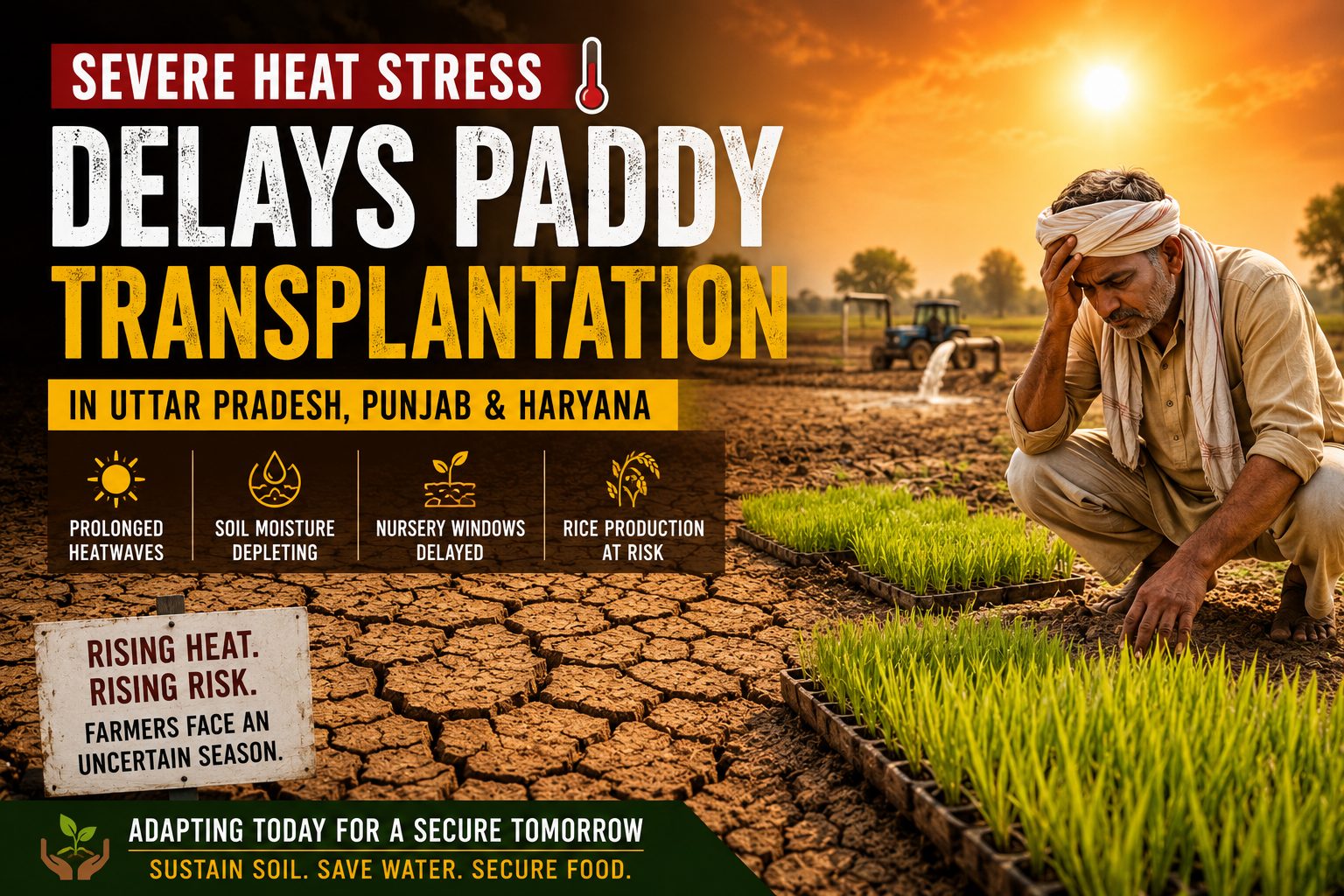
Unprecedented heatwaves across Uttar Pradesh, Punjab, and Haryana are depleting surface soil moisture and disrupting traditional paddy transplantation schedules. As climate pressures intensify, farmers must adapt to new realities that could reshape rice production across India's agricultural heartland.
Severe Heat Stress Threatens Paddy Season: How Rising Temperatures Are Reshaping Rice Farming in North India
The Heatwave Warning Farmers Cannot Ignore
Across Uttar Pradesh, Punjab, and Haryana, prolonged heatwaves are creating a challenge that extends far beyond uncomfortable temperatures.
Surface soil moisture is rapidly declining.
Traditional nursery transplantation windows for paddy are being delayed.
And farmers are increasingly confronting a reality that climate experts have been discussing for years: agricultural calendars are changing.
For India's rice-producing regions, this is not merely a seasonal disruption.
It may be an early signal of a larger transformation in how rice is cultivated across Bharat.
Farmers looking to stay ahead of climate-driven agricultural changes can explore practical learning and adaptation opportunities through AGRIBOZ:
https://www.agriboz.com
---
Why Soil Moisture Matters for Paddy
Rice cultivation depends heavily on timing.
Successful transplantation requires:
- Adequate soil moisture
- Stable nursery development
- Reliable water availability
- Favorable weather conditions
When heatwaves intensify, moisture evaporates more rapidly from the soil surface.
Even when irrigation resources are available, excessive temperatures can increase water demand and operational costs.
The result is delayed transplantation and increased production uncertainty.
---
The Bharat Rice Belt Under Pressure
Punjab, Haryana, and Uttar Pradesh play a critical role in India's food security system.
These states contribute significantly to:
- Rice procurement
- National food grain reserves
- Agricultural exports
- Rural employment
Any disruption in paddy transplantation can have ripple effects throughout the agricultural value chain.
This makes the current heat stress situation more than a local farming concern.
It is a national agricultural issue.
---
A Bigger Climate Reality Is Emerging
Historically, farmers relied on relatively predictable seasonal patterns.
Today, weather variability is becoming the norm.
Agriculture is increasingly facing:
- Longer heatwaves
- Delayed rainfall
- Extreme weather events
- Water scarcity challenges
- Changing pest dynamics
The current paddy transplantation delays highlight how climate risks are moving from theoretical discussions to operational realities.
---
The Economic Impact on Farmers
Delayed transplantation can affect:
Yield Potential
Missed optimal planting windows may influence crop development.
Input Costs
Additional irrigation and field preparation increase expenses.
Labor Planning
Schedule disruptions create management challenges.
Market Timing
Delayed harvests can impact selling opportunities and procurement schedules.
In an environment where margins are already under pressure, climate-related disruptions can significantly affect profitability.
---
MID-CONTENT CTA
Climate-smart farming is becoming a necessity rather than an option.
Farmers who understand water management, resilient cultivation practices, and emerging agricultural technologies are likely to be better positioned for future challenges.
Explore AGRIBOZ workshops to build future-ready farming skills:
https://www.agriboz.com/workshops
---
How Progressive Farmers Are Adapting
Forward-looking farmers are increasingly adopting:
Water-Efficient Irrigation
Precision irrigation reduces water wastage and improves efficiency.
Climate-Informed Planning
Using weather intelligence to guide field decisions.
Diversified Cropping Systems
Reducing dependence on a single crop cycle.
Improved Soil Health Management
Healthy soils retain moisture more effectively during heat stress periods.
Technology Integration
Sensors, weather apps, and digital advisory services are becoming valuable decision-making tools.
---
Strategic Insight: Soil Health Is Climate Insurance
One of the most overlooked lessons from recurring heatwaves is the importance of soil health.
Soils rich in organic matter:
- Retain water longer
- Improve root development
- Enhance crop resilience
- Reduce moisture stress
As climate risks increase, soil management may become one of the most powerful risk mitigation tools available to farmers.
---
What This Means for the Future of Rice Farming
The ongoing heat stress episode could accelerate several long-term trends:
- Climate-smart agriculture adoption
- Precision irrigation investments
- Alternative rice cultivation techniques
- Improved water management policies
- Greater focus on resource efficiency
The future of rice farming may increasingly depend on adaptability rather than tradition alone.
---
How AGRIBOZ Supports Climate-Ready Agriculture
As weather patterns evolve, continuous learning becomes essential.
AGRIBOZ helps farmers, agripreneurs, trainers, and rural innovators access:
- Agricultural workshops
- Practical field knowledge
- Farm learning experiences
- Expert networks
- Government scheme awareness
- Climate adaptation insights
Explore the AGRIBOZ ecosystem:
https://www.agriboz.com
---
The Road Ahead
Heatwaves delaying paddy transplantation are not isolated events.
They are indicators of a broader agricultural transition already underway.
The farms that succeed in the coming decade may not simply be those with the most land or resources.
They may be the farms that adapt fastest.
As climate uncertainty grows, knowledge, resilience, and innovation will become the most valuable agricultural assets.
The challenge is real.
But so is the opportunity to build a stronger, smarter, and more climate-resilient future for Indian agriculture.
The future belongs to farmers who prepare before disruption becomes crisis. Join AGRIBOZ to access workshops, expert insights, agricultural opportunities, and a growing ecosystem designed for climate-resilient farming.
https://www.agriboz.com
Q1. Why are heatwaves delaying paddy transplantation? High temperatures rapidly reduce surface soil moisture, making field conditions unsuitable for timely transplantation.
Q2. Which states are currently most affected? Uttar Pradesh, Punjab, and Haryana are experiencing significant heat stress impacting paddy nursery transplantation schedules.
Q3. How does soil moisture affect rice cultivation? Adequate soil moisture supports nursery establishment, root development, and successful transplantation.
Q4. What can farmers do to adapt to increasing heat stress? Farmers can adopt climate-smart practices, improve soil health, optimize irrigation, and use weather-based planning.
Q5. Will climate change continue affecting rice farming? Many experts believe increasing weather variability will continue influencing agricultural calendars, water availability, and crop management decisions.