
PMDDKY Diversification Model: Transition from Grain Monoculture to High-Value Horticulture
The PMDDKY diversification model aims to help farmers move beyond traditional grain monoculture by supporting high-value horticulture. Explore how this transition can improve income, sustainability, market access, and long-term farm resilience.
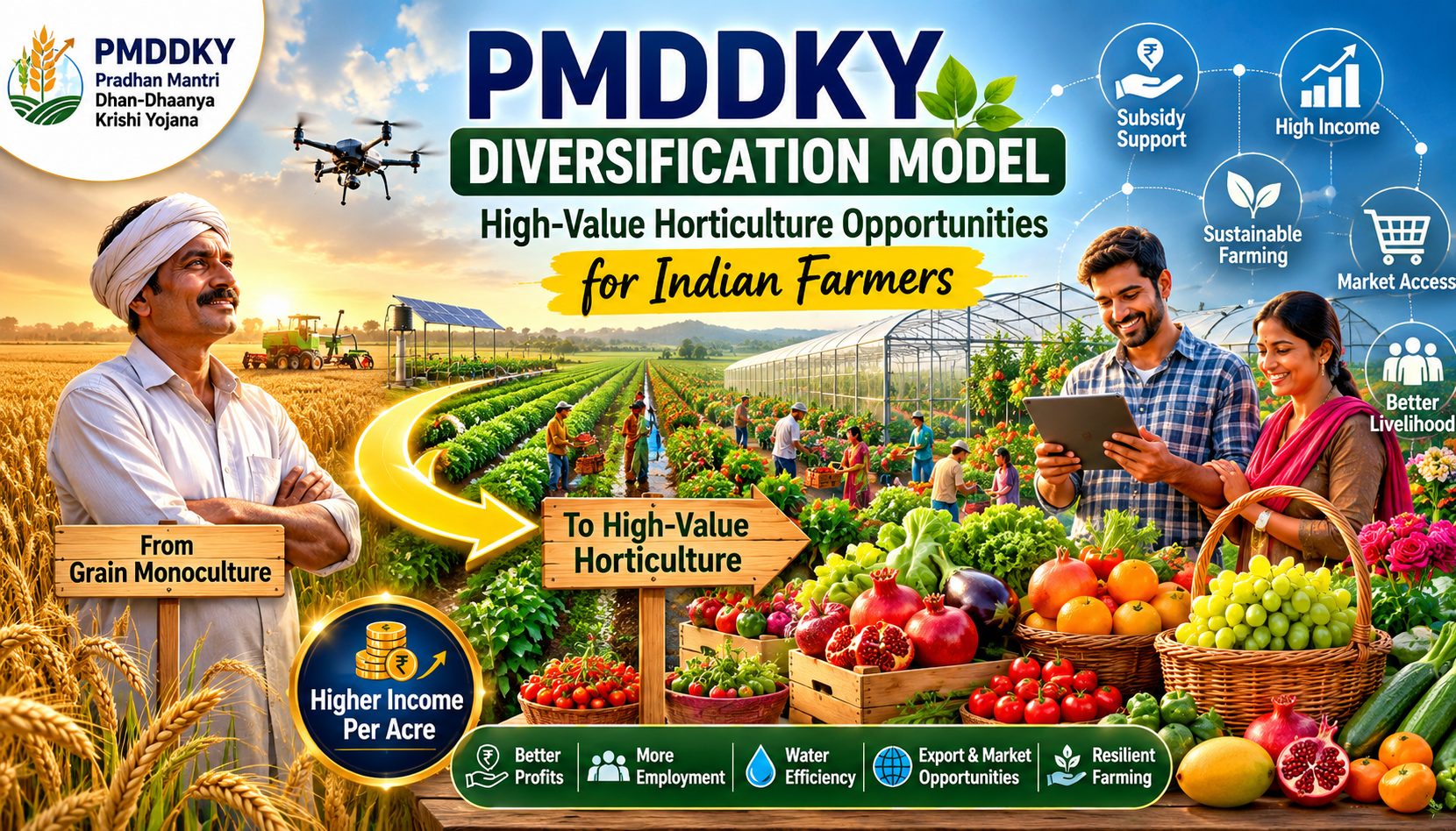
Diversification Model: How PMDDKY Can Transform Grain Monoculture into High-Value Horticulture
A New Chapter for Indian Agriculture
For decades, millions of farmers have depended heavily on a limited number of crops such as wheat and rice. While these crops remain critical for food security, overdependence on grain monoculture has created challenges including declining profitability, soil degradation, groundwater stress, and vulnerability to market fluctuations.
The proposed diversification approach under the Pradhan Mantri Dhan-Dhaanya Krishi Yojana (PMDDKY) introduces a powerful idea: help farmers gradually transition toward high-value horticulture while reducing economic risk through government support.
For farmers, agripreneurs, and rural youth, this is not merely a scheme. It could become a gateway to a more profitable agricultural future.
Soft Opportunity CTA
Interested in exploring future-ready agriculture opportunities, government schemes, and practical farm learning? Create your AGRIBOZ account and stay updated: https://www.agriboz.com
---
Understanding the Monoculture Challenge
Large-scale cultivation of a single crop offers operational simplicity but creates long-term vulnerabilities.
Some of the most common issues include:
- Price fluctuations affecting income stability
- Increasing input costs
- Soil nutrient imbalance
- Water resource depletion
- Pest and disease concentration
- Limited value addition opportunities
Many farmers remain trapped in a low-margin production cycle despite increasing productivity.
The challenge is no longer only about growing more food.
The challenge is growing more value per acre.
---
What PMDDKY Attempts to Solve
The PMDDKY diversification model can potentially support farmers through:
- Transition subsidies
- Input support
- Horticulture infrastructure assistance
- Farmer training programs
- Market linkage development
- Value chain integration
- Post-harvest management support
This reduces the financial risk farmers often face when shifting away from traditional cropping systems.
Instead of forcing abrupt changes, PMDDKY can encourage gradual diversification.
---
Bharat's Market Reality: Why Horticulture Matters
Consumer demand patterns across India are changing rapidly.
Urbanization, rising incomes, health awareness, and organized retail expansion are increasing demand for:
- Fruits
- Vegetables
- Exotic crops
- Medicinal plants
- Flowers
- Spices
- Protected cultivation products
Compared with traditional grains, many horticulture crops can generate significantly higher revenue per acre when supported by proper market access and management.
This creates an opportunity for farmers to participate in premium agricultural value chains.
---
The Economic Advantage of High-Value Horticulture
Higher Income Potential
Many horticulture crops provide:
- Better market realization
- Multiple harvest cycles
- Export opportunities
- Direct consumer sales potential
Employment Generation
Diversified farms often require:
- Nursery operations
- Sorting and grading
- Packaging
- Processing
- Logistics
This creates rural employment opportunities beyond primary farming.
Value Addition Ecosystem
Horticulture opens doors for:
- Food processing
- Agri startups
- Farmer Producer Organizations (FPOs)
- Agritourism
- Direct farm marketing
---
Strategic Crop Diversification Opportunities
Depending on regional suitability, farmers may consider:
Fruit Crops
- Mango
- Guava
- Pomegranate
- Citrus
- Dragon Fruit
Vegetable Clusters
- Tomato
- Capsicum
- Onion
- Cucumber
- Leafy Greens
Protected Cultivation
- Polyhouse vegetables
- Hydroponics
- Precision farming
Specialty Crops
- Medicinal plants
- Aromatic crops
- Export-oriented produce
The most successful diversification strategies align crop selection with local climate, water availability, logistics, and market demand.
---
Challenges Farmers Must Prepare For
Diversification is promising, but not risk-free.
Potential challenges include:
- Market volatility
- Perishability
- Technical knowledge gaps
- Storage limitations
- Initial investment requirements
This is why farmer education and ecosystem support become critical.
---
MID-CONTENT CTA
Farmers who want practical guidance on diversification, horticulture business models, and emerging agricultural opportunities can explore AGRIBOZ learning programs and ecosystem resources:
https://www.agriboz.com
The right knowledge often becomes the difference between experimentation and profitable transformation.
---
How Technology Strengthens Diversification
Modern horticulture increasingly depends on:
- Precision irrigation
- Sensor-based monitoring
- Digital advisory systems
- Farm management software
- Weather intelligence
- AI-driven crop planning
Combining PMDDKY support with technology adoption can significantly improve outcomes.
The future farm will not simply produce crops.
It will produce data-driven profitability.
---
The Role of AGRIBOZ in the Diversification Journey
As diversification expands, farmers need more than subsidies.
They need:
- Knowledge
- Networks
- Mentorship
- Market intelligence
- Training opportunities
- Ecosystem participation
AGRIBOZ can help connect farmers, trainers, experts, agripreneurs, and rural innovators through a collaborative agriculture ecosystem designed for Bharat's future.
Potential opportunities include:
- Agricultural workshops
- Farm retreats
- Expert sessions
- Partnership opportunities
- Government scheme awareness
- Agri-business networking
---
Practical Action Steps for Farmers
Step 1: Evaluate Current Farm Economics
Understand profit per acre rather than production volume alone.
Step 2: Study Local Demand
Identify high-demand horticulture products in nearby markets.
Step 3: Start Small
Diversify a portion of land before full-scale transition.
Step 4: Build Market Linkages
Secure buyers before expanding production.
Step 5: Continuously Learn
Invest in training, technology, and business planning.
---
The Bigger Vision
If implemented effectively, PMDDKY could become one of the most influential diversification initiatives in modern Indian agriculture.
The goal is not to abandon food security.
The goal is to create a more resilient, profitable, and future-ready agricultural economy where farmers earn more while using resources more efficiently.
For many farmers, the next agricultural breakthrough may not come from producing more grain.
It may come from producing more value.
---
A Future Built on Opportunity
The transition from monoculture to diversified horticulture represents more than a change in crops.
It represents a change in mindset.
From production-centric farming to value-centric farming.
From subsidy dependence to ecosystem participation.
From survival to growth.
And for Bharat's agricultural future, that shift could be transformational.
The next decade of Indian agriculture will reward farmers who adapt early.
Whether you are a farmer, agripreneur, trainer, investor, or agriculture enthusiast, AGRIBOZ provides a platform to learn, connect, and grow within Bharat's evolving agricultural ecosystem.
Create your AGRIBOZ account today: https://www.agriboz.com
Discover opportunities. Build partnerships. Unlock agricultural growth.
1. What is the PMDDKY diversification model?
The PMDDKY diversification model aims to support farmers transitioning from grain monoculture to higher-value agricultural systems such as horticulture through financial assistance, training, and ecosystem support.
2. Why is crop diversification important for Indian farmers?
Crop diversification helps improve farm income, reduce market risks, improve soil health, and create multiple revenue streams.
3. Which horticulture crops offer strong income potential?
Fruit crops, vegetables, spices, medicinal plants, flowers, and protected cultivation crops often provide higher returns than traditional grain systems when managed effectively.
4. What are the biggest risks in horticulture farming?
Market fluctuations, perishability, infrastructure gaps, and technical management requirements are among the major challenges.
5. How can farmers prepare for diversification opportunities?
Farmers should evaluate local demand, seek training, build buyer networks, adopt technology, and gradually transition through well-planned diversification strategies.