National Seed Reserve of 1.74 Lakh Quintals: How India’s Seed Security Buffer Protects Farmers from Climate Risks
India has established an emergency National Seed Reserve of 1.74 lakh quintals to safeguard farmers against climate-induced seed losses. This strategic seed security buffer aims to ensure timely seed availability during floods, droughts, heatwaves, and other extreme weather events, strengthening agricultural resilience and food security across the country.
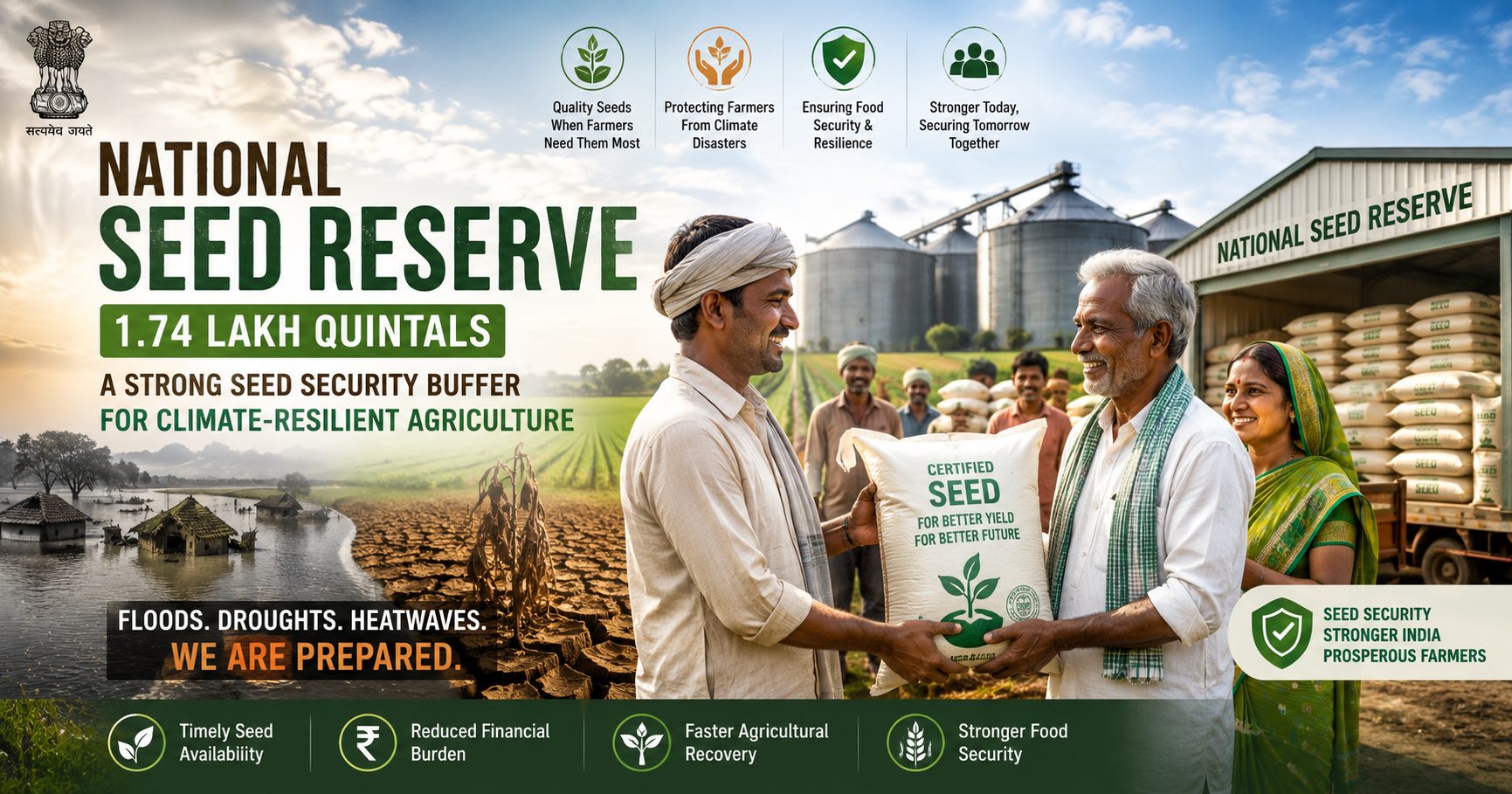
National Seed Reserve of 1.74 Lakh Quintals: A Major Shield Against Climate-Induced Seed Losses
Introduction
Climate change is increasingly disrupting agricultural systems across India. Unpredictable rainfall, floods, droughts, heatwaves, cyclones, and other extreme weather events often destroy stored seeds and standing crops, leaving farmers without quality planting material for the next season.
To address this growing challenge, the Government of India has established an emergency National Seed Reserve of 1.74 lakh quintals. This strategic seed security buffer is designed to ensure that farmers have access to quality seeds even when climate disasters lead to large-scale seed mortality.
The initiative represents a significant step toward strengthening agricultural resilience, protecting farmer livelihoods, and ensuring uninterrupted food production.
Why Seed Security Matters in Modern Agriculture
Seeds Are the Foundation of Food Production
Every agricultural season begins with access to quality seeds. When farmers lose seeds due to floods, droughts, or storage damage, the impact extends beyond individual farms and affects regional food production.
Without timely access to replacement seeds, farmers may:
- Miss critical sowing windows
- Experience reduced productivity
- Face increased financial stress
- Depend on expensive emergency seed purchases
- Delay crop cultivation
Climate Change Is Increasing Seed Vulnerability
Extreme weather events are becoming more frequent and intense. Seed stocks stored at farms and local institutions can be damaged by:
- Flooding
- Excessive moisture
- Heat stress
- Pest outbreaks
- Cyclones
- Prolonged drought conditions
The National Seed Reserve acts as a safeguard against these risks.
Understanding the National Seed Reserve
What Is the Seed Security Buffer?
The National Seed Reserve is a strategic emergency stockpile of certified seeds maintained to support farmers during crises.
The reserve ensures that replacement seeds can be supplied quickly when climate-related disasters cause large-scale seed losses.
Scale of the Initiative
The reserve contains approximately 1.74 lakh quintals of seeds, making it one of the most significant agricultural preparedness measures aimed at strengthening India's seed ecosystem.
This buffer helps ensure continuity in agricultural operations across multiple states and agro-climatic regions.
How Farmers Benefit from the Seed Reserve
Timely Access to Seeds
One of the biggest challenges after natural disasters is obtaining quality seeds before the sowing season ends.
The reserve enables rapid seed distribution, helping farmers resume cultivation without significant delays.
Reduced Financial Burden
Emergency seed purchases can be expensive, especially for small and marginal farmers.
Government-supported seed availability can reduce economic pressure and help maintain farm profitability.
Improved Agricultural Recovery
Faster access to seeds means:
- Quicker re-sowing
- Reduced crop loss
- Better seasonal productivity
- Improved farm resilience
Enhanced Food Security
When farmers can quickly restore cultivation after disasters, food production remains more stable, benefiting consumers and the broader economy.
Role of Climate-Resilient Agriculture
Building Long-Term Agricultural Stability
The seed reserve is not just an emergency response mechanism. It is part of a broader climate adaptation strategy focused on:
- Risk reduction
- Disaster preparedness
- Sustainable agriculture
- Food security enhancement
Supporting Climate-Smart Farming
Future agricultural resilience requires a combination of:
- Quality seeds
- Improved irrigation systems
- Digital advisory services
- Weather intelligence
- Sustainable farming practices
The seed reserve strengthens one of the most critical pillars of climate-smart agriculture.
Challenges and Areas for Further Improvement
Efficient Distribution Systems
The success of the reserve depends on rapid delivery mechanisms that can reach farmers immediately after climate-related disruptions.
Regional Seed Diversity
Different regions require different crop varieties. Maintaining adequate diversity within the reserve will be essential for effectiveness.
Farmer Awareness
Many farmers may not be aware of available emergency support systems. Awareness campaigns and digital platforms can improve access and utilization.
The Future of Seed Security in India
India's agricultural sector faces increasing climate uncertainty. Strategic interventions such as the National Seed Reserve demonstrate proactive planning and commitment to farmer welfare.
As climate risks continue to evolve, stronger seed systems, improved storage infrastructure, and technology-driven agricultural intelligence will become increasingly important.
The establishment of a 1.74 lakh quintal seed reserve is a positive step toward creating a more resilient, productive, and secure agricultural future.
Conclusion
The National Seed Reserve serves as a critical safety net for farmers facing climate-induced seed mortality. By ensuring timely access to quality seeds during emergencies, the initiative strengthens agricultural resilience, protects livelihoods, and supports national food security.
As climate challenges grow, preparedness measures such as seed security buffers will play a vital role in safeguarding India's farming community.
Register on https://www.agriboz.com and stay connected with innovations, policies, expert insights, and opportunities shaping the future of Indian agriculture.
CTA
Explore the Agriculture Intelligence Platform of Bharat - AGRIBOZ
Access agricultural insights, policy updates, expert guidance, training opportunities, and ecosystem support designed to help farmers, agripreneurs, trainers, and agriculture stakeholders thrive in a changing climate.
Register on https://www.agriboz.com
FAQ
What is the National Seed Reserve?
It is an emergency stockpile of quality seeds maintained to support farmers when climate disasters cause large-scale seed losses.
How large is the reserve?
The government has established a reserve of approximately 1.74 lakh quintals of seeds.
Why is the seed reserve important?
It helps ensure timely seed availability, reduces farmer losses, and supports agricultural recovery after disasters.
How does climate change affect seed availability?
Floods, droughts, heatwaves, and other extreme weather events can destroy stored seeds and disrupt planting schedules.
How does this initiative support food security?
By enabling quick restoration of crop cultivation after disasters, the reserve helps maintain agricultural production and food supply stability.
Explore the Agriculture Intelligence Platform of Bharat - AGRIBOZ
Stay ahead with agriculture policy updates, climate-smart farming insights, expert-led workshops, networking opportunities, and agribusiness intelligence.
Register on https://www.agriboz.com
Q1. What is the purpose of the National Seed Reserve? A. It ensures emergency seed availability for farmers affected by climate-related disasters and seed mortality.
Q2. How much seed has been reserved under the initiative? A. The government has established a reserve of approximately 1.74 lakh quintals of seeds.
Q3. Which farmers benefit from this reserve? A. Farmers impacted by floods, droughts, cyclones, heatwaves, and other climate-related disruptions can benefit from emergency seed support.
Q4. How does the reserve improve agricultural resilience? A. It enables timely re-sowing, reduces production losses, and supports faster recovery after disasters.
Q5. Why is seed security important for India? A. Reliable access to quality seeds is essential for stable crop production, farmer income protection, and national food security.