
Monsoon Paralysis: Why the Southwest Monsoon Stalled Over Maharashtra and What a 38–41% Rainfall Deficit Means for India
A major slowdown in the Southwest Monsoon over southern Maharashtra has raised concerns across India's agricultural landscape. With an estimated early-June rainfall deficit of 38–41%, farmers, policymakers, and agri-businesses are closely monitoring the situation. Here's what the monsoon stall means for crops, water resources, and rural livelihoods.
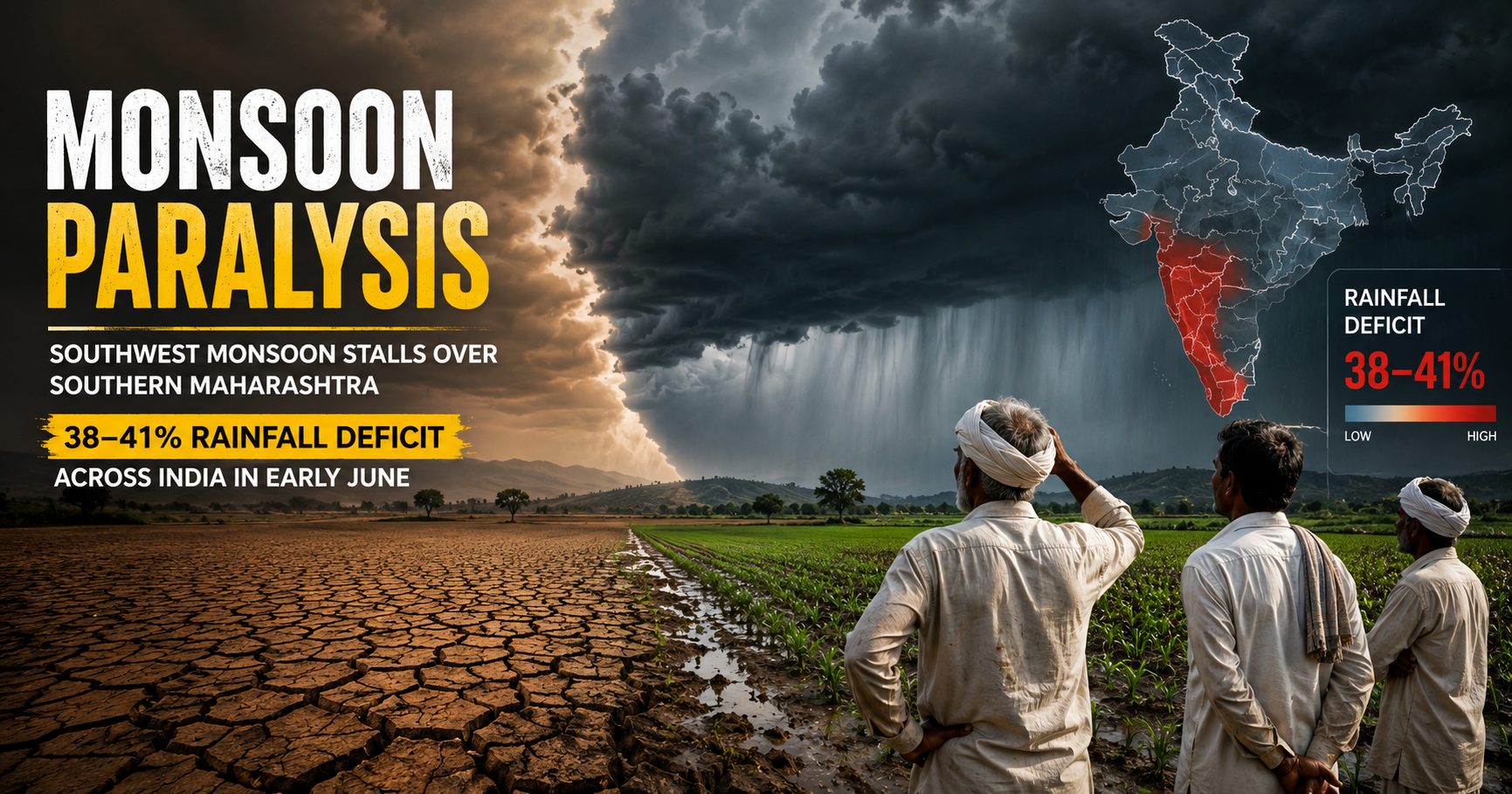
Monsoon Paralysis: The Southwest Monsoon Faces a Major Slowdown Over Maharashtra
The Southwest Monsoon is the lifeline of Indian agriculture. Every year, millions of farmers depend on its timely arrival and steady progress to begin sowing operations, replenish reservoirs, recharge groundwater, and support rural economies.
This season, however, meteorologists and agricultural stakeholders are closely watching an unusual development. The monsoon's northward advancement has slowed significantly over southern Maharashtra, contributing to a substantial rainfall deficit across large parts of the country during the early phase of June.
Reports indicate that national rainfall levels have remained considerably below seasonal expectations, creating uncertainty for farmers preparing for the crucial Kharif season.
What Does "Monsoon Paralysis" Mean?
The term "Monsoon Paralysis" refers to a situation where the monsoon system temporarily loses momentum and stops advancing as expected.
Normally, the Southwest Monsoon progresses steadily across the Indian subcontinent after entering Kerala. However, atmospheric conditions can occasionally create barriers that weaken moisture transport and suppress rainfall activity.
When this occurs:
- Rain-bearing systems become weaker.
- Cloud formation reduces.
- Rainfall distribution becomes uneven.
- Agricultural operations face delays.
- Water resource planning becomes more difficult.
While temporary monsoon stalls are not unprecedented, their timing during the early sowing season can significantly affect agricultural planning.
What May Be Causing the Monsoon Slowdown?
Meteorologists often identify several atmospheric factors that can contribute to a stalled monsoon phase:
1. Weak Moisture Flow
The monsoon depends on strong moisture-laden winds from the Arabian Sea and Bay of Bengal. Any weakening in these flows can reduce rainfall intensity and geographic spread.
2. Atmospheric Stability
When the atmosphere becomes unusually stable, vertical cloud development is suppressed. This limits thunderstorm formation and widespread rainfall.
3. Large-Scale Weather Patterns
Global climate influences such as ocean temperature anomalies, pressure systems, and circulation patterns can alter monsoon behavior and temporarily slow its progression.
4. Break-Like Conditions
At times, the monsoon enters a pause phase where rainfall decreases across many regions before becoming active again.
Impact on Indian Agriculture
Agriculture remains the sector most sensitive to monsoon fluctuations.
Delayed Kharif Sowing
Farmers often begin sowing immediately after receiving adequate rainfall. A prolonged deficit may delay planting of:
- Soybean
- Cotton
- Paddy
- Pulses
- Maize
Delayed sowing can shorten crop growth duration and potentially affect productivity.
Increased Input Risk
When rainfall becomes uncertain, farmers face difficult decisions regarding:
- Seed purchases
- Fertilizer applications
- Land preparation
- Irrigation investments
Mistimed decisions can increase production costs.
Water Availability Concerns
Reduced rainfall affects:
- Farm ponds
- Reservoirs
- Canal systems
- Groundwater recharge
Regions already facing water stress become particularly vulnerable.
Which Crops Are Most Vulnerable?
Paddy
Rice cultivation requires reliable moisture during nursery preparation and transplanting stages.
Soybean
Soybean growers depend heavily on timely early-season rainfall for successful germination.
Cotton
Cotton can tolerate short dry spells, but prolonged moisture shortages during establishment may reduce plant vigor.
Pulses
Many pulse crops are sensitive during germination and early vegetative growth.
Potential Economic Consequences
A significant rainfall deficit can create ripple effects throughout the economy.
Possible impacts include:
- Reduced agricultural output
- Higher irrigation costs
- Pressure on food prices
- Lower rural incomes
- Increased demand for drought-management measures
Since agriculture contributes substantially to rural employment and economic activity, monsoon performance remains a closely watched indicator.
What Farmers Can Do Right Now
While rainfall patterns remain uncertain, proactive planning can reduce risk.
Strengthen Water Conservation
Farmers should prioritize:
- Farm ponds
- Rainwater harvesting structures
- Mulching
- Soil moisture conservation practices
Diversify Crop Choices
In areas facing persistent uncertainty, diversified cropping systems may provide better resilience than dependence on a single crop.
Follow Weather Advisories
Regular monitoring of official weather updates can help farmers make informed sowing and irrigation decisions.
Use Quality Seeds
Certified seeds with strong germination potential can improve establishment when rainfall windows become shorter.
Explore Climate-Smart Practices
Techniques such as precision irrigation, integrated nutrient management, and resilient crop planning can improve adaptability.
What Happens Next?
The future trajectory of the monsoon will determine whether the current rainfall deficit remains a short-term concern or develops into a larger agricultural challenge.
Historically, monsoon systems have often recovered after temporary pauses. However, the duration of the slowdown and the speed of recovery will be critical factors influencing Kharif crop prospects across India.
Agricultural stakeholders, weather agencies, agritech companies, and farmers will continue monitoring developments closely over the coming weeks.
The Bottom Line
The slowdown of the Southwest Monsoon over southern Maharashtra has triggered concern due to a substantial early-season rainfall deficit across India. Although temporary monsoon stalls can occur naturally, their impact during the Kharif sowing period can be significant.
For farmers, preparedness is the best strategy. Water conservation, timely weather monitoring, crop diversification, and informed decision-making can help reduce risk while waiting for monsoon activity to strengthen.
As the season unfolds, the resilience of India's agricultural ecosystem will once again be tested by the behavior of its most important weather system—the Southwest Monsoon.
Q1. What is meant by Monsoon Paralysis? A. It refers to a temporary slowdown or halt in the normal advancement of the Southwest Monsoon, resulting in reduced rainfall across affected regions.
Q2. Why is the rainfall deficit important for farmers? A. Rainfall deficits can delay sowing, reduce soil moisture, increase irrigation costs, and affect crop establishment.
Q3. Which crops are most affected by delayed monsoon rainfall? A. Paddy, soybean, cotton, maize, and several pulse crops are particularly sensitive during early growth stages.
Q4. Can the monsoon recover after a stall? A. Yes. Temporary slowdowns can be followed by renewed monsoon activity. The timing and strength of recovery are key factors.
Q5. How can farmers prepare during uncertain monsoon conditions? A. Farmers can focus on water conservation, weather monitoring, quality seeds, crop diversification, and climate-smart farming practices.
Q6. Does a rainfall deficit always lead to lower yields? A. Not necessarily. Crop outcomes depend on how long the deficit lasts, subsequent rainfall distribution, irrigation availability, and farm management practices.
Stay ahead of changing weather patterns with AGRIBOZ.
Join the AGRIBOZ ecosystem to access:
✓ Agriculture workshops ✓ Expert farming guidance ✓ Climate-smart farming strategies ✓ Farm business opportunities ✓ Agri-training programs ✓ Rural entrepreneurship networks
Whether you are a farmer, agripreneur, trainer, or agriculture enthusiast, AGRIBOZ helps you build resilience and grow sustainably.
Register today and become part of India's next-generation agricultural community. https://www.agriboz.com