Monsoon Crisis 2026: India's Weakest June Rainfall Start Threatens Kharif Farming and Food Security
India's 2026 southwest monsoon has started with one of the sharpest rainfall deficits in recent decades, raising concerns over Kharif sowing, groundwater recharge, food inflation, and farmer incomes. Discover what this means for agriculture and how farmers can reduce risks through better planning.
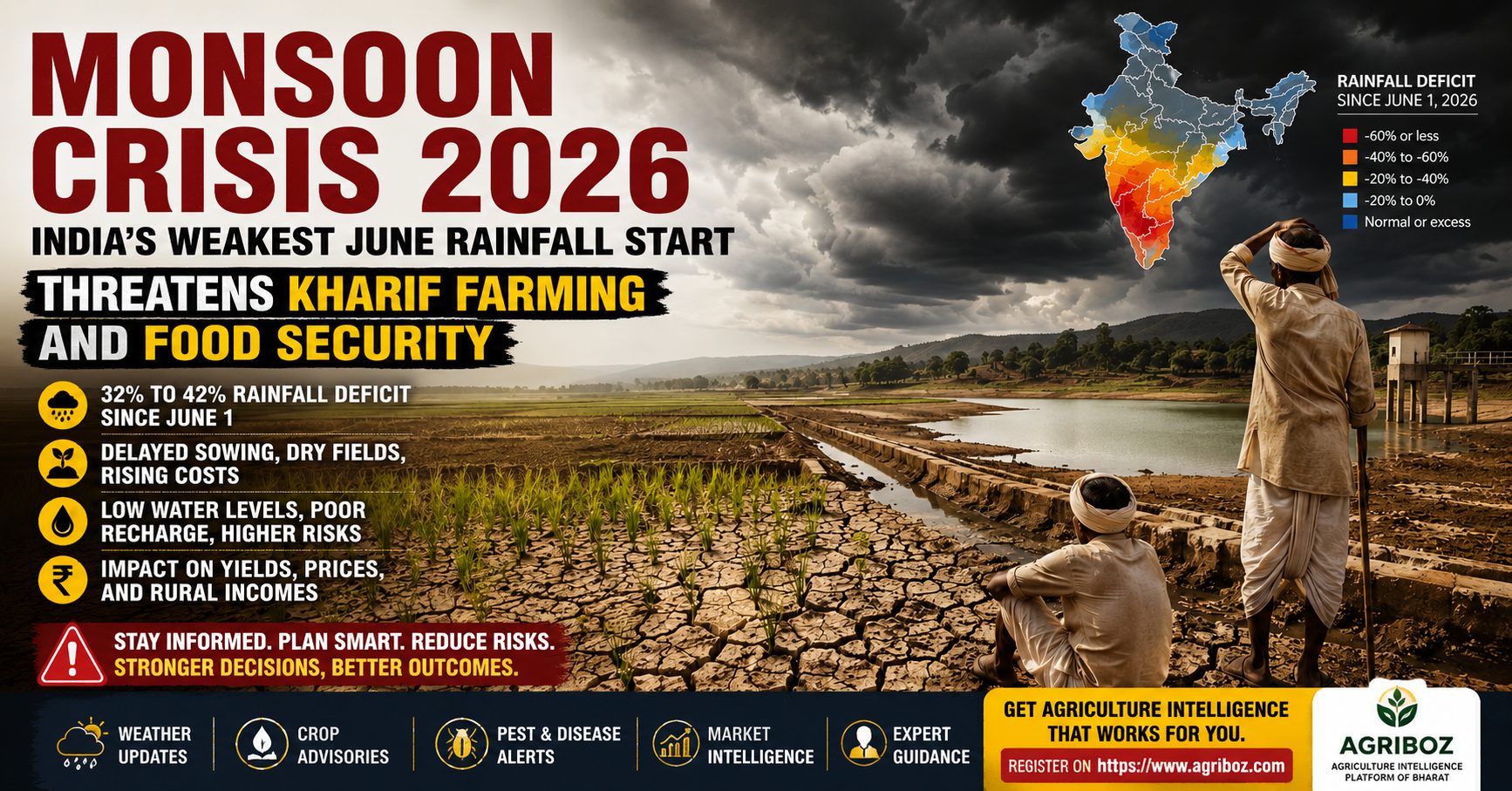
Monsoon Crisis 2026: Weak June Rainfall Puts India's Agriculture Under Pressure
India's southwest monsoon is the backbone of the country's agriculture, supporting nearly half of the cultivated land that depends entirely on rainfall. A delayed or weak monsoon can quickly affect sowing schedules, water availability, crop productivity, and rural incomes.
The 2026 monsoon season has begun on a worrying note. Rainfall during the opening weeks of June remained significantly below the long-period average across much of the country. Although weather systems are expected to improve conditions later in the season, the weak start has already created uncertainty for millions of farmers preparing for the Kharif season.
Why the Weak Start Matters
Nearly 52 percent of India's net sown area relies on monsoon rainfall.
A prolonged rainfall deficit can affect:
Delayed Kharif sowing
Farmers postpone sowing of paddy, soybean, cotton, maize, pulses, and groundnut until adequate soil moisture becomes available.
Reduced soil moisture
Dry fields reduce seed germination and increase the risk of poor crop establishment.
Lower groundwater recharge
Weak early rainfall delays the replenishment of wells, ponds, reservoirs, and irrigation systems.
Rising cultivation costs
Repeated sowing, additional irrigation, and higher diesel consumption increase production expenses.
Crops Most Vulnerable
Certain crops are highly sensitive to delayed rainfall.
Paddy
Nursery preparation and transplantation depend heavily on timely rainfall.
Soybean
Late sowing can significantly reduce yield potential.
Cotton
Moisture stress during germination often leads to uneven crop establishment.
Pulses
Moong, urad, and arhar may require revised sowing windows depending on rainfall progression.
Maize
Poor soil moisture during emergence affects plant population and final productivity.
Economic Impact Beyond Farms
A weak monsoon influences far more than agriculture.
Food Inflation
Lower crop production can increase prices of cereals, pulses, vegetables, and edible oils.
Rural Income
Reduced yields directly affect farm profitability and rural purchasing power.
Livestock
Fodder shortages and reduced pasture growth impact dairy and livestock production.
Water Availability
Cities and villages alike depend on healthy monsoon recharge for drinking water supplies.
What Farmers Should Do Now
Although the season has started slowly, panic is not the solution. Farmers should focus on adaptive management.
Monitor Official Weather Advisories
Regularly check district-level forecasts before sowing.
Use Suitable Crop Varieties
Choose short-duration or drought-tolerant varieties where rainfall remains uncertain.
Practice Moisture Conservation
Adopt mulching, residue retention, ridge-and-furrow planting, and conservation tillage.
Plan Irrigation Efficiently
Use available water carefully during crop establishment.
Avoid Premature Sowing
Waiting for stable rainfall often reduces the risk of crop failure.
The Importance of Digital Agriculture
Climate variability is becoming the new normal. Modern farming increasingly depends on timely information rather than assumptions.
Digital agriculture platforms help farmers receive:
Weather intelligence
Crop-specific advisories
Pest and disease alerts
Market information
Expert guidance
Access to reliable information enables farmers to make informed decisions that reduce production risks.
Looking Ahead
Meteorological agencies expect monsoon activity to improve after the initial slowdown. While a weak start creates challenges, the overall season will depend on rainfall distribution during July and August, the most critical months for Kharif crops.
Farmers should remain alert, follow official advisories, and adapt their field operations according to changing weather conditions rather than relying solely on seasonal averages.
Conclusion
The opening phase of India's 2026 southwest monsoon highlights how closely agriculture depends on weather. A slow beginning does not necessarily determine the outcome of the entire season, but it emphasizes the importance of preparedness, scientific farming, and timely decision-making.
As climate variability increases, access to reliable agricultural intelligence will become as important as rainfall itself.
Register on https://www.agriboz.com and stay connected with expert advisories, agricultural intelligence, and practical farming solutions.
AGRIBOZ CTA
Explore the Agriculture Intelligence Platform of Bharat - AGRIBOZ
Whether you are a farmer, agripreneur, agriculture student, FPO, trainer, or agribusiness professional, AGRIBOZ provides knowledge, learning opportunities, expert guidance, and a growing agricultural ecosystem designed to help you succeed.
Register on https://www.agriboz.com today and become part of India's agriculture intelligence movement.
Explore the Agriculture Intelligence Platform of Bharat - AGRIBOZ
Get access to agriculture news, expert crop advisories, workshops, farm retreats, learning resources, and a nationwide agricultural community.
Register on https://www.agriboz.com today.
Q1. Why is the weak start of the monsoon important?
Because delayed rainfall affects Kharif sowing, soil moisture, irrigation availability, and overall crop productivity.
Q2. Which crops are most affected by delayed monsoon?
Paddy, soybean, cotton, maize, pulses, and groundnut are among the most vulnerable.
Q3. Can the monsoon recover after a weak June?
Yes. A weak beginning does not necessarily mean a poor overall season. July and August rainfall often determine the final agricultural outcome.
Q4. How can farmers reduce monsoon-related risks?
By following weather advisories, choosing suitable crop varieties, conserving soil moisture, and using scientific crop planning.
Q5. How can AGRIBOZ help farmers?
AGRIBOZ provides agricultural intelligence, expert guidance, workshops, digital learning, crop advisories, and a collaborative ecosystem for farmers and agripreneurs.