
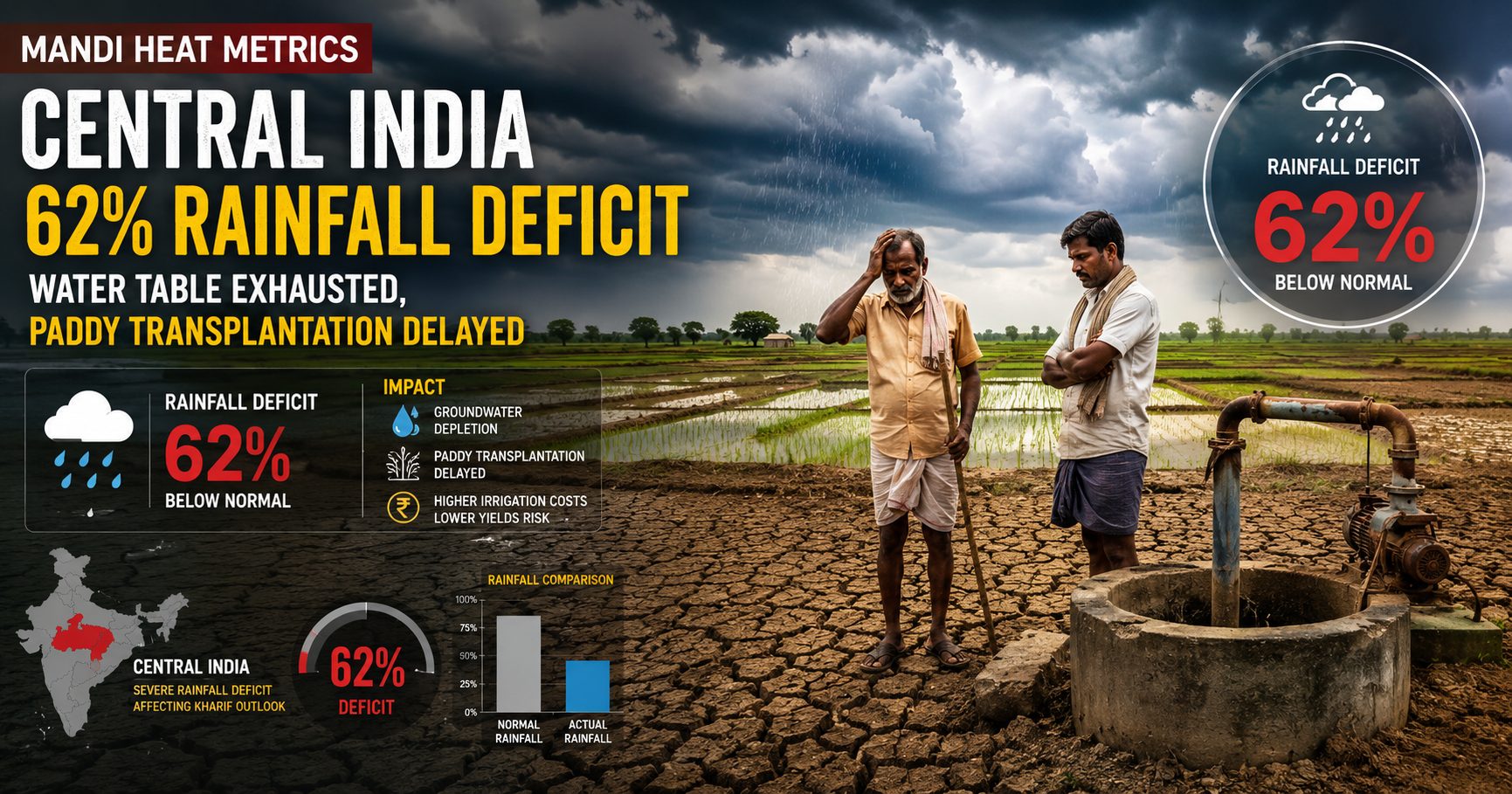
Mandi Heat Metrics: Central India Faces 62% Rainfall Deficit, Delaying Paddy Transplantation and Straining Water Resources
A severe 62% localized rainfall deficit across parts of Central India is accelerating water table depletion and disrupting the traditional paddy transplantation calendar. Farmers are facing rising irrigation costs, increased crop establishment risks, and growing uncertainty around kharif season productivity. Understanding the implications and adopting adaptive strategies is now critical for agricultural resilience.
Mandi Heat Metrics: Central India Faces 62% Rainfall Deficit, Delaying Paddy Transplantation and Straining Water Resources
Introduction
Central India's agricultural landscape is facing a significant challenge as localized regions report a severe 62% rainfall deficit. The situation is rapidly affecting groundwater reserves, creating water stress across farming communities, and delaying traditional paddy transplantation activities.
For rice-growing regions that depend heavily on timely monsoon rainfall, every week of delay can influence crop establishment, productivity, labor planning, and market dynamics. The current weather pattern is becoming a major concern for farmers, agri-businesses, policymakers, and mandi participants alike.
Understanding the 62% Rainfall Deficit
What Does a Rainfall Deficit Mean?
A rainfall deficit occurs when actual precipitation falls significantly below the long-term average for a region. A 62% deficit indicates that farmers have received only a fraction of the expected monsoon rainfall required for normal agricultural operations.
Why This Matters for Agriculture
Rainfall directly influences:
- Soil moisture availability
- Groundwater recharge
- Surface water storage
- Irrigation scheduling
- Crop establishment success
- Input utilization efficiency
When rainfall remains substantially below normal, agricultural operations become increasingly dependent on groundwater extraction.
Immediate Impact on Water Tables
Accelerated Groundwater Depletion
The absence of sufficient rainfall has forced many farmers to rely heavily on tube wells and borewells. Continuous pumping without natural recharge is rapidly lowering groundwater levels.
Rising Irrigation Costs
As water tables fall:
- Pumping depth increases
- Electricity consumption rises
- Diesel expenses increase
- Irrigation frequency becomes more expensive
This directly affects farm profitability, especially for small and marginal farmers.
Increased Risk of Water Scarcity
Regions already experiencing water stress may face severe shortages if rainfall patterns do not improve during the remaining monsoon period.
Delayed Paddy Transplantation Across Key Farming Regions
Why Timing Matters in Paddy Cultivation
Paddy transplantation traditionally follows the arrival of adequate monsoon rains. Delays disrupt the entire crop calendar.
Farmers depend on sufficient standing water for:
- Nursery establishment
- Field puddling
- Seedling transplantation
- Early crop growth
Consequences of Delayed Transplantation
Delayed paddy planting can lead to:
- Reduced yield potential
- Higher pest and disease exposure
- Increased irrigation dependence
- Harvest delays
- Market timing challenges
In extreme cases, prolonged delays may force farmers to reconsider crop choices altogether.
Market Implications and Mandi Outlook
Potential Supply-Side Concerns
If rainfall deficits continue, paddy acreage and productivity may decline in affected regions. This can influence future rice availability and mandi arrivals.
Input Demand Changes
Farmers may increase demand for:
- Drought-tolerant varieties
- Water-saving technologies
- Crop advisory services
- Efficient irrigation systems
Price Volatility Risks
Weather-related disruptions often create uncertainty in agricultural markets. Traders and buyers will closely monitor rainfall recovery and crop progress over the coming weeks.
Adaptive Strategies for Farmers
Improve Water Management
Farmers should focus on:
- Field leveling
- Mulching practices
- Alternate wetting and drying techniques
- Efficient irrigation scheduling
Consider Crop Diversification
Where water availability becomes a major constraint, alternative crops with lower water requirements may provide better economic stability.
Monitor Weather Intelligence
Real-time weather monitoring allows farmers to make better decisions regarding:
- Transplantation timing
- Irrigation planning
- Fertilizer application
- Pest management
Adopt Climate-Smart Agriculture
Climate variability is becoming a recurring challenge. Long-term resilience requires:
- Water conservation structures
- Farm ponds
- Rainwater harvesting
- Soil health improvement
- Precision agriculture practices
The Role of Agricultural Intelligence Platforms
Data-Driven Farming Decisions
In an environment of increasing climate uncertainty, access to reliable agricultural intelligence is becoming essential.
Farmers need:
- Weather forecasts
- Market intelligence
- Crop advisory support
- Water management insights
- Risk mitigation strategies
Building Resilience Through Information
Timely information helps farmers reduce uncertainty, optimize resources, and improve decision-making during difficult seasons.
Conclusion
The reported 62% localized rainfall deficit in Central India is a serious agricultural development with immediate implications for groundwater resources and paddy transplantation schedules. As water tables decline and traditional crop calendars face disruption, proactive planning becomes critical.
Farmers who adopt efficient water management, climate-smart practices, and data-driven decision-making will be better positioned to navigate the current season's challenges.
Register on https://www.agriboz.com and stay informed with actionable agricultural intelligence, market insights, weather intelligence, and expert-driven farming guidance.
CTA
Explore the Agriculture Intelligence Platform of Bharat - AGRIBOZ
Access agriculture intelligence, weather updates, market insights, expert guidance, workshops, networking opportunities, and innovative farming knowledge designed for the future of Indian agriculture.
Register on https://www.agriboz.com
FAQ
How does a rainfall deficit affect paddy cultivation?
A significant rainfall deficit reduces soil moisture and water availability, making paddy transplantation difficult and increasing irrigation dependence.
Why are groundwater levels falling rapidly?
Farmers are extracting more groundwater to compensate for inadequate rainfall, while natural recharge remains limited.
Can delayed paddy transplantation reduce yields?
Yes. Delayed transplantation can shorten the effective growing period and increase exposure to weather, pest, and disease risks.
What can farmers do during prolonged rainfall deficits?
Farmers can improve irrigation efficiency, conserve water, monitor weather forecasts, and consider climate-resilient farming strategies.
Why is agricultural intelligence important during climate uncertainty?
Accurate information helps farmers make better decisions regarding crop planning, water management, input use, and market timing.
Explore the Agriculture Intelligence Platform of Bharat - AGRIBOZ
Get access to agriculture intelligence, weather insights, mandi trends, expert guidance, workshops, farm business opportunities, and a growing ecosystem built for Bharat's farmers and agri-entrepreneurs.
Register on https://www.agriboz.com
Q1. What does a 62% rainfall deficit indicate? It means the affected region has received substantially less rainfall than the historical average, creating significant agricultural stress.
Q2. Why is paddy transplantation being delayed? Paddy cultivation requires adequate water availability. Insufficient rainfall delays field preparation and seedling transplantation.
Q3. How does groundwater depletion impact farming? Lower groundwater levels increase irrigation costs, reduce water availability, and create long-term sustainability concerns.
Q4. Will the rainfall deficit affect rice production? If the deficit persists, rice acreage and productivity may be impacted in some regions.
Q5. How can farmers reduce risk during water shortages? Efficient irrigation, rainwater harvesting, climate-smart practices, and timely agricultural intelligence can help reduce risk.