
KisaanSay Samagam 2026: Women-Led FPCs Driving Corporate Contract Farming Growth in India
KisaanSay Samagam 2026 placed women-led Farmer Producer Companies at the center of India's next agricultural transformation. The summit showcased how organized women farmers are becoming trusted partners for corporate buyers seeking quality, traceability, and sustainable supply chains.
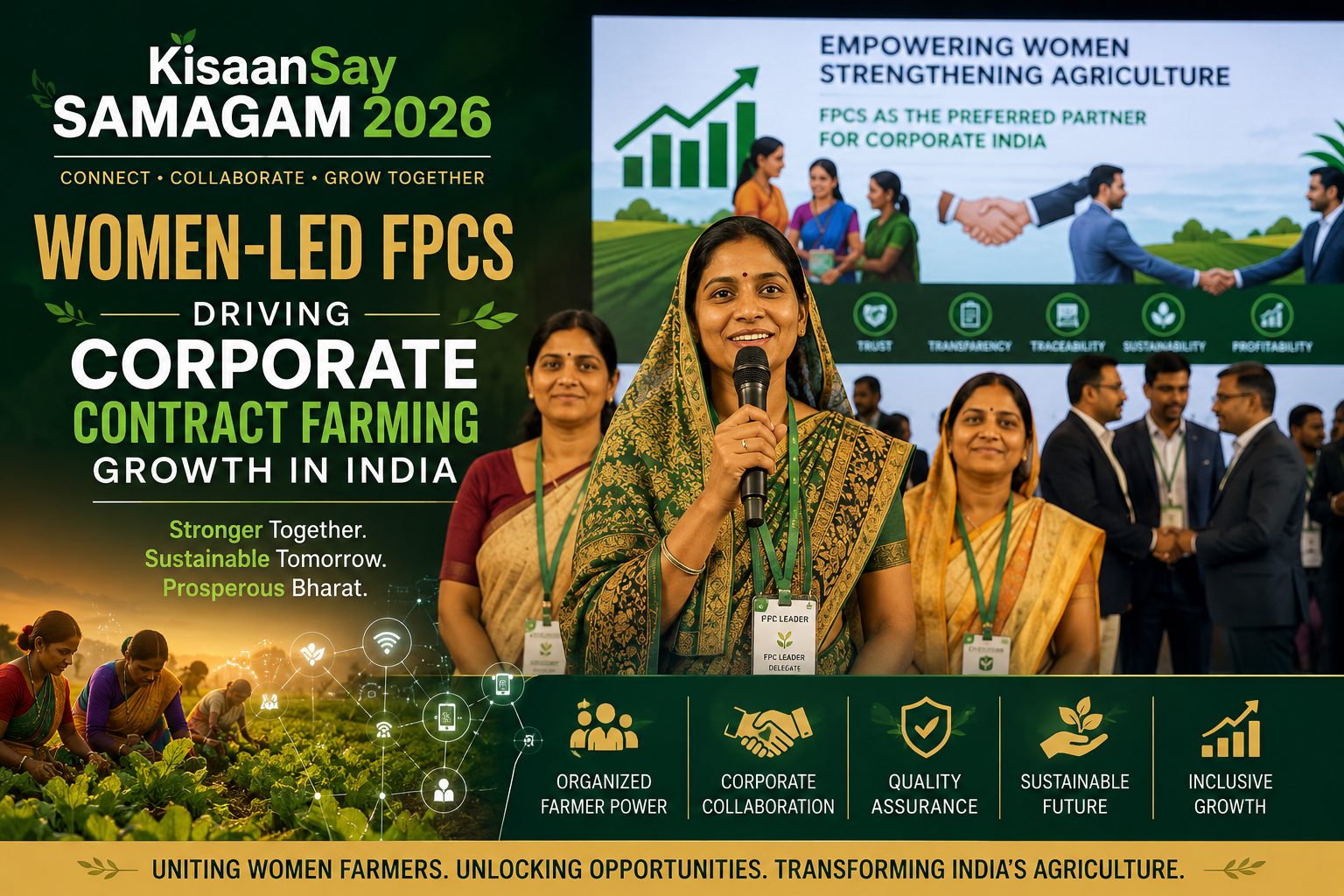
KisaanSay Samagam 2026: Flagship New Delhi Summit Highlights Women-Led FPCs as the Preferred Vehicle for Corporate Contract Farming
A Defining Moment for India's Agricultural Future
India's agricultural transformation is increasingly being shaped not only by technology and markets but also by leadership emerging from rural communities.
At KisaanSay Samagam 2026 in New Delhi, one message stood out clearly: women-led Farmer Producer Companies (FPCs) are becoming the preferred structure for corporate contract farming partnerships.
This shift reflects a deeper evolution in India's agri-economy—one where organized farmer groups, transparency, traceability, and inclusive growth are becoming critical business requirements.
For farmers, entrepreneurs, agribusinesses, and rural leaders, this development opens significant opportunities.
Readers interested in practical agriculture opportunities, farmer networks, and rural business ecosystems can explore AGRIBOZ here: https://www.agriboz.com
---
Why Corporate Buyers Are Re-Evaluating Contract Farming Models
For years, corporate contract farming often struggled with challenges such as:
- Fragmented landholdings
- Inconsistent supply
- Quality variations
- Traceability issues
- Farmer engagement gaps
- Operational inefficiencies
Large buyers increasingly require:
- Reliable volumes
- Standardized quality
- Digital records
- Sustainability compliance
- Transparent procurement systems
Working with thousands of individual farmers can become operationally complex.
This is where Farmer Producer Companies create value.
FPCs aggregate production, streamline communication, improve bargaining power, and provide a structured framework for market engagement.
---
Why Women-Led FPCs Are Gaining Strong Corporate Confidence
The discussions at KisaanSay Samagam 2026 highlighted a growing trend across multiple agricultural value chains.
Women-led FPCs are demonstrating strengths that align closely with corporate procurement expectations.
These include:
1. Strong Community Trust
Women leaders often possess deep social connections within farming communities.
This trust can improve farmer participation, adoption of best practices, and long-term program stability.
2. Better Collective Decision-Making
Many successful women-led groups have shown strong collaborative governance models.
For corporate partners, predictable governance reduces operational risk.
3. Focus on Quality and Compliance
Women-led organizations frequently excel in:
- Record keeping
- Group coordination
- Quality monitoring
- Traceability systems
These capabilities are increasingly important in domestic and export markets.
4. Long-Term Sustainability
Corporates are moving beyond short-term procurement relationships.
They seek sustainable supply ecosystems that can grow over time.
Women-led FPCs are increasingly viewed as strategic partners rather than simple sourcing channels.
---
The Bharat Market Reality
India's rural economy is changing rapidly.
Farmers are no longer satisfied with selling commodities alone.
They are exploring:
- Value addition
- Direct market access
- Processing opportunities
- Branding initiatives
- Digital agriculture
- Agri-tourism ventures
Women are playing a larger role in these emerging models.
As rural entrepreneurship expands, women-led FPCs can become engines of local economic development.
This is particularly relevant for regions seeking to increase rural incomes while maintaining agricultural sustainability.
---
How FPCs Can Unlock New Revenue Streams
The discussion extended beyond traditional crop procurement.
Experts emphasized that future-ready FPCs can participate in:
- Food processing
- Specialty crops
- Organic value chains
- Seed production
- Input distribution
- Agri-export programs
- Rural tourism initiatives
- Climate-smart agriculture projects
This creates multiple income channels for member farmers.
---
Mid-Content Opportunity: Building Future-Ready Farmer Ecosystems
Organizations, trainers, and farmer leaders looking to strengthen FPC capabilities can benefit from continuous learning and collaboration.
AGRIBOZ provides access to agriculture-focused ecosystems, knowledge-sharing opportunities, workshops, and industry connections.
Explore opportunities here:
https://www.agriboz.com
---
Strategic Insights for Farmer Groups
The summit discussions point toward several important lessons.
Invest in Governance
Strong governance remains the foundation of successful FPC growth.
Adopt Digital Systems
Digital records, member management, and traceability systems increase buyer confidence.
Build Market-Oriented Leadership
Understanding buyer requirements is as important as improving production.
Focus on Value Creation
Future success will come from delivering solutions, not just commodities.
---
Practical Example of the Emerging Model
Imagine a women-led FPC representing 2,000 smallholder farmers.
Instead of negotiating individually, farmers collectively engage with a food processing company.
The FPC manages:
- Production planning
- Quality standards
- Training programs
- Aggregation logistics
- Market coordination
The result:
- Reduced transaction costs
- Better price realization
- Improved supply reliability
- Greater farmer bargaining power
This is the model many stakeholders now see as scalable and sustainable.
---
What This Means for India's Agricultural Future
The emphasis on women-led FPCs at KisaanSay Samagam 2026 reflects a broader transition occurring across Indian agriculture.
The future is likely to be built around:
- Organized farmer networks
- Data-driven agriculture
- Inclusive leadership
- Strong rural institutions
- Corporate-farmer collaboration
- Sustainable value chains
Women-led FPCs are uniquely positioned at the intersection of these trends.
---
AGRIBOZ and the Next Generation of Rural Opportunity
As agriculture evolves, farmers and rural entrepreneurs need more than information.
They need ecosystems.
They need access to training, partnerships, mentors, markets, and opportunities.
AGRIBOZ is helping build that bridge through workshops, collaborations, rural development initiatives, and agricultural networking opportunities.
Whether you are a farmer, trainer, agri-startup founder, FPC leader, or agribusiness professional, participating in strong agricultural ecosystems can accelerate growth.
Learn more and create your account:
https://www.agriboz.com
---
The Transformation Ahead
KisaanSay Samagam 2026 may be remembered as a milestone event that reinforced a powerful idea:
The future of Indian agriculture will not be built solely through technology or capital.
It will be built through organized communities, inclusive leadership, and trusted institutions.
Women-led Farmer Producer Companies are emerging as one of the most promising vehicles for that future.
For those prepared to participate, the opportunity extends far beyond contract farming—it reaches into the next chapter of rural prosperity, agricultural entrepreneurship, and sustainable growth.
The future of agriculture belongs to organized, market-ready, opportunity-driven communities.
Whether you are a farmer, FPC leader, trainer, agribusiness entrepreneur, or rural innovator, AGRIBOZ can help you connect with the ecosystem that drives growth.
Create your AGRIBOZ account today and become part of India's next agricultural transformation.
Visit: https://www.agriboz.com
1. What is a Farmer Producer Company (FPC)?
A Farmer Producer Company is a farmer-owned organization that helps members collectively access markets, inputs, training, and better pricing opportunities.
2. Why are women-led FPCs gaining attention in India?
Women-led FPCs often demonstrate strong community engagement, governance, accountability, and quality management, making them attractive partners for corporate buyers.
3. How does contract farming benefit FPC members?
Contract farming can provide market assurance, technical support, predictable demand, and improved income opportunities when managed effectively.
4. Can small farmers join an FPC?
Yes. FPCs are specifically designed to help small and marginal farmers achieve scale and access larger market opportunities.
5. How can farmers learn more about agricultural opportunities and partnerships?
Farmers can explore knowledge resources, workshops, networking opportunities, and agricultural ecosystems through platforms like AGRIBOZ.