IIM Bangalore June 2026 ESG Report: Scope 3 Emissions Now Surpass Scope 1 & 2 for India's Top Companies
The IIM Bangalore June 2026 ESG Report reveals a major shift in corporate sustainability reporting. Disclosed Scope 3 emissions among India's top 1,000 listed companies have exceeded combined Scope 1 and Scope 2 emissions, while 57.1% of companies still fail to disclose value-chain emissions. Discover what this means for Indian businesses, ESG compliance, investors, and the future of sustainable growth.
IIM Bangalore June 2026 ESG Report: Scope 3 Emissions Have Become India's Biggest Climate Challenge
Introduction
The latest IIM Bangalore June 2026 ESG Report has uncovered one of the biggest sustainability revelations for Indian businesses.
For the first time, disclosed Scope 3 greenhouse gas emissions from India's top 1,000 listed companies have surpassed their combined Scope 1 and Scope 2 emissions.
Even more concerning, more than half of India's largest listed companies are still not reporting their value-chain emissions.
This isn't just another ESG statistic.
It signals a major transformation in how businesses, regulators, investors, suppliers, and consumers will evaluate corporate sustainability over the coming years.
If Indian companies fail to measure what happens beyond their factory gates, they may struggle with future compliance, investor confidence, and global competitiveness.
What Does the IIM Bangalore Report Reveal?
The report analyzed sustainability disclosures submitted under India's Business Responsibility and Sustainability Reporting (BRSR) framework.
Some of the most significant findings include:
Total Disclosed Scope 3 Emissions
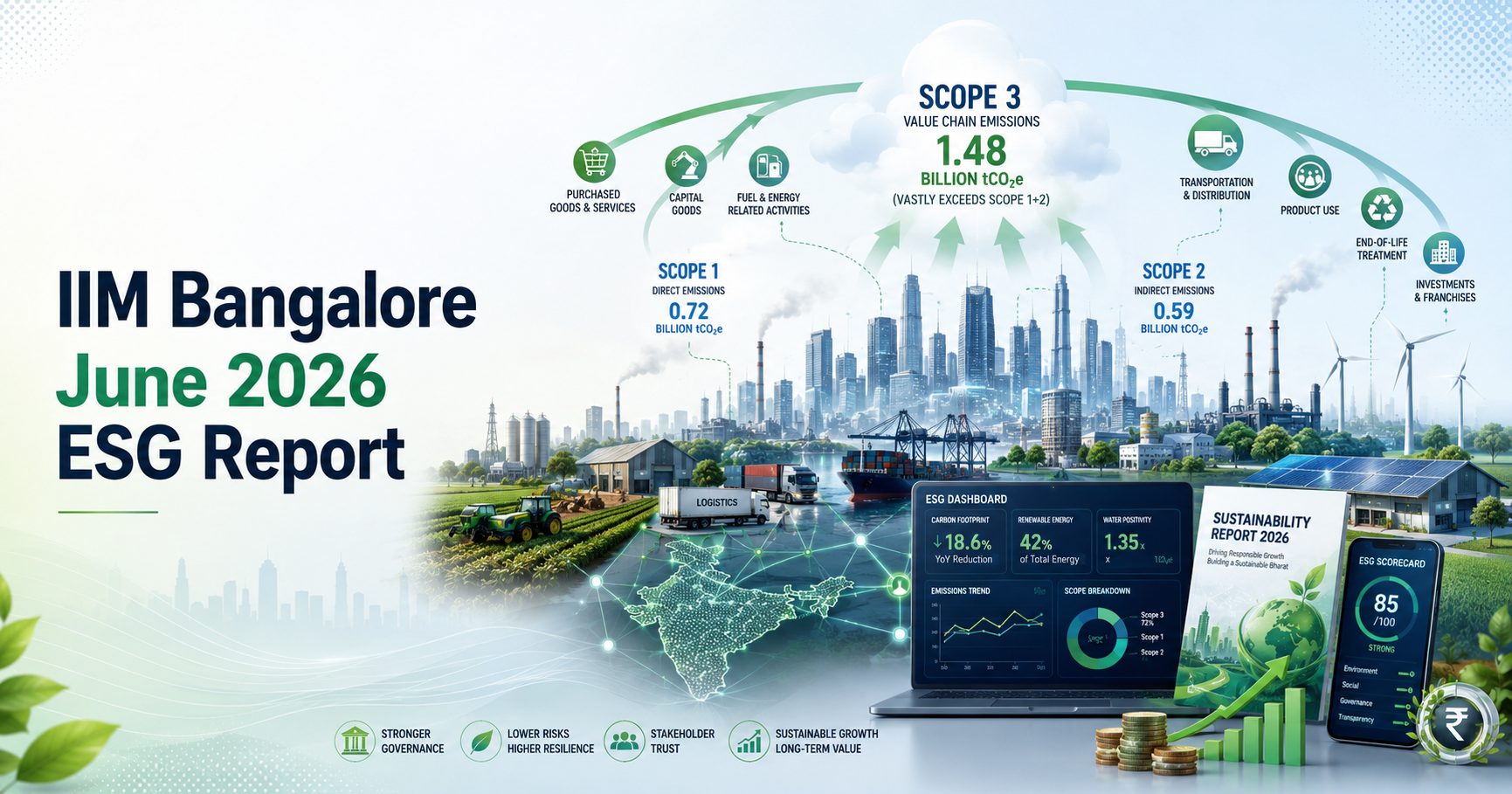
1.482 billion tonnes of CO₂ equivalent
Combined Scope 1 and Scope 2 Emissions
1.307 billion tonnes of CO₂ equivalent
This means value-chain emissions are now larger than operational emissions among companies reporting ESG data.
Why Scope 3 Matters More Than Ever
Many businesses focus primarily on emissions generated inside their facilities.
However, Scope 3 emissions often represent the largest share of a company's environmental impact.
These include:
Purchased raw materials
Emissions generated while producing inputs sourced from suppliers.
Transportation
Logistics across suppliers, distributors and customers.
Employee travel
Business travel and commuting emissions.
Product use
Emissions generated while customers use products.
Waste management
Disposal and recycling after products reach the end of their life.
For sectors like energy, manufacturing, agriculture, food processing, FMCG, and logistics, Scope 3 emissions can be several times larger than operational emissions.
The Biggest Disclosure Gap
Perhaps the most alarming statistic is disclosure itself.
Only 421 companies disclosed Scope 3 emissions.
That means 57.1% of India's top listed companies still do not report value-chain emissions.
Without reliable disclosure, companies face several challenges:
Reduced investor confidence
Global investors increasingly expect complete ESG transparency.
Supply chain risks
Large multinational buyers are demanding verified emissions data from suppliers.
Regulatory preparedness
Future reporting standards are expected to become more comprehensive.
Competitive disadvantage
Companies with poor ESG transparency may lose opportunities in international markets.
What This Means for Agriculture and Agribusiness
Agriculture has one of the largest and most complex value chains.
Emissions originate from:
Farm inputs
Fertilizers, pesticides and seeds.
Irrigation
Energy consumption and water management.
Transportation
Movement of produce from farms to markets.
Food processing
Manufacturing and packaging.
Cold chain logistics
Storage and distribution.
Retail
Final delivery to consumers.
As ESG expectations expand, agribusinesses will increasingly need to understand and measure emissions across their entire supply chain.
Why Businesses Should Act Now
Organizations that begin measuring Scope 3 emissions today will be better positioned to:
- Meet future ESG regulations
- Improve investor trust
- Strengthen supply-chain resilience
- Win international business
- Reduce operational inefficiencies
- Build long-term sustainability strategies
Waiting until disclosures become mandatory could significantly increase compliance costs.
AGRIBOZ's Role in Sustainable Agriculture
The future of agriculture is no longer defined solely by productivity.
It is increasingly measured through sustainability, transparency, and responsible resource management.
AGRIBOZ is building India's Agriculture Intelligence Platform to empower farmers, agribusinesses, professionals, researchers, trainers, and innovators with knowledge that supports smarter decision-making.
Whether you are learning about ESG, climate-smart farming, sustainable supply chains, or emerging agricultural technologies, staying informed is the first step toward future readiness.
Conclusion
The IIM Bangalore June 2026 ESG Report marks an important turning point for corporate sustainability in India.
With disclosed Scope 3 emissions now exceeding Scope 1 and Scope 2 emissions, businesses can no longer afford to ignore the environmental impact of their value chains.
At the same time, the fact that 57.1% of India's top listed companies still do not disclose Scope 3 emissions highlights a significant opportunity for improvement.
Companies that invest in transparency, data quality, and sustainable value-chain management today will be better prepared for tomorrow's regulatory, financial, and market expectations.
Explore the Agriculture Intelligence Platform of Bharat - AGRIBOZ.
Register on https://www.agriboz.com
CTA
Explore the Agriculture Intelligence Platform of Bharat - AGRIBOZ.
Discover insights on sustainable agriculture, ESG, climate-smart farming, innovation, agribusiness, research, and emerging technologies that are shaping the future of Indian agriculture.
Register on https://www.agriboz.com
FAQ
What are Scope 3 emissions?
Scope 3 emissions are indirect greenhouse gas emissions that occur throughout a company's value chain, including suppliers, logistics, product use, and disposal.
Why are Scope 3 emissions important?
They often represent the largest portion of a company's total carbon footprint and are becoming increasingly important for ESG reporting.
What percentage of India's top listed companies disclose Scope 3 emissions?
According to the IIM Bangalore June 2026 report, only 42.9% disclosed Scope 3 emissions, while 57.1% did not.
Why does this matter for agriculture?
Agriculture has extensive supply chains involving farming, transportation, processing, storage, and retail, making Scope 3 emissions particularly significant.
How can AGRIBOZ help?
AGRIBOZ provides agricultural intelligence, knowledge resources, sustainability insights, expert learning opportunities, and ecosystem participation to help stakeholders stay informed about emerging agricultural trends.
Explore the Agriculture Intelligence Platform of Bharat - AGRIBOZ.
Join thousands of agriculture professionals, farmers, entrepreneurs, researchers, trainers, startups, and agribusiness leaders who are preparing for the future of sustainable agriculture.
Register on https://www.agriboz.com
Q. What are Scope 1, Scope 2, and Scope 3 emissions?
Scope 1 are direct emissions, Scope 2 are indirect emissions from purchased energy, and Scope 3 are indirect emissions across the entire value chain.
Q. Why is Scope 3 reporting becoming important?
Investors, regulators, and global buyers increasingly expect businesses to disclose complete value-chain emissions.
Q. What did the IIM Bangalore June 2026 report reveal?
The report found that disclosed Scope 3 emissions reached 1.482 billion tonnes CO₂e, exceeding combined Scope 1 and Scope 2 emissions of 1.307 billion tonnes CO₂e.
Q. How many companies do not disclose Scope 3 emissions?
Approximately 57.1% of India's top 1,000 listed companies do not currently disclose Scope 3 emissions.
Q. Why should agribusinesses care about ESG?
Agriculture has extensive supply chains where most emissions occur, making ESG reporting increasingly important for future market access and sustainability.