ICAR-IARI Industry Directives: Precision Horticulture, Technology Commercialization & CSR to Transform Indian Agriculture
ICAR-IARI's latest industry directives emphasize rapid commercialization of agricultural technologies and CSR-funded scaling of precision horticulture systems. Discover how these initiatives can accelerate innovation, improve farm productivity, strengthen agribusiness partnerships, and support sustainable agriculture across India.
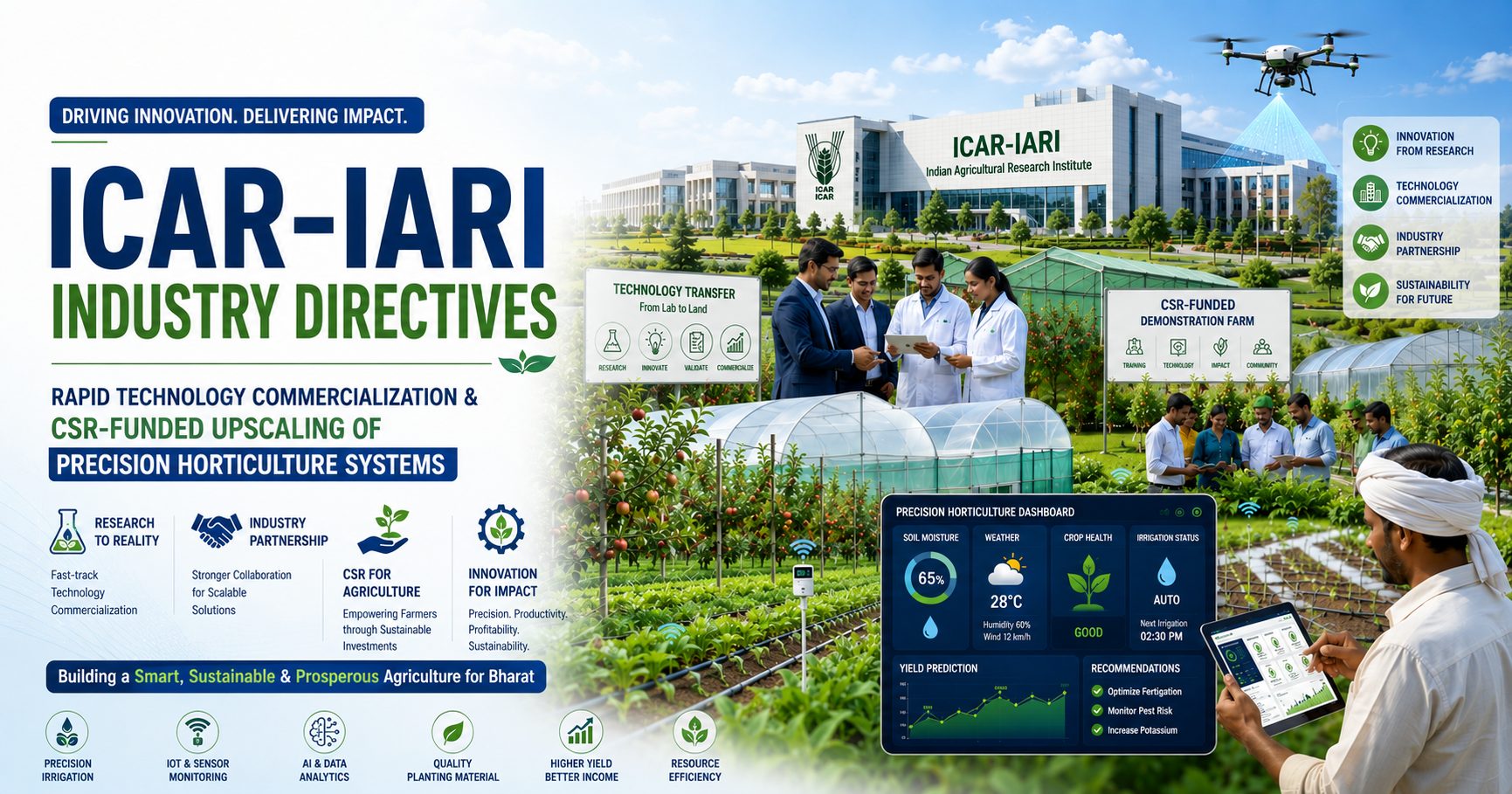
ICAR-IARI Industry Directives: Accelerating Precision Horticulture Through Technology Commercialization and CSR Partnerships
Introduction
Indian agriculture is rapidly evolving from traditional farming practices to technology-driven, data-enabled production systems. Research institutions are no longer focused solely on scientific discovery—they are increasingly expected to ensure that innovations reach farmers, agribusinesses, startups, and industry partners quickly.
Recent industry directives from ICAR-Indian Agricultural Research Institute (ICAR-IARI) reinforce this vision by encouraging the rapid commercialization of agricultural technologies and promoting Corporate Social Responsibility (CSR)-funded expansion of precision horticulture systems.
These directives highlight a growing recognition that collaboration between research institutions, private industry, and corporate CSR initiatives is essential for building a resilient, productive, and sustainable agricultural ecosystem.
Why Technology Commercialization Matters
India produces world-class agricultural research, but many innovations take years to reach farmers.
Accelerating commercialization can help bridge the gap between laboratories and fields by enabling:
Faster adoption of proven technologies
Innovations can reach growers more quickly, improving productivity and profitability.
Stronger industry partnerships
Private companies can help manufacture, distribute, and scale agricultural technologies.
Increased startup opportunities
Agritech entrepreneurs can transform research into commercially viable solutions.
Better returns on public research
Scientific discoveries generate greater impact when adopted at scale.
Precision Horticulture: The Future of High-Value Farming
Precision horticulture combines digital technologies with scientific crop management to optimize production while reducing resource use.
Key components include:
Sensor-based irrigation
Delivering water precisely where and when crops need it.
Smart fertigation
Applying nutrients efficiently to improve crop health and reduce wastage.
Remote crop monitoring
Using drones, satellites, and IoT devices to monitor crop growth and detect problems early.
Data-driven decision making
Helping farmers improve yield, quality, and resource efficiency through analytics.
Protected cultivation
Integrating precision technologies into greenhouses, shade nets, and polyhouses for consistent production.
The Role of CSR in Scaling Agricultural Innovation
Corporate Social Responsibility initiatives can accelerate the adoption of precision horticulture by supporting:
Demonstration farms
Allowing farmers to experience new technologies under real farming conditions.
Farmer capacity building
Training growers to effectively use precision agriculture tools.
Digital infrastructure
Supporting smart irrigation, weather monitoring, and farm management systems.
Research-industry collaboration
Strengthening partnerships between research institutions, agribusinesses, and technology providers.
Rural innovation ecosystems
Encouraging sustainable agricultural entrepreneurship in rural communities.
Benefits for Farmers and Agribusinesses
Wider adoption of precision horticulture can contribute to:
- Higher crop productivity
- Better water-use efficiency
- Reduced fertilizer losses
- Improved crop quality
- Lower production costs
- Enhanced climate resilience
- Stronger market competitiveness
Opportunities for the Agriculture Ecosystem
The emphasis on commercialization creates new opportunities for:
Agritech startups
Developing scalable technologies based on research innovations.
Corporate partners
Supporting agricultural transformation through impactful CSR investments.
Farmer Producer Organizations
Adopting precision technologies across member farms.
Researchers
Collaborating more closely with industry to maximize real-world impact.
Investors
Supporting innovative agricultural technologies with long-term growth potential.
AGRIBOZ's Vision for Agricultural Innovation
Innovation creates value only when knowledge reaches the people who need it most.
AGRIBOZ is building the Agriculture Intelligence Platform of Bharat to connect farmers, researchers, agritech startups, agribusinesses, industry experts, trainers, and policymakers with trusted agricultural knowledge, emerging technologies, market intelligence, and sustainability insights.
By following developments in agricultural research, precision farming, and industry collaboration, stakeholders can make better decisions and prepare for the future of Indian agriculture.
Conclusion
The ICAR-IARI industry directives underscore an important shift in India's agricultural innovation strategy—moving from research generation to research adoption.
Rapid technology commercialization, combined with CSR-supported precision horticulture initiatives, has the potential to improve productivity, strengthen sustainability, and create long-term value across the agricultural value chain.
As collaboration between research institutions, industry, and farmers grows stronger, India's horticulture sector will be better positioned to meet future challenges while enhancing food security and economic resilience.
Explore the Agriculture Intelligence Platform of Bharat - AGRIBOZ.
Register on https://www.agriboz.com
CTA
Explore the Agriculture Intelligence Platform of Bharat - AGRIBOZ.
Stay informed with the latest agricultural research, precision farming technologies, innovation trends, agribusiness opportunities, and sustainability insights.
Register on https://www.agriboz.com
FAQ
What is precision horticulture?
Precision horticulture uses technologies such as sensors, drones, IoT, automation, and analytics to improve crop management and resource efficiency.
Why is technology commercialization important?
It helps convert research innovations into practical solutions that benefit farmers, businesses, and the agricultural economy.
How can CSR support agriculture?
CSR investments can fund farmer training, demonstration projects, digital infrastructure, and adoption of sustainable farming technologies.
Who benefits from these initiatives?
Farmers, agritech startups, research institutions, agribusinesses, investors, and consumers all benefit from faster agricultural innovation.
How can AGRIBOZ help?
AGRIBOZ provides agriculture intelligence, innovation updates, expert learning resources, and ecosystem connections that support sustainable agricultural development.
Explore the Agriculture Intelligence Platform of Bharat - AGRIBOZ.
Connect with India's growing ecosystem of farmers, agritech startups, researchers, trainers, agribusinesses, and innovators to stay ahead of emerging agricultural technologies.
Register on https://www.agriboz.com
Q. What is precision horticulture?
It is a technology-driven approach to managing horticultural crops using data, automation, sensors, and precision inputs.
Q. Why is commercialization important in agricultural research?
Commercialization ensures research innovations are adopted by farmers and businesses, creating practical and economic impact.
Q. How can CSR accelerate agricultural innovation?
CSR funding can support demonstrations, training, digital infrastructure, and technology adoption in rural communities.
Q. Who can benefit from ICAR-IARI's industry-focused approach?
Farmers, agritech companies, startups, researchers, corporate partners, and the broader agricultural value chain.
Q. How does AGRIBOZ support agricultural innovation?
AGRIBOZ connects stakeholders with agricultural intelligence, sustainability insights, learning resources, and innovation opportunities.