AI Agriculture Backbone: ANNAM.AI, Syngenta and Google Launch HACK CORE 2026 for Microclimate Intelligence
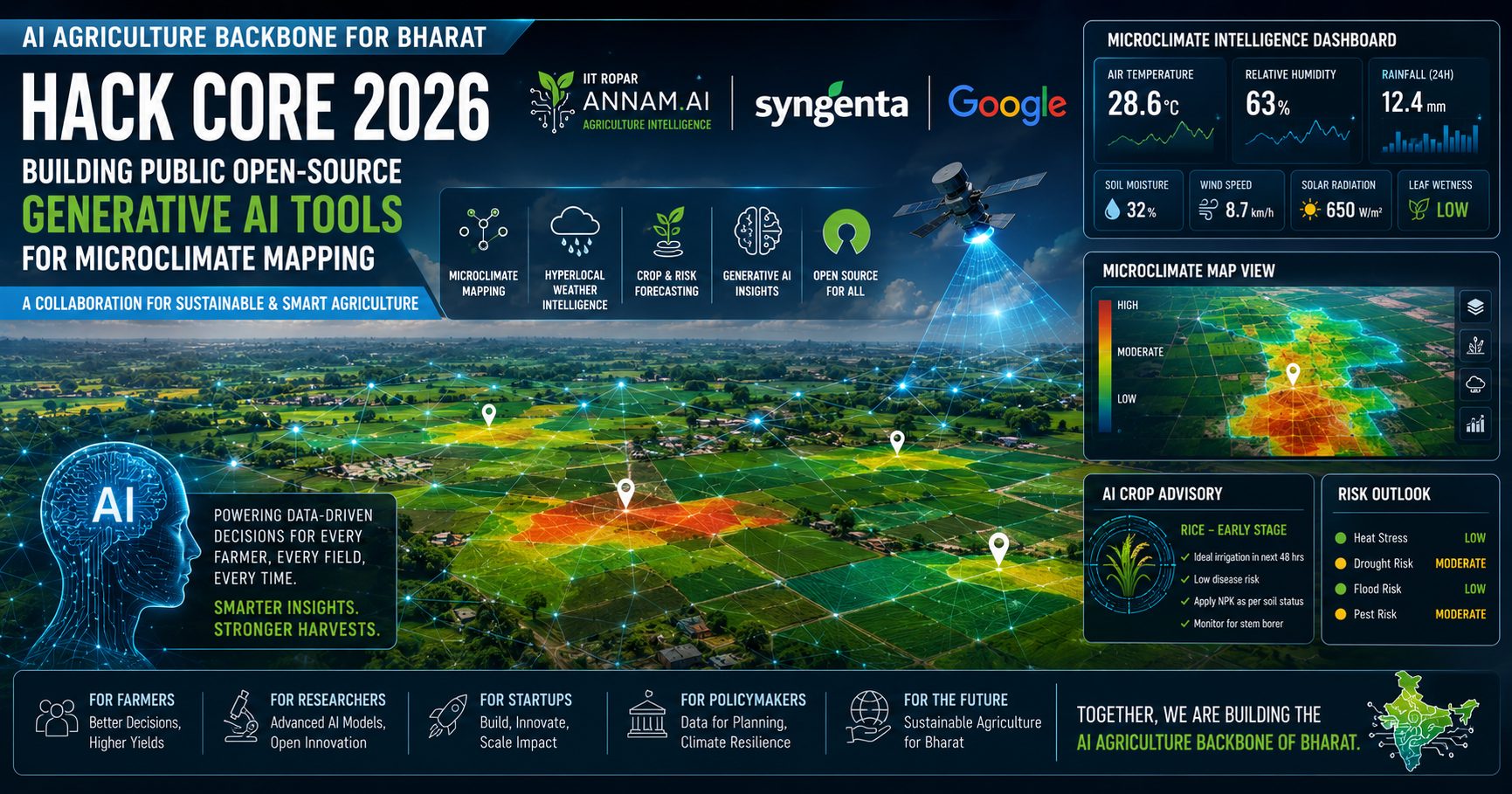
A major leap toward AI-powered agriculture has emerged with the launch of HACK CORE 2026 by IIT Ropar's ANNAM.AI, Syngenta, and Google. The initiative aims to develop public open-source generative AI tools for microclimate mapping, enabling precision farming, localized weather intelligence, and data-driven agricultural decision-making across Bharat.
AI Agriculture Backbone: ANNAM.AI, Syngenta and Google Launch HACK CORE 2026 for Microclimate Intelligence
Introduction
Agriculture is entering a new era where artificial intelligence is becoming as important as seeds, soil, and water. As climate variability increases and weather patterns become more localized, farmers require highly precise environmental intelligence to make profitable decisions.
In a significant development for India's agricultural innovation ecosystem, IIT Ropar's ANNAM.AI, Syngenta, and Google have jointly introduced the HACK CORE 2026 framework. The initiative seeks to accelerate the development of public open-source generative AI tools designed specifically for microclimate mapping and agricultural intelligence.
The announcement signals a major step toward democratizing advanced AI capabilities for farmers, researchers, agri-startups, policymakers, and ecosystem stakeholders.
Understanding HACK CORE 2026
What Is HACK CORE 2026?
HACK CORE 2026 is a collaborative innovation framework focused on building open-source generative AI infrastructure for agriculture.
The initiative aims to create tools capable of:
- Microclimate mapping
- Hyperlocal weather intelligence
- Agricultural forecasting
- Climate-risk assessment
- Crop advisory generation
- Environmental data interpretation
The framework promotes broader accessibility by encouraging public participation, open innovation, and collaborative development.
Why Open-Source AI Matters
Traditional agricultural technology often remains inaccessible to smaller farmers and local innovators.
Open-source AI frameworks can:
- Lower technology barriers
- Encourage innovation
- Improve transparency
- Accelerate adoption
- Support regional customization
- Enable affordable agricultural solutions
This approach can significantly expand the reach of climate intelligence tools across rural Bharat.
What Is Microclimate Mapping?
Beyond General Weather Forecasts
Most weather forecasts operate at district or regional levels.
Microclimate mapping focuses on highly localized environmental conditions, including:
- Temperature variations
- Humidity patterns
- Soil moisture dynamics
- Wind behavior
- Rainfall distribution
- Heat stress zones
These factors can vary dramatically within short distances.
Why Farmers Need Microclimate Intelligence
Localized environmental insights help farmers:
- Optimize sowing schedules
- Improve irrigation planning
- Reduce input wastage
- Prevent crop stress
- Increase productivity
- Improve risk management
The future of precision agriculture depends on understanding conditions at the farm level rather than relying solely on broader regional forecasts.
The Role of ANNAM.AI
Advancing Agricultural Intelligence
ANNAM.AI, developed through IIT Ropar's innovation ecosystem, focuses on applying artificial intelligence to real-world agricultural challenges.
Its involvement strengthens the initiative through:
- AI research expertise
- Agricultural data science
- Model development
- Innovation partnerships
- Public technology deployment
Building India's AI Agriculture Infrastructure
The collaboration highlights a growing emphasis on indigenous agricultural intelligence systems capable of addressing Bharat's unique farming conditions.
Syngenta's Contribution
Connecting Science with Farming
As a major agricultural technology organization, Syngenta brings expertise in:
- Crop science
- Agronomy
- Field intelligence
- Agricultural innovation
- Farmer engagement
Its participation can help ensure that AI tools remain practical and relevant for on-ground agricultural applications.
Accelerating Adoption
Industry participation often helps bridge the gap between research and real-world deployment, enabling faster adoption of emerging technologies.
Google's Role in the AI Ecosystem
Scaling Generative AI Innovation
Google's AI capabilities can contribute to:
- Large-scale model development
- Cloud infrastructure
- Data processing
- AI accessibility
- Developer ecosystems
The partnership demonstrates how global technology capabilities can support agricultural transformation.
Democratizing Advanced Technologies
The use of open-source approaches can allow startups, universities, governments, and independent developers to build innovative solutions on top of shared AI infrastructure.
Potential Impact on Indian Agriculture
Better Climate Resilience
Microclimate intelligence can help farmers prepare for:
- Heat waves
- Rainfall variability
- Drought conditions
- Flood risks
- Pest outbreaks
- Disease pressures
Improved Productivity
AI-driven recommendations can support:
- Better resource allocation
- Improved crop management
- Precision irrigation
- Input optimization
- Higher farm profitability
Stronger Agricultural Ecosystems
The framework may also benefit:
- Agri-startups
- Researchers
- Extension services
- Policymakers
- Agribusinesses
By making agricultural intelligence more accessible.
Challenges Ahead
Data Quality and Accessibility
Successful AI systems depend on reliable data inputs.
Key challenges include:
- Data standardization
- Data availability
- Rural connectivity
- Adoption barriers
- Local language support
Bridging the Last-Mile Gap
Technology adoption succeeds only when farmers can easily access and understand the insights generated.
Farmer education and ecosystem support will remain critical.
The Future of AI-Powered Agriculture
Agriculture Is Becoming Intelligence-Driven
The future farm will increasingly combine:
- Artificial intelligence
- Remote sensing
- Weather intelligence
- Predictive analytics
- Farm management systems
Microclimate intelligence represents one of the most important building blocks of this transformation.
Building Bharat's Agricultural Digital Infrastructure
Initiatives such as HACK CORE 2026 indicate a shift toward creating foundational AI infrastructure capable of supporting millions of farmers and agricultural stakeholders.
Conclusion
The launch of HACK CORE 2026 by IIT Ropar's ANNAM.AI, Syngenta, and Google marks an important milestone in the evolution of AI-powered agriculture. By focusing on open-source generative AI tools for microclimate mapping, the initiative has the potential to make precision agriculture more accessible, scalable, and impactful.
As climate uncertainty grows, localized intelligence and predictive insights will become essential tools for agricultural success.
Explore the Agriculture Intelligence Platform of Bharat - AGRIBOZ.
Register on https://www.agriboz.com to access agricultural intelligence, climate insights, emerging AgriTech opportunities, and expert-driven ecosystem participation.
CTA Section
Explore the Agriculture Intelligence Platform of Bharat - AGRIBOZ
AGRIBOZ connects farmers, innovators, trainers, researchers, startups, and agribusiness leaders through a powerful agriculture intelligence ecosystem.
Benefits include:
- Agriculture intelligence
- Climate-risk insights
- AgriTech opportunities
- Expert workshops
- Farm retreat experiences
- Strategic partnerships
Register on https://www.agriboz.com and become part of Bharat's agriculture innovation movement.
FAQ Section
What is HACK CORE 2026?
HACK CORE 2026 is an open innovation framework focused on developing public open-source generative AI tools for agricultural microclimate mapping.
What is microclimate mapping?
Microclimate mapping analyzes highly localized environmental conditions that influence crop performance and farming decisions.
Why is AI important for agriculture?
AI helps farmers improve decision-making, optimize resources, predict risks, and increase productivity.
How can open-source AI benefit farmers?
Open-source AI can reduce technology costs, improve accessibility, encourage innovation, and support localized agricultural solutions.
What industries can benefit from microclimate intelligence?
Farmers, agribusinesses, researchers, governments, insurers, agri-startups, and climate-risk organizations can all benefit.
Explore the Agriculture Intelligence Platform of Bharat - AGRIBOZ
Register on https://www.agriboz.com
Gain access to agriculture intelligence, climate analytics, AgriTech innovations, expert communities, workshops, farm retreats, and growth opportunities across Bharat's agricultural ecosystem.
Q1. Who launched HACK CORE 2026? The framework was jointly introduced by IIT Ropar's ANNAM.AI, Syngenta, and Google.
Q2. What is the primary objective of HACK CORE 2026? To develop public open-source generative AI tools for microclimate mapping and agricultural intelligence.
Q3. Why is microclimate mapping important? It provides localized environmental insights that support precision farming and climate-resilient agriculture.
Q4. How can generative AI support farmers? Generative AI can transform complex climate and agricultural data into actionable recommendations and advisories.
Q5. What are the long-term benefits of open-source agricultural AI? Greater accessibility, faster innovation, lower costs, wider adoption, and stronger agricultural resilience.