
Groundwater Vigilance: Why India Needs a Rigorous Water Audit Before Expanding Ethanol Blending
As India accelerates its ethanol blending ambitions to strengthen energy security and reduce fossil fuel dependence, environmental experts and agri-tech stakeholders are raising concerns about groundwater depletion in already stressed agricultural regions. A comprehensive water audit framework can help balance renewable fuel goals with long-term water sustainability, farmer resilience, and agricultural productivity.
Groundwater Vigilance: Why India Needs a Rigorous Water Audit Before Expanding Ethanol Blending
Introduction
India's ethanol blending program has emerged as a strategic pillar in the nation's energy transition roadmap. By reducing dependence on imported fossil fuels and supporting domestic agricultural markets, ethanol production offers multiple economic and environmental benefits.
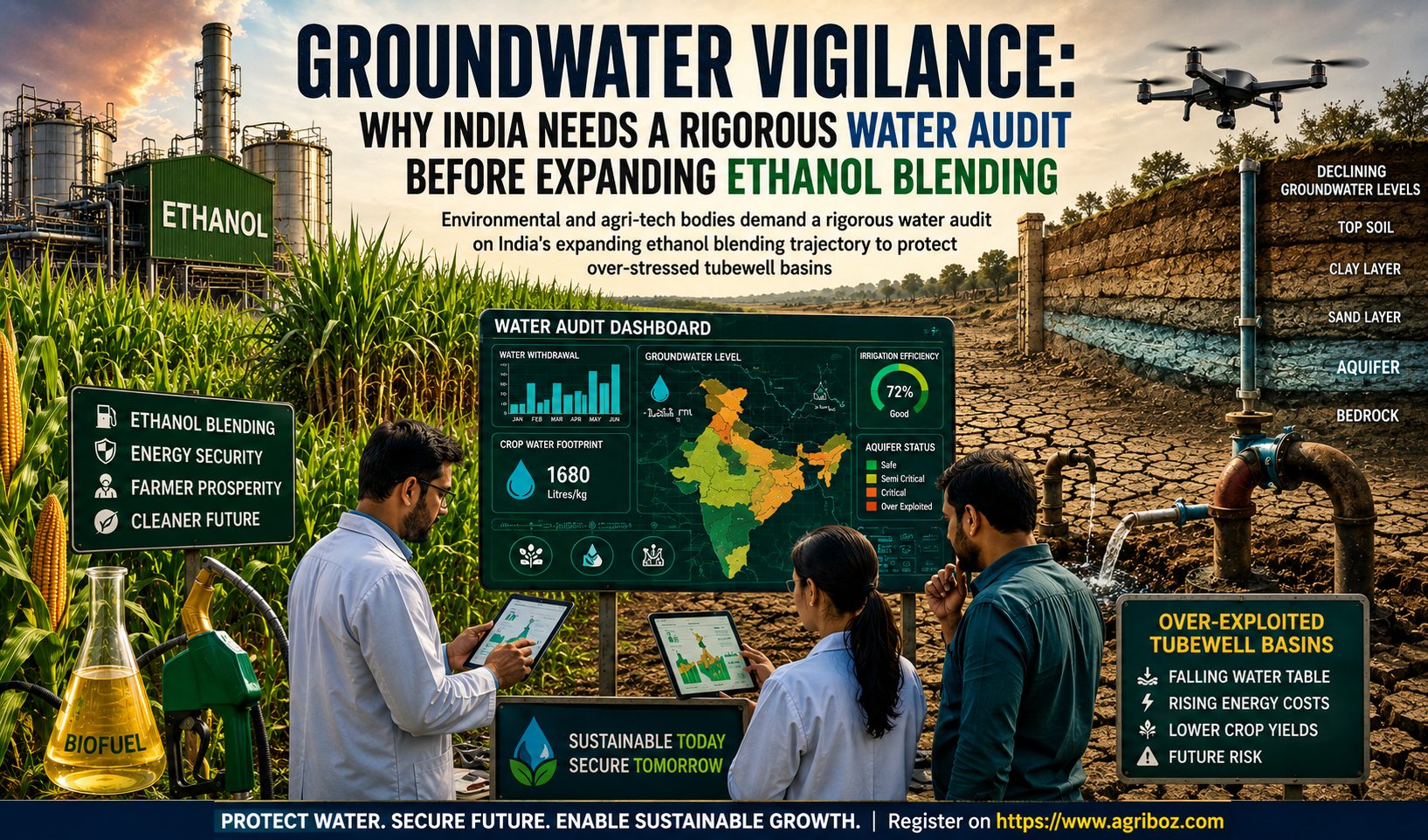
However, a growing coalition of environmental researchers, groundwater experts, and agri-tech organizations is warning that rapid expansion without comprehensive water accounting could intensify pressure on already stressed aquifers. Many ethanol feedstocks, particularly sugarcane and certain grain crops, rely heavily on irrigation in regions where groundwater extraction already exceeds recharge rates.
The question is no longer whether ethanol blending is beneficial. The real challenge is whether India can achieve its blending targets while protecting its groundwater reserves.
India's Expanding Ethanol Blending Ambition
Why Ethanol Matters
India's ethanol blending program aims to:
- Reduce crude oil imports
- Improve energy security
- Support farmer incomes
- Lower greenhouse gas emissions
- Strengthen rural industrial development
The success of ethanol blending has encouraged policymakers to pursue more ambitious targets over the coming years.
The Agricultural Connection
Most ethanol production depends on agricultural feedstocks such as:
- Sugarcane
- Maize
- Broken rice
- Other surplus grains
While these crops contribute to fuel production, they also consume substantial amounts of water, especially when cultivated in groundwater-dependent regions.
The Groundwater Challenge Behind Ethanol Expansion
India's Water Stress Reality
India is one of the world's largest users of groundwater.
Millions of farmers depend on:
- Borewells
- Tubewells
- Irrigation pumps
In many agricultural belts, groundwater extraction exceeds natural recharge, creating long-term sustainability concerns.
Over-Stressed Tubewell Basins
Several agricultural regions already face:
- Falling water tables
- Rising pumping costs
- Reduced well productivity
- Increased energy consumption for irrigation
Expanding water-intensive feedstock cultivation in such regions could accelerate aquifer depletion.
Hidden Water Costs
The economic benefits of ethanol are often visible.
The water costs are frequently hidden.
Without rigorous measurement systems, policymakers may underestimate:
- Water consumed per litre of ethanol
- Regional groundwater impacts
- Long-term agricultural risks
- Ecosystem consequences
Why Environmental and Agri-Tech Bodies Are Demanding Water Audits
Data-Driven Decision Making
Experts argue that every major ethanol-producing region should undergo detailed water audits.
These audits can identify:
- Water withdrawal levels
- Aquifer recharge rates
- Irrigation efficiency
- Crop water footprints
- Sustainability thresholds
Protecting Future Agricultural Productivity
Groundwater is not only a resource for ethanol feedstock crops.
It supports:
- Food production
- Livestock systems
- Rural livelihoods
- Climate resilience
Protecting aquifers today safeguards agricultural productivity for future generations.
Preventing Regional Water Crises
Some regions may be capable of supporting additional ethanol feedstock production.
Others may already be operating beyond ecological limits.
Water audits help distinguish between the two.
What Should a Rigorous Water Audit Include?
Aquifer-Level Assessment
Audits should evaluate:
- Groundwater recharge rates
- Extraction intensity
- Seasonal variations
- Long-term trends
This creates a scientific basis for planning ethanol expansion.
Crop Water Footprint Analysis
Different feedstocks have different water requirements.
A water audit should compare:
- Sugarcane water demand
- Maize water demand
- Alternative feedstock options
- Regional suitability
Irrigation Efficiency Evaluation
Modern irrigation technologies can significantly reduce water consumption.
Assessment should include:
- Drip irrigation adoption
- Precision irrigation systems
- Soil moisture monitoring
- Smart irrigation scheduling
Climate Risk Mapping
Future rainfall uncertainty must be integrated into planning.
Climate-informed water audits can help identify vulnerable regions before problems emerge.
The Role of Agri-Tech in Sustainable Ethanol Development
Precision Agriculture
Modern technologies can reduce water use while maintaining productivity.
Examples include:
- IoT-enabled irrigation systems
- Remote sensing platforms
- Satellite-based crop monitoring
- AI-driven irrigation recommendations
Real-Time Water Monitoring
Digital tools can help governments and industries monitor:
- Groundwater extraction
- Water productivity
- Crop performance
- Resource efficiency
Data Transparency
Open and transparent water data can improve accountability across the ethanol value chain.
Stakeholders can make informed decisions based on measurable sustainability indicators.
Balancing Energy Security and Water Security
A Dual Sustainability Challenge
India does not need to choose between renewable fuels and water conservation.
The goal should be balanced growth that supports:
- Energy independence
- Agricultural prosperity
- Groundwater protection
- Environmental sustainability
Smarter Feedstock Strategies
Future policies may benefit from:
- Region-specific feedstock planning
- Water-efficient crop promotion
- Waste-based ethanol pathways
- Sustainable procurement standards
Incentivizing Water Efficiency
Government support mechanisms can reward:
- Efficient irrigation practices
- Low-water feedstocks
- Groundwater conservation initiatives
- Sustainable farming innovations
The Economic Case for Water Audits
Avoiding Future Costs
Ignoring groundwater depletion today could create:
- Higher irrigation costs
- Reduced farm profitability
- Declining crop yields
- Water conflict risks
Water audits are not merely environmental exercises. They are economic risk-management tools.
Strengthening Investor Confidence
Sustainability assessments improve confidence among:
- Policymakers
- Investors
- Industries
- International partners
Responsible ethanol growth can strengthen India's position in the global biofuel economy.
Conclusion
India's ethanol blending journey represents an important opportunity for energy security and rural development. However, groundwater resources remain the foundation of agricultural productivity and national food security.
A rigorous, transparent, and science-based water audit framework can ensure that ethanol expansion does not come at the cost of future water availability. By combining policy innovation, agri-tech solutions, precision irrigation, and responsible resource management, India can build a biofuel ecosystem that is both economically viable and environmentally sustainable.
Explore the Agriculture Intelligence Platform of Bharat - AGRIBOZ.
Register on https://www.agriboz.com
Explore the Agriculture Intelligence Platform of Bharat - AGRIBOZ
Whether you are a farmer, agribusiness professional, researcher, policymaker, trainer, or sustainability advocate, AGRIBOZ provides valuable agriculture intelligence, industry insights, expert-led learning opportunities, and ecosystem connections.
Benefits of joining AGRIBOZ:
- Access agriculture and sustainability insights
- Participate in workshops and expert sessions
- Connect with agri-tech innovators
- Discover emerging agricultural opportunities
- Stay updated on policy and market developments
- Become part of Bharat's agriculture intelligence ecosystem
Register on https://www.agriboz.com
Q1. Why is groundwater a concern in ethanol production?
Groundwater is often used to irrigate ethanol feedstock crops such as sugarcane and maize. Increased cultivation of water-intensive crops can accelerate aquifer depletion in already stressed regions.
Q2. What is a water audit?
A water audit is a systematic assessment of water use, withdrawal, recharge, efficiency, and sustainability within a specific region, industry, or agricultural system.
Q3. Can ethanol blending continue without harming groundwater?
Yes. Sustainable expansion is possible through rigorous water audits, efficient irrigation technologies, region-specific planning, and promotion of lower-water feedstocks.
Q4. Which agricultural crops are commonly used for ethanol production in India?
Sugarcane, maize, broken rice, and surplus grains are among the primary feedstocks used for ethanol production.
Q5. How can agri-tech help reduce water consumption?
Agri-tech solutions such as precision irrigation, satellite monitoring, AI-based recommendations, and IoT-enabled systems can significantly improve water-use efficiency.
Q6. Why are environmental organizations calling for stricter monitoring?
Experts believe that without accurate water accounting and groundwater assessments, ethanol expansion could unintentionally worsen water stress in vulnerable agricultural regions.
Q7. What role can farmers play in groundwater conservation?
Farmers can adopt water-efficient irrigation methods, soil moisture monitoring, crop diversification, and sustainable farming practices to reduce groundwater dependence.