Re-Export Organic Processing Arbitrage: How APEDA’s New NOP Import Framework Creates a High-Margin Export Opportunity
APEDA’s new operational framework allowing the import of USDA National Organic Program (NOP)-certified organic ingredients for value addition and re-export to the United States is creating a powerful regulatory arbitrage opportunity for Indian agri-processors. By combining global organic sourcing with India’s competitive processing ecosystem, exporters can capture higher margins, expand product portfolios, and strengthen their position in premium international organic markets.
Re-Export Organic Processing Arbitrage: APEDA’s New Organic Trade Corridor Could Transform India’s Agri-Processing Industry
Introduction
India's agricultural export sector has traditionally competed on production capacity, raw material availability, and cost efficiency. However, a significant policy development has the potential to shift the conversation from commodity exports to high-value processing-led export growth.
APEDA's operational guidelines allowing the import of USDA National Organic Program (NOP)-certified organic ingredients for value addition and subsequent re-export to the United States have opened a new commercial pathway for Indian agri-processors.
This is not merely a regulatory update. It is the creation of a strategic export corridor that allows Indian businesses to leverage global organic supply chains, domestic processing expertise, and premium international demand simultaneously.
For exporters, processors, entrepreneurs, and investors, this development represents one of the most attractive value-addition opportunities emerging in India's agricultural sector.
Understanding the New APEDA Framework
What Has Changed?
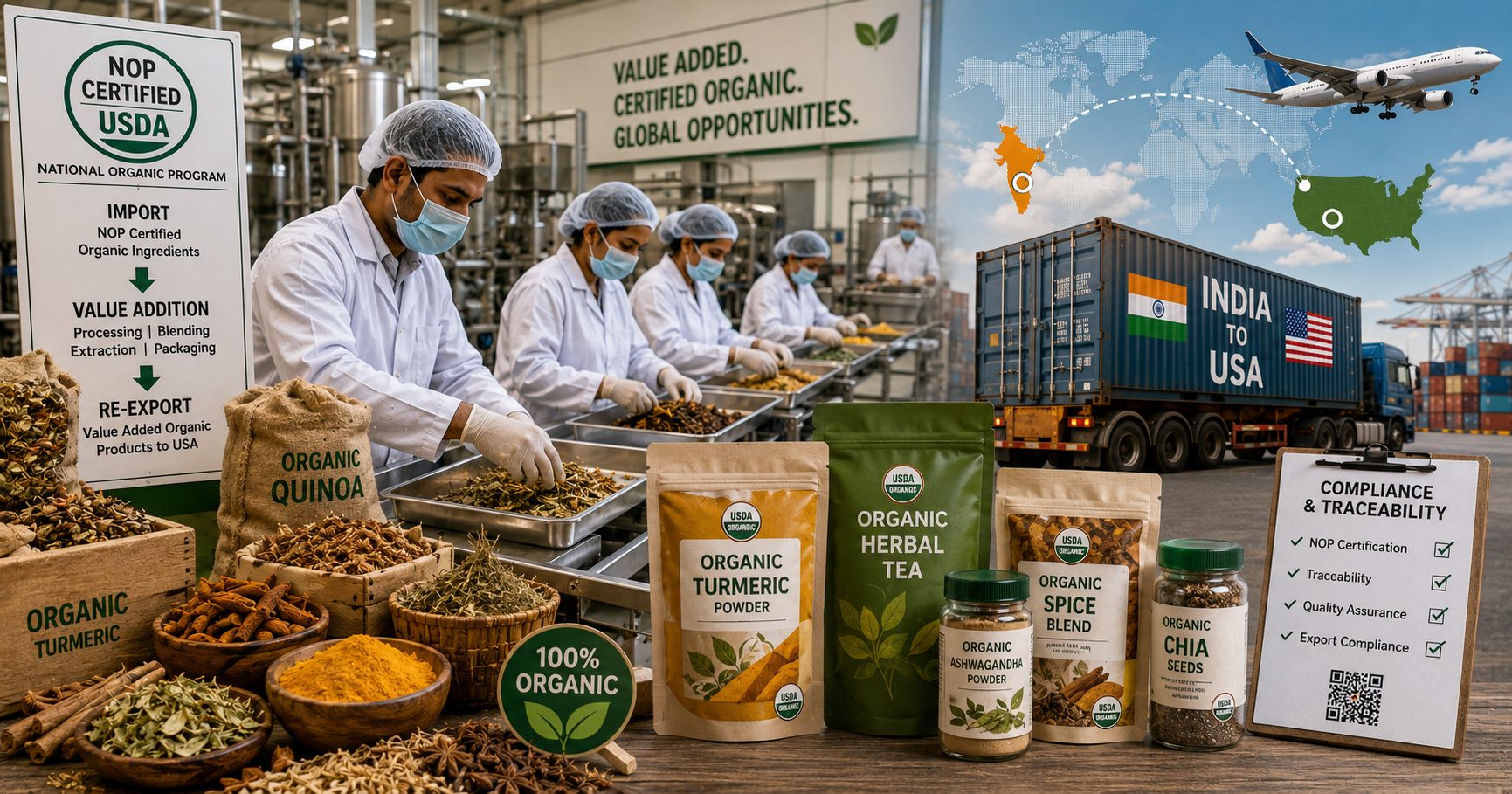
Under the revised operational framework, eligible businesses can import NOP-certified organic ingredients into India for processing, blending, packaging, extraction, formulation, and other value-addition activities.
The finished products can then be re-exported to the United States while maintaining compliance with organic market requirements.
Why This Matters
Historically, access to premium organic markets often depended on domestic raw material availability.
The new framework changes the equation by allowing processors to source internationally certified organic ingredients while utilizing India's manufacturing and processing capabilities.
This significantly expands commercial flexibility.
The Emergence of Regulatory Arbitrage
What Is Regulatory Arbitrage?
Regulatory arbitrage occurs when businesses legally capitalize on differences in regulatory structures, market access conditions, or compliance frameworks to create additional value.
In this case, processors can:
- Source certified organic ingredients globally
- Utilize India's competitive processing ecosystem
- Create higher-value products
- Access premium U.S. organic consumers
The result is potentially stronger margins than traditional commodity exports.
Why India Is Well Positioned
India already possesses several competitive advantages:
- Established food processing infrastructure
- Competitive labor costs
- Export-oriented manufacturing capacity
- Growing organic sector expertise
- Strategic geographic connectivity
The APEDA framework allows these strengths to be leveraged at scale.
The High-Margin Opportunity for Agri-Processors
Moving Beyond Raw Material Exports
Commodity exports often generate limited value capture.
Value-added processing creates opportunities through:
- Product differentiation
- Brand creation
- Specialized formulations
- Premium packaging
- Consumer-focused products
Each stage of processing can increase commercial value.
Product Categories with Significant Potential
Potential categories include:
- Organic spice blends
- Organic nutraceutical ingredients
- Organic herbal extracts
- Organic beverage formulations
- Organic ready-to-cook products
- Organic superfood mixes
- Organic functional food ingredients
These categories often command substantially higher margins than raw agricultural commodities.
Why the U.S. Organic Market Matters
A Premium Consumer Base
The United States remains one of the world's largest organic food markets.
Consumers increasingly prioritize:
- Certified organic products
- Transparency
- Traceability
- Sustainability
- Clean-label ingredients
This creates consistent demand for high-quality value-added organic products.
Growing Demand for Processed Organic Products
Market growth is increasingly concentrated in:
- Convenience foods
- Functional nutrition
- Wellness products
- Specialty organic ingredients
- Private-label organic offerings
Indian processors can participate across multiple segments.
Building Competitive Export Models
Step 1: Strategic Ingredient Sourcing
Businesses can identify globally available NOP-certified organic ingredients that complement processing capabilities.
Step 2: Value Addition in India
Processors can enhance value through:
- Cleaning
- Grading
- Blending
- Extraction
- Packaging
- Formulation
Step 3: Export Market Positioning
Products can be positioned around:
- Premium quality
- Organic compliance
- Sustainability
- Traceability
- Functional benefits
This creates stronger commercial differentiation.
Opportunities for FPOs and Agripreneurs
Expanding Participation in Organic Supply Chains
Farmer Producer Organizations can benefit through:
- Organic contract farming
- Processing partnerships
- Export aggregation
- Ingredient supply arrangements
Creating New Revenue Streams
The framework may encourage:
- Organic certification adoption
- Processing investments
- Export collaborations
- Product innovation
These developments can improve rural value creation.
Risks Businesses Must Manage
Compliance Remains Critical
Success depends on maintaining:
- Organic integrity
- Documentation standards
- Traceability systems
- Export compliance requirements
Quality Control Cannot Be Compromised
Premium markets reward consistency.
Businesses must invest in:
- Quality assurance
- Testing systems
- Certification management
- Supply chain transparency
Companies that prioritize compliance will be best positioned to capitalize on the opportunity.
Strategic Implications for India's Organic Export Future
From Producer to Processing Hub
The new framework positions India not only as an organic producer but also as a global organic processing destination.
This transition could generate:
- Higher export earnings
- Greater value capture
- Increased employment
- Stronger processing ecosystems
The Next Phase of Agricultural Export Growth
Future export competitiveness will increasingly depend on:
- Value addition
- Branding
- Certification
- Regulatory intelligence
- Supply chain innovation
The APEDA framework aligns directly with these trends.
Conclusion
APEDA's operational guidelines permitting the import of NOP-certified organic ingredients for value addition and re-export to the United States have created a powerful new opportunity for India's agri-processing sector. By combining global organic sourcing with domestic processing capabilities, businesses can access premium markets, improve margins, and build globally competitive value-added product portfolios.
The companies that move quickly, establish robust compliance systems, and invest in processing excellence are likely to emerge as leaders in this expanding organic export ecosystem.
Register on https://www.agriboz.com
AGRIBOZ CTA
Explore the Agriculture Intelligence Platform of Bharat - AGRIBOZ
Stay ahead of emerging agricultural opportunities, export regulations, organic market trends, value-addition strategies, agribusiness intelligence, workshops, ecosystem partnerships, and growth opportunities designed for the future of Indian agriculture.
Register on https://www.agriboz.com
Explore the Agriculture Intelligence Platform of Bharat - AGRIBOZ
Gain access to export intelligence, policy updates, organic agriculture opportunities, market insights, workshops, expert knowledge, and strategic agribusiness opportunities that help transform information into growth.
Register on https://www.agriboz.com
Q1. What is the USDA National Organic Program (NOP)? The National Organic Program is the U.S. regulatory framework governing organic agricultural products and certification standards.
Q2. What do APEDA’s new guidelines allow? The guidelines allow the import of NOP-certified organic ingredients into India for value addition and subsequent re-export to the United States.
Q3. Why is this considered a regulatory arbitrage opportunity? Businesses can legally combine global organic sourcing, Indian processing advantages, and premium U.S. market demand to create additional value and margin opportunities.
Q4. Which industries can benefit the most? Organic food processors, spice manufacturers, nutraceutical companies, herbal extract producers, exporters, and value-added food brands can benefit significantly.
Q5. What are the key success factors? Compliance management, traceability, quality assurance, certification integrity, and strong export market positioning are critical.
Q6. How can Indian agribusinesses participate? Businesses can invest in organic processing, certification systems, export partnerships, product innovation, and premium market development strategies.