Urban Rooftop Micro-Farming: How Premium Food Production Networks Are Redefining Wellness Real Estate Value
Urban rooftop real estate is rapidly evolving from underutilized infrastructure into a premium revenue-generating asset. High-end modular micro-farming systems integrated into luxury residential developments are creating new forms of wellness-driven value by combining food security, sustainability, community engagement, and lifestyle differentiation. As buyers increasingly prioritize health, environmental responsibility, and experiential living, rooftop food production networks are emerging as a powerful driver of modern real estate valuation and long-term asset appreciation.
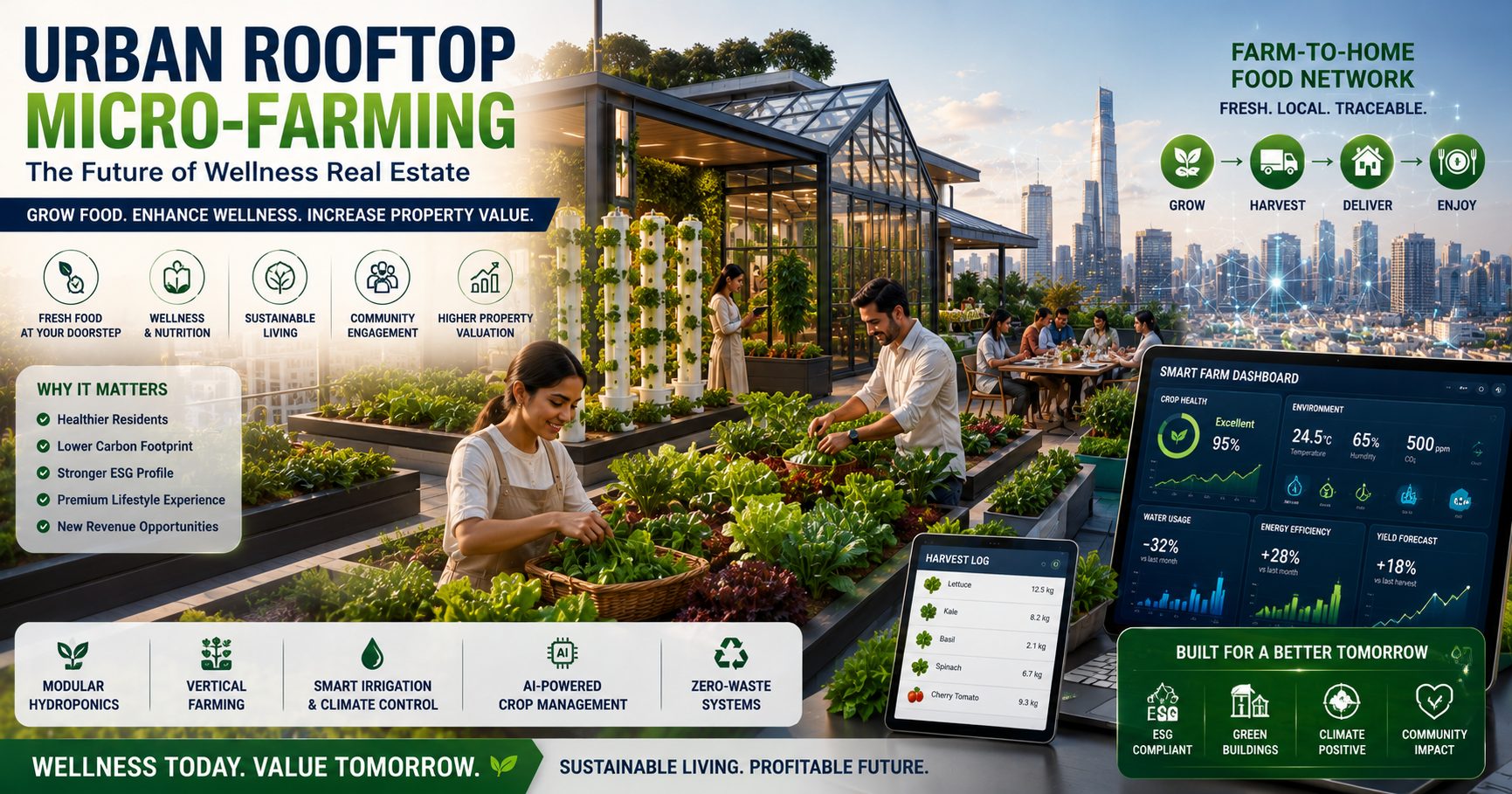
Urban Rooftop Micro-Farming: The Next Billion-Dollar Layer of Wellness Real Estate
Cities around the world are facing a paradox. Residential developments are becoming more luxurious, yet urban residents are increasingly disconnected from nature, food systems, and healthy living environments.
At the same time, developers face intense competition as premium amenities such as gyms, clubhouses, swimming pools, and co-working spaces become standardized rather than differentiated.
This is creating an entirely new opportunity: transforming rooftop real estate into productive, revenue-generating micro-farming ecosystems.
What was once considered unused building infrastructure is now emerging as a strategic asset capable of enhancing property value, strengthening brand positioning, generating recurring income, and delivering measurable wellness outcomes.
Why Rooftop Space Is Becoming an Economic Asset
Traditionally, rooftops served limited functions:
- Mechanical equipment placement
- Solar installations
- Water tanks
- Basic recreational areas
However, rising land prices are forcing developers to extract greater value from every square foot of built infrastructure.
The New Asset Class
High-end modular micro-farms convert dormant rooftop areas into:
- Premium food production zones
- Wellness destinations
- Educational ecosystems
- Community engagement hubs
- ESG value generators
- Branded residential experiences
This fundamentally changes how rooftop space is evaluated within project economics.
The Rise of Wellness Real Estate
The global real estate market is experiencing a major shift from luxury-focused development toward wellness-focused development.
Buyers increasingly evaluate properties based on:
- Air quality
- Access to healthy food
- Green spaces
- Mental wellness benefits
- Sustainability credentials
- Community experiences
The Wellness Premium
Projects capable of delivering measurable health benefits often command:
- Higher selling prices
- Faster inventory absorption
- Improved resident retention
- Stronger rental yields
- Greater brand differentiation
Food-producing rooftops directly support many of these buyer priorities.
Modular Micro-Farming as a Premium Amenity
Luxury real estate has traditionally competed through lifestyle amenities.
The challenge is that many amenities depreciate in perceived value over time.
Why Food Production Is Different
Unlike passive amenities, rooftop farms create ongoing value.
Residents receive:
- Fresh produce access
- Farm-to-home experiences
- Health-focused community programs
- Sustainability participation
- Educational opportunities
This creates recurring engagement rather than occasional usage.
The Experience Economy Effect
Modern buyers increasingly purchase experiences rather than physical features.
A rooftop farm offers:
- Harvest events
- Chef collaborations
- Farm-to-table dining
- Children's learning activities
- Resident gardening programs
These experiences strengthen emotional attachment to a property.
Commercial Monetization Models
The strongest business case emerges when rooftop farms move beyond aesthetics and become revenue-producing infrastructure.
Model 1: Produce Subscription Programs
Residents subscribe to:
- Weekly vegetable baskets
- Seasonal produce plans
- Specialty herb collections
- Premium salad programs
This creates recurring income while improving resident satisfaction.
Model 2: Community Supported Agriculture (CSA)
Developments can establish internal food membership systems where residents receive priority access to rooftop-grown produce.
Benefits include:
- Predictable revenue
- Community participation
- Enhanced resident loyalty
Model 3: Farm-to-Restaurant Partnerships
Mixed-use developments can supply:
- In-house cafes
- Restaurants
- Hospitality facilities
- Culinary experiences
This creates additional commercial opportunities within the project ecosystem.
Model 4: Corporate Wellness Programs
Residential and commercial developments can integrate:
- Nutrition workshops
- Urban farming education
- Employee wellness experiences
- Sustainability training
These programs generate premium service revenue.
Model 5: Agritourism and Experience Monetization
Luxury developments increasingly monetize experiences.
Examples include:
- Guided farm tours
- Harvest festivals
- Farm dining events
- Wellness retreats
These activities strengthen project identity and market positioning.
Impact on Real Estate Valuation
Valuation models are evolving.
Historically, amenities were viewed primarily as cost centers.
Modern wellness infrastructure increasingly functions as a value multiplier.
Direct Value Drivers
Rooftop farms can contribute through:
- Increased property desirability
- Premium pricing potential
- Higher occupancy rates
- Improved tenant retention
- Enhanced brand recognition
Indirect Value Drivers
Additional benefits include:
- ESG compliance advantages
- Sustainability certifications
- Improved environmental performance
- Community engagement metrics
These factors are becoming increasingly important to institutional investors.
ESG and Institutional Investment Appeal
Environmental, Social, and Governance (ESG) performance is now a critical consideration in real estate financing.
Environmental Benefits
Rooftop farms support:
- Urban heat reduction
- Carbon footprint mitigation
- Water efficiency improvements
- Biodiversity enhancement
Social Benefits
Projects generate:
- Community interaction
- Food education
- Health improvement opportunities
- Localized food resilience
These outcomes strengthen ESG narratives for investors.
The Future: Distributed Urban Food Networks
The most transformative opportunity extends beyond individual buildings.
Networked Food Infrastructure
Future developments may connect multiple rooftops into:
- Hyperlocal food ecosystems
- Smart logistics networks
- AI-driven production systems
- Neighborhood food exchanges
This creates a distributed agricultural infrastructure embedded within urban environments.
Real Estate as Food Infrastructure
Developers increasingly have the opportunity to become:
- Food ecosystem operators
- Wellness service providers
- Sustainability leaders
- Community builders
This expands the traditional role of real estate far beyond housing.
Strategic Implications for Developers
Developers that integrate modular micro-farming early may gain significant competitive advantages.
Potential outcomes include:
- Premium project positioning
- Stronger buyer attraction
- Higher asset valuation
- Enhanced ESG credentials
- Additional recurring revenue streams
As wellness becomes a core component of residential decision-making, food-producing infrastructure is likely to become one of the most powerful differentiators in premium urban developments.
Conclusion
Urban rooftop micro-farming represents far more than a sustainability feature. It is the emergence of a new real estate asset class where food production, wellness, technology, community engagement, and environmental performance converge.
By transforming rooftops into productive agricultural ecosystems, developers can create recurring revenue opportunities, strengthen resident experiences, enhance ESG performance, and command premium market positioning.
The future of luxury real estate may not be defined solely by architecture or amenities, but by a property's ability to actively improve human health, food access, and quality of life.
Register on https://www.agriboz.com to explore emerging opportunities at the intersection of agriculture, real estate, sustainability, wellness infrastructure, and future-ready urban development.
CTA
Explore the Agriculture Intelligence Platform of Bharat - AGRIBOZ
Discover opportunities in urban agriculture, agri-real estate innovation, controlled environment farming, sustainability ecosystems, and future food infrastructure.
Register on https://www.agriboz.com
FAQ
Can rooftop micro-farms generate revenue for residential projects?
Yes. Revenue can come from produce subscriptions, farm experiences, wellness programs, restaurant supply partnerships, and community-supported agriculture models.
Why do rooftop farms increase real estate value?
They provide wellness benefits, sustainability differentiation, community engagement, and premium lifestyle experiences that influence buyer demand.
What is modular micro-farming?
It is a scalable farming system using modular growing units that can be deployed on rooftops, terraces, and other urban spaces.
How do rooftop farms support ESG goals?
They improve environmental performance, encourage community participation, support food resilience, and contribute to sustainability objectives.
Are luxury homebuyers interested in food-producing amenities?
Increasingly yes. Health, sustainability, and experiential living have become major drivers of premium residential purchasing decisions.
Explore the Agriculture Intelligence Platform of Bharat - AGRIBOZ
Connect with innovators shaping the future of urban agriculture and wellness infrastructure.
Benefits:
- Urban farming intelligence
- Controlled environment agriculture insights
- Sustainable real estate opportunities
- Agri-business innovation updates
- Expert workshops and ecosystem access
- Investment and partnership opportunities
- Future food system intelligence
Register on https://www.agriboz.com
Q1. What is rooftop micro-farming? It is the practice of producing food on rooftops using modular, controlled, and space-efficient farming systems.
Q2. How can rooftop farms generate commercial returns? Returns can come from produce sales, subscription models, experiential events, wellness programs, and hospitality partnerships.
Q3. Why is wellness real estate growing? Modern consumers increasingly prioritize health, sustainability, nature access, and quality-of-life benefits when choosing properties.
Q4. How does food production influence property value? It creates differentiation, supports wellness branding, improves ESG performance, and enhances resident engagement.
Q5. What types of crops are suitable for rooftop farms? Leafy greens, herbs, microgreens, strawberries, specialty vegetables, and premium culinary crops are commonly used.
Q6. Are rooftop farms suitable for luxury residential projects? Yes. They align strongly with premium buyer preferences for wellness, sustainability, exclusivity, and lifestyle experiences.
Q7. How can developers stay informed about emerging agri-real-estate opportunities? AGRIBOZ provides insights into agricultural innovation, urban farming, sustainability trends, and future infrastructure opportunities.