
Reservoir Crash Alert: Southern and Eastern Water Basins Fall Sharply Below Decadal Storage Levels
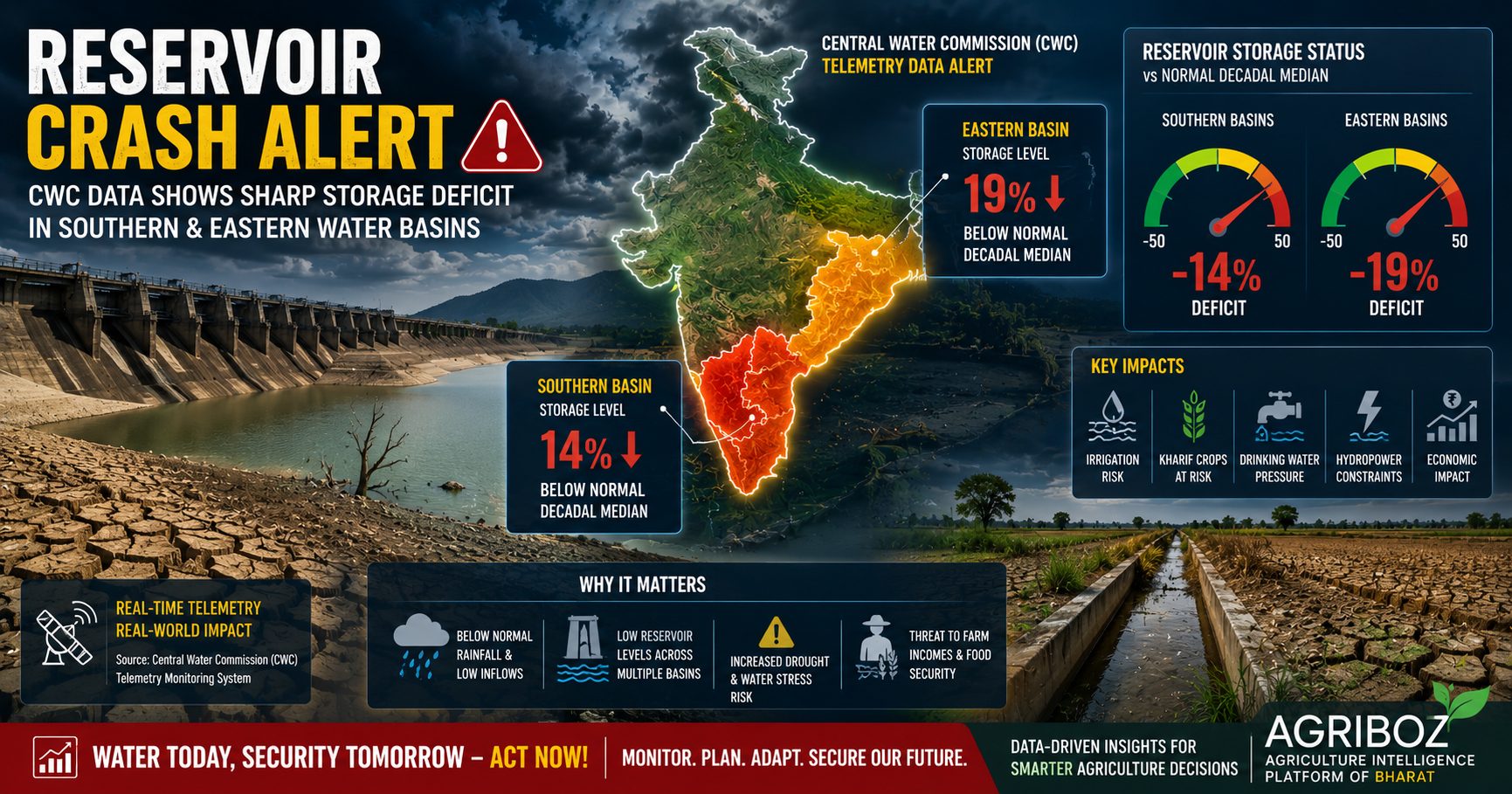
Central Water Commission telemetry data reveals a significant reservoir storage deficit across India's Southern and Eastern water basins. With storage levels falling 14% and 19% below normal decadal medians, concerns are growing over irrigation security, Kharif crop performance, and regional water resilience.
Reservoir Crash Alert: Southern and Eastern Water Basins Fall Sharply Below Decadal Storage Levels
Introduction
India's agricultural economy depends heavily on the availability of water during the Kharif season. While rainfall often dominates headlines, reservoir storage levels provide a more accurate picture of the nation's water security and irrigation preparedness.
Recent telemetry data from the Central Water Commission (CWC) indicates a concerning trend. Reservoir storage across Southern and Eastern water basins has fallen significantly below normal decadal storage medians, raising concerns for agriculture, drinking water supplies, hydropower generation, and regional economic stability.
Understanding the Reservoir Deficit
What the Data Shows
According to CWC telemetry monitoring:
- Southern water basins are operating 14% below normal decadal storage levels.
- Eastern water basins are operating 19% below normal decadal storage levels.
These deficits indicate reduced water availability compared to long-term historical averages.
Why Reservoir Storage Matters
Reservoirs act as strategic water reserves that support:
- Irrigation systems
- Drinking water supplies
- Hydropower production
- Industrial operations
- Drought management
When storage levels decline significantly, multiple sectors face increased risk.
Why Southern Basins Are Under Pressure
Dependence on Monsoon Recharge
Southern India relies heavily on seasonal rainfall to replenish reservoirs.
Challenges include:
- Delayed monsoon activity
- Uneven rainfall distribution
- Higher evaporation rates
- Increasing water demand
Impact on Agriculture
Lower reservoir levels may affect:
- Paddy cultivation
- Sugarcane production
- Horticulture crops
- Multi-cropping systems
Farmers dependent on canal irrigation could face water allocation restrictions if storage conditions worsen.
Why Eastern Basins Face Greater Risk
A 19% Deficit Is Significant
The Eastern basin's larger deficit suggests elevated vulnerability.
Potential concerns include:
- Reduced irrigation capacity
- Water stress during critical crop stages
- Increased dependence on rainfall
- Greater exposure to dry spells
Implications for Kharif Crops
Kharif crops require adequate moisture during:
- Germination
- Establishment
- Vegetative growth
- Flowering stages
Reservoir shortages can reduce irrigation support precisely when crops need it most.
The Agricultural Impact
Irrigation Security Becomes Uncertain
Water deficits often lead to:
- Reduced irrigation releases
- Crop yield losses
- Delayed sowing decisions
- Increased production risks
Economic Consequences
Agricultural water shortages can influence:
- Farm income
- Rural employment
- Food supply chains
- Commodity prices
- Agricultural lending
The ripple effects extend far beyond the farm gate.
Climate Change and Reservoir Volatility
Storage Stability Is Becoming Harder to Maintain
Climate variability is creating new challenges:
- Intense rainfall events
- Longer dry periods
- Unpredictable recharge cycles
- Increased evaporation losses
These conditions make reservoir management more complex than ever before.
The Need for Smarter Water Management
Future resilience will depend on:
- Real-time monitoring
- Predictive analytics
- Watershed development
- Efficient irrigation systems
- Climate-informed planning
Solutions for Farmers and Policymakers
Improve Water Use Efficiency
Farmers can reduce water stress through:
- Drip irrigation
- Sprinkler systems
- Soil moisture conservation
- Precision irrigation scheduling
Strengthen Local Water Resources
Communities can invest in:
- Farm ponds
- Check dams
- Rainwater harvesting
- Groundwater recharge structures
Adopt Data-Driven Agriculture
Access to reservoir intelligence, weather forecasts, and water advisories enables better planning and risk management.
The Growing Importance of Agricultural Intelligence
Early Warning Systems Matter
Reservoir data serves as an important early warning indicator for agriculture.
Timely intelligence helps stakeholders:
- Assess irrigation risks
- Plan crop strategies
- Allocate resources efficiently
- Respond proactively to water shortages
Building Water Resilience
The future of Indian agriculture will increasingly depend on integrating water intelligence with farming decisions.
Conclusion
The latest Central Water Commission telemetry data highlights a worrying decline in reservoir storage across Southern and Eastern water basins, with levels falling 14% and 19% below normal decadal medians respectively.
As water security becomes a defining challenge for agriculture, proactive planning, efficient water management, and data-driven decision-making will be essential for protecting farm productivity and rural livelihoods.
Explore the Agriculture Intelligence Platform of Bharat - AGRIBOZ.
Register on https://www.agriboz.com to access agriculture intelligence, climate insights, water-risk monitoring, and expert-led agricultural opportunities.
CTA Section
Explore the Agriculture Intelligence Platform of Bharat - AGRIBOZ
AGRIBOZ empowers farmers, agribusinesses, researchers, trainers, and agriculture professionals with actionable intelligence.
Benefits include:
- Agriculture intelligence
- Climate and water-risk insights
- Expert networks
- Workshops and training
- Farm retreat opportunities
- Agri-business growth resources
Register on https://www.agriboz.com and become part of Bharat's agriculture intelligence ecosystem.
FAQ Section
What is reservoir storage deficit?
A reservoir storage deficit occurs when current water levels fall below historical averages or expected storage benchmarks.
Why are reservoir levels important for agriculture?
Reservoirs supply irrigation water, helping crops survive periods of insufficient rainfall.
Which regions are currently facing major storage deficits?
Recent CWC telemetry data indicates significant deficits in Southern and Eastern water basins.
How can farmers prepare for water shortages?
Farmers can adopt efficient irrigation systems, conserve soil moisture, diversify crops, and use water intelligence tools.
Why is reservoir monitoring important?
Reservoir monitoring provides early warning signals that help governments, farmers, and agribusinesses prepare for emerging water risks.
Explore the Agriculture Intelligence Platform of Bharat - AGRIBOZ
Register on https://www.agriboz.com
Access agriculture intelligence, climate-risk monitoring, water-resource insights, expert workshops, farm retreat opportunities, and strategic growth resources for the agriculture ecosystem.
Q1. What does a reservoir storage deficit indicate? It indicates that current water storage levels are below historical averages and may signal future water stress.
Q2. How far below normal are the Southern and Eastern basins? Southern basins are 14% below normal decadal storage medians, while Eastern basins are 19% below.
Q3. Why is reservoir storage important during Kharif? Reservoirs provide irrigation support when rainfall becomes inadequate or unevenly distributed.
Q4. Can low reservoir levels affect food production? Yes. Reduced irrigation availability can impact crop yields, planting decisions, and overall agricultural output.
Q5. What solutions can improve water resilience? Efficient irrigation, rainwater harvesting, watershed development, groundwater recharge, and data-driven water management can strengthen resilience.