Paddy Acreage Surges 53%: What Record Rice Sowing Means for India's Agriculture and Farmers
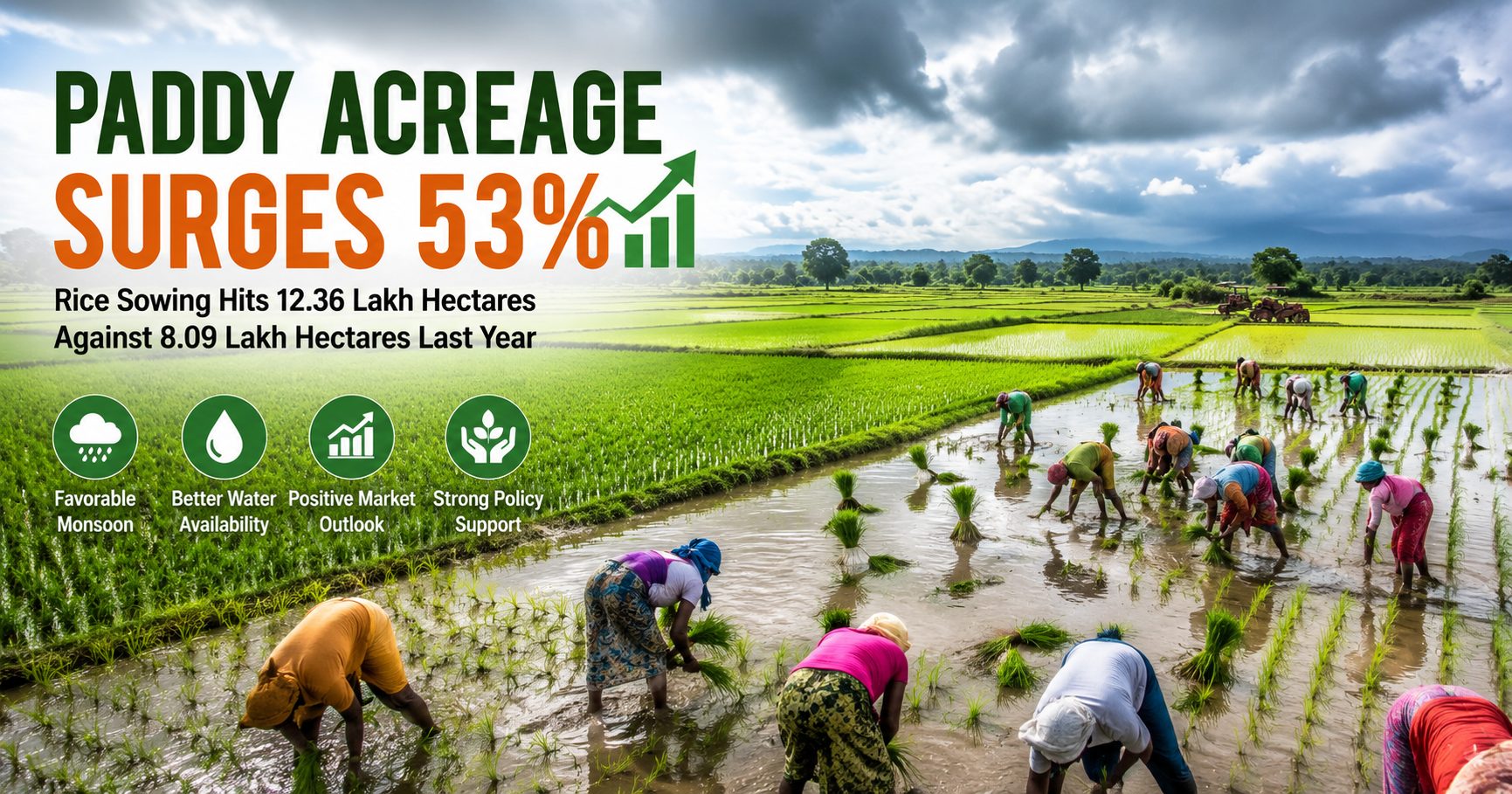
India's rice cultivation has witnessed a remarkable jump, with paddy acreage rising from 8.09 lakh hectares to 12.36 lakh hectares during the corresponding period. Discover what is driving this growth, its impact on food security, farmer incomes, market dynamics, and the opportunities emerging for agriculture stakeholders.
Paddy Acreage Surges 53%: What Record Rice Sowing Means for India's Agriculture and Farmers
Introduction
India's agriculture sector has received a strong boost with paddy acreage recording the highest individual volumetric increase among major crops this season. Rice sowing has expanded to 12.36 lakh hectares compared to 8.09 lakh hectares during the same period last year.
This remarkable increase of 4.27 lakh hectares reflects growing farmer confidence, favorable monsoon conditions, improved irrigation support, and strong expectations of profitable returns. As rice remains one of India's most important staple crops, this development has significant implications for food security, rural livelihoods, agricultural markets, and the broader economy.
Why the Paddy Acreage Surge Matters
Rice is the backbone of India's food system. Millions of farmers depend on paddy cultivation for their livelihood, while billions of consumers rely on rice as a daily staple.
The substantial increase in acreage indicates that farmers are allocating more land toward rice cultivation than they did last year.
Key Numbers at a Glance
Current Paddy Acreage: 12.36 lakh hectares
Last Year's Acreage: 8.09 lakh hectares
Increase: 4.27 lakh hectares
Growth Rate: Approximately 53%
This growth makes rice the strongest-performing crop in terms of acreage expansion among major crops this season.
What Is Driving the Increase in Rice Sowing?
Several factors have contributed to the significant rise in paddy cultivation.
Favorable Monsoon Conditions
Timely and widespread rainfall has encouraged farmers to begin sowing operations earlier and with greater confidence.
Good monsoon distribution improves soil moisture, reduces irrigation costs, and enhances crop establishment.
Improved Water Availability
Reservoir levels and groundwater availability in several agricultural regions have supported increased rice cultivation.
Since paddy is a water-intensive crop, access to water remains one of the most important factors influencing acreage decisions.
Positive Market Expectations
Farmers often increase acreage when they anticipate stable demand and favorable prices.
Rice continues to enjoy strong domestic consumption and export opportunities, making it an attractive crop choice.
Government Support Measures
Policies related to minimum support prices (MSP), procurement mechanisms, crop insurance, and agricultural infrastructure have strengthened farmer confidence.
Government-backed support systems often encourage growers to expand cultivation areas.
Impact on Farmers
The rise in paddy acreage creates several opportunities for farming communities.
Potential for Higher Income
If weather conditions remain favorable and yields perform well, farmers could benefit from larger harvest volumes.
Higher production may translate into increased farm revenues, especially when combined with efficient market access.
Greater Adoption of Modern Farming Practices
The expansion of acreage often drives greater use of:
Improved seed varieties
Precision farming tools
Mechanization
Digital agriculture platforms
Agricultural advisory services
These technologies can enhance productivity while reducing costs.
Increased Need for Crop Management
Larger cultivation areas also require effective management of:
Water resources
Pest control
Nutrient management
Disease prevention
Harvest planning
Farmers who utilize data-driven decision-making are more likely to maximize returns.
Implications for India's Food Security
Rice is a strategic crop for India.
An increase in cultivated area strengthens the country's ability to:
Meet domestic food demand
Maintain public distribution systems
Build buffer stocks
Support exports
Stabilize market prices
Strong production levels contribute directly to national food security and economic stability.
Market Outlook for Rice
Production Expectations
If weather patterns remain supportive throughout the season, India could witness a substantial increase in rice production.
Higher acreage generally creates the foundation for higher output, though final yields will depend on climate and crop management.
Export Opportunities
India remains one of the world's leading rice exporters.
Improved production levels can enhance export competitiveness while supporting foreign exchange earnings.
Price Dynamics
Increased production may help stabilize rice prices.
However, factors such as global demand, logistics, weather disruptions, and government policies will continue to influence market trends.
Challenges That Farmers Must Watch
While acreage expansion is encouraging, several risks remain.
Weather Variability
Excess rainfall, floods, or dry spells can impact crop performance.
Pest and Disease Pressure
Larger cultivation areas may increase vulnerability to pest infestations and disease outbreaks.
Rising Input Costs
Costs associated with fertilizers, labor, machinery, and crop protection products continue to affect profitability.
Water Management Concerns
Sustainable water use remains critical for long-term rice production.
Farmers should adopt efficient irrigation practices whenever possible.
How Agricultural Intelligence Can Help Farmers
Modern agriculture increasingly relies on timely information and informed decision-making.
Farmers can improve outcomes through:
Weather intelligence
Market insights
Crop advisory systems
Training programs
Expert guidance
Digital agriculture networks
Access to reliable agricultural intelligence helps farmers reduce risks and increase profitability.
The Role of AGRIBOZ in Supporting Modern Agriculture
AGRIBOZ is building the Agriculture Intelligence Platform of Bharat by connecting farmers, agripreneurs, trainers, researchers, and industry stakeholders.
Through knowledge sharing, workshops, expert guidance, agricultural updates, and ecosystem collaboration, AGRIBOZ empowers stakeholders to make smarter farming decisions.
Whether you are a farmer, trainer, agriculture startup, consultant, or agribusiness professional, staying connected with agricultural intelligence is becoming essential for long-term success.
Conclusion
The rise in paddy acreage from 8.09 lakh hectares to 12.36 lakh hectares marks one of the strongest agricultural developments of the season. The increase reflects farmer confidence, favorable monsoon conditions, and the continued importance of rice in India's agricultural economy.
As the season progresses, stakeholders across the agriculture ecosystem will closely monitor crop development, production prospects, market trends, and export opportunities.
For farmers and agribusiness professionals, access to timely agricultural intelligence will be a key factor in turning this acreage expansion into profitable outcomes.
Register on https://www.agriboz.com and stay ahead with the latest agricultural insights, opportunities, and ecosystem connections.
CTA Section
Explore the Agriculture Intelligence Platform of Bharat - AGRIBOZ
Join a growing ecosystem of farmers, agripreneurs, trainers, agricultural experts, researchers, and industry leaders.
Access agricultural intelligence, training opportunities, workshops, networking events, farm retreats, and market insights designed to help you grow faster and make better decisions.
Register on https://www.agriboz.com
FAQ
Why has paddy acreage increased this year?
Favorable monsoon conditions, better water availability, government support measures, and positive market expectations have encouraged farmers to increase rice cultivation.
How much has rice sowing increased compared to last year?
Rice sowing increased from 8.09 lakh hectares to 12.36 lakh hectares, representing a rise of approximately 53%.
Will higher acreage guarantee higher rice production?
Not necessarily. Final production depends on weather conditions, pest management, input availability, and overall crop health throughout the growing season.
What does higher rice acreage mean for consumers?
Increased rice cultivation can support food security, improve stock availability, and potentially help stabilize prices.
How can farmers benefit from agricultural intelligence platforms?
Agricultural intelligence platforms provide weather updates, market information, expert guidance, training resources, and networking opportunities that help farmers improve productivity and profitability.
Explore the Agriculture Intelligence Platform of Bharat - AGRIBOZ
Connect with farmers, agripreneurs, agriculture experts, trainers, researchers, and industry leaders.
Discover workshops, agricultural intelligence, farm retreats, partnerships, training opportunities, and market insights.
Register on https://www.agriboz.com
Q1. How much has paddy acreage increased this season?
Rice sowing increased from 8.09 lakh hectares to 12.36 lakh hectares, showing an increase of approximately 53%.
Q2. Why are farmers increasing rice cultivation?
Better monsoon conditions, improved water availability, government support, and favorable market expectations are driving the expansion.
Q3. How does higher rice acreage affect food security?
Higher acreage can lead to larger production volumes, helping strengthen food security and maintain buffer stocks.
Q4. What risks could affect rice production despite increased acreage?
Weather fluctuations, pest attacks, diseases, rising input costs, and water management challenges can impact final yields.
Q5. How can AGRIBOZ help farmers and agribusinesses?
AGRIBOZ provides agricultural intelligence, expert insights, training opportunities, networking, workshops, and ecosystem support for agriculture stakeholders.