
Extension Mobilization in India: PM Narendra Modi Certifies 30,000+ Krishi Sakhis to Strengthen Agricultural Advisory Services
India's agricultural extension ecosystem is undergoing a major transformation as more than 30,000 self-help group members have been certified as Krishi Sakhis across 12 states. This initiative aims to create a decentralized network of grassroots para-extension workers who can bridge knowledge gaps, improve technology adoption, and empower rural women while accelerating farm productivity and sustainability.
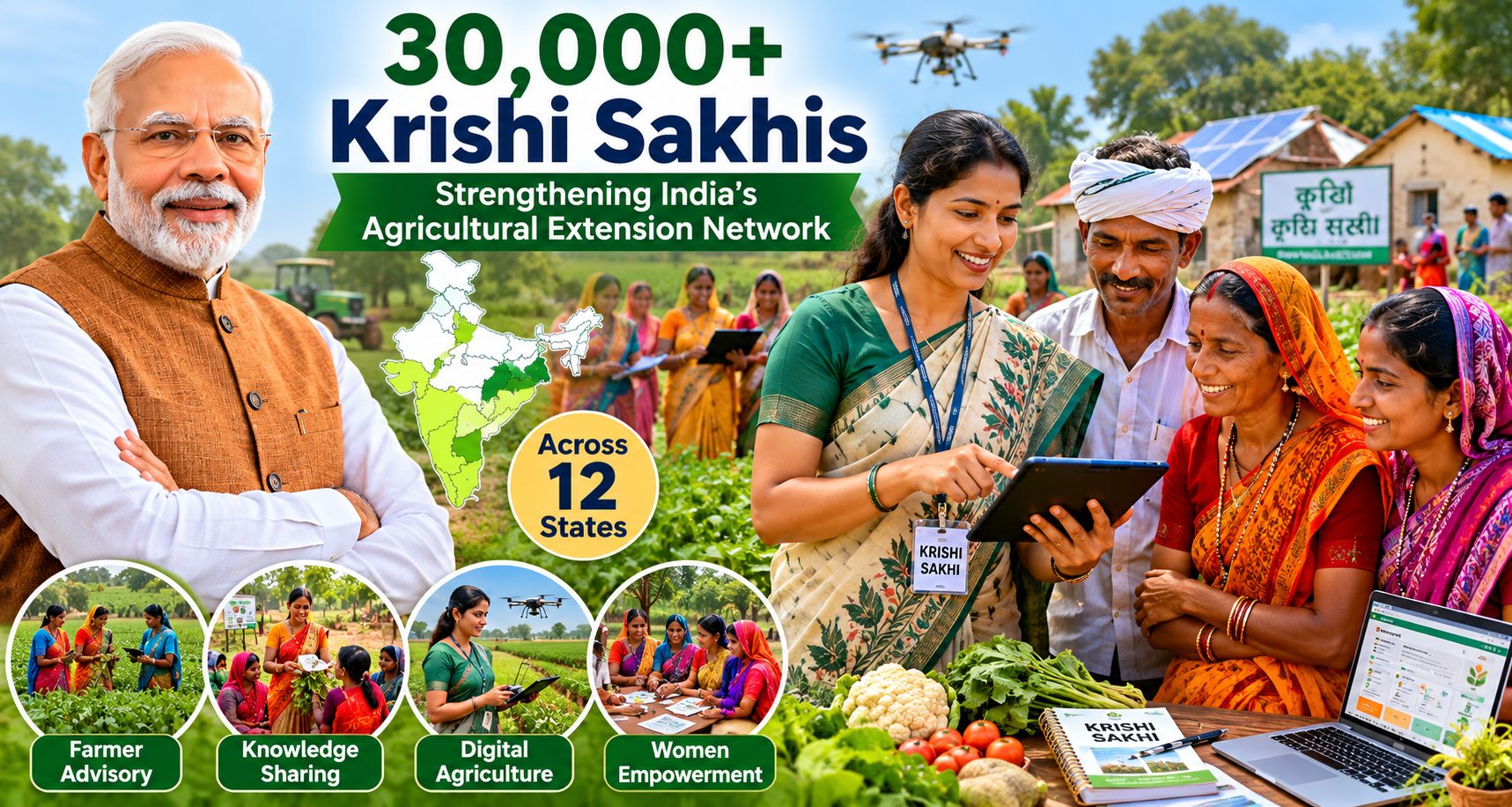
Extension Mobilization in India: 30,000+ Krishi Sakhis Set to Transform Agricultural Extension Services
Introduction
India's agricultural sector has long faced a critical challenge: ensuring that scientific farming knowledge reaches every farmer at the right time. While research institutions continue to develop innovative solutions, the last-mile delivery of knowledge often remains weak.
To address this challenge, Prime Minister Narendra Modi has certified more than 30,000 self-help group members as Krishi Sakhis across 12 states. These trained women will function as decentralized para-extension workers, helping farmers access modern agricultural knowledge, government schemes, climate-resilient practices, and productivity-enhancing technologies.
This initiative represents a significant step toward strengthening grassroots agricultural advisory systems while simultaneously creating livelihood opportunities for rural women.
Why Agricultural Extension Matters
The Knowledge Gap in Indian Agriculture
Many farmers still struggle with:
- Limited access to expert guidance
- Low awareness of modern technologies
- Inefficient input utilization
- Pest and disease management challenges
- Climate-related uncertainties
Without effective extension support, productivity improvements remain difficult to achieve.
The Need for Last-Mile Advisory Services
Agriculture is highly localized. Farmers need guidance that considers:
- Local weather conditions
- Soil characteristics
- Crop patterns
- Pest outbreaks
- Market opportunities
Decentralized extension workers can provide faster and more relevant support than centralized systems alone.
Who Are Krishi Sakhis?
Community-Based Agriculture Facilitators
Krishi Sakhis are trained women from self-help groups who provide agricultural guidance and support within their communities.
Their responsibilities may include:
- Farmer awareness programs
- Demonstration of improved farming practices
- Input management guidance
- Sustainable agriculture promotion
- Government scheme facilitation
- Digital agriculture awareness
Building Trust Through Local Presence
One of the biggest advantages of Krishi Sakhis is community trust.
Since they belong to the same villages and social networks as farmers, they can:
- Improve knowledge adoption
- Encourage behavioral change
- Increase participation in government programs
- Facilitate peer-to-peer learning
Impact of Certifying 30,000+ Krishi Sakhis
Strengthening Extension Infrastructure
The certification of more than 30,000 women significantly expands India's agricultural extension network.
Benefits include:
- Greater outreach to remote villages
- Faster dissemination of information
- Improved farmer engagement
- Enhanced advisory coverage
Empowering Rural Women
The initiative is not only about agriculture.
It also supports:
- Women's leadership
- Economic empowerment
- Community participation
- Rural entrepreneurship
By becoming recognized agricultural advisors, women gain both social and economic opportunities.
Improving Technology Adoption
Many innovations fail because farmers lack practical guidance.
Krishi Sakhis can help farmers adopt:
- Precision agriculture techniques
- Integrated nutrient management
- Water conservation methods
- Climate-smart farming practices
- Digital agriculture tools
How Krishi Sakhis Can Support Sustainable Agriculture
Promoting Climate-Resilient Farming
Climate variability is becoming a major risk for farmers.
Krishi Sakhis can educate farmers on:
- Crop diversification
- Water-efficient practices
- Soil health management
- Risk reduction strategies
Encouraging Natural and Sustainable Farming
Sustainable agriculture requires consistent awareness and field-level support.
Krishi Sakhis can help farmers understand:
- Organic inputs
- Biofertilizers
- Integrated pest management
- Regenerative farming practices
Enhancing Soil Health Awareness
Healthy soil is the foundation of profitable farming.
Local extension workers can encourage:
- Soil testing
- Balanced fertilization
- Organic matter improvement
- Long-term soil conservation
Economic Benefits for Rural Communities
Better Farm Productivity
When farmers receive timely advice, they can make better decisions regarding:
- Crop selection
- Input application
- Irrigation scheduling
- Pest management
This can improve yields and profitability.
New Income Opportunities
Krishi Sakhis themselves can create value by offering advisory support and participating in agriculture-related service ecosystems.
Stronger Rural Ecosystems
A localized advisory network contributes to:
- Knowledge sharing
- Community resilience
- Farmer collaboration
- Agricultural innovation
The Future of Decentralized Agricultural Extension
A Scalable Model for Bharat
The Krishi Sakhi model demonstrates how community-led extension can complement formal agricultural systems.
As the network grows, India could witness:
- Improved farm productivity
- Higher technology adoption
- Stronger rural livelihoods
- More inclusive agricultural development
Digital Agriculture Integration
Future opportunities include linking Krishi Sakhis with:
- Mobile advisory platforms
- AI-powered agriculture tools
- Weather intelligence systems
- Market information networks
This combination can significantly improve decision-making at the farm level.
Conclusion
The certification of over 30,000 Krishi Sakhis marks an important milestone in India's agricultural transformation journey. By combining women empowerment, grassroots leadership, and decentralized extension services, the initiative has the potential to improve knowledge delivery, technology adoption, sustainability, and farm profitability across rural India.
As agriculture becomes increasingly knowledge-driven, community-based extension workers will play a crucial role in bridging the gap between innovation and implementation.
Explore the Agriculture Intelligence Platform of Bharat - AGRIBOZ.
Register on https://www.agriboz.com Explore the Agriculture Intelligence Platform of Bharat - AGRIBOZ
Whether you are a farmer, agri-entrepreneur, trainer, researcher, FPO member, extension professional, or rural innovator, AGRIBOZ helps you stay connected with the evolving agricultural ecosystem.
Benefits of joining AGRIBOZ:
• Access agriculture intelligence and market insights • Discover training programs and workshops • Connect with agriculture experts and practitioners • Learn sustainable and climate-smart farming practices • Participate in agricultural innovation ecosystems • Explore collaboration opportunities across Bharat
Register on https://www.agriboz.com
Q1. What is a Krishi Sakhi? A Krishi Sakhi is a trained woman from a self-help group who provides agricultural advisory and extension support to farmers within her community.
Q2. How many Krishi Sakhis have been certified under the recent initiative? More than 30,000 self-help group members have been certified as Krishi Sakhis across 12 states.
Q3. What role do Krishi Sakhis play in agriculture? They help farmers adopt improved farming practices, access government schemes, improve productivity, and implement sustainable agriculture techniques.
Q4. Why is decentralized agricultural extension important? It improves last-mile delivery of agricultural knowledge and provides location-specific guidance directly within farming communities.
Q5. How does the initiative support women empowerment? The program creates leadership opportunities, skill development pathways, and income-generating roles for rural women.
Q6. Can Krishi Sakhis help promote climate-smart agriculture? Yes. They can educate farmers about water conservation, crop diversification, soil health management, and climate-resilient farming practices.
Q7. How can digital tools enhance the effectiveness of Krishi Sakhis? Digital platforms can provide real-time weather updates, advisory services, market intelligence, and farm management support.
Q8. How can agriculture professionals engage with AGRIBOZ? Agriculture professionals can join AGRIBOZ to access knowledge resources, training opportunities, networking platforms, and agriculture intelligence services.