
Jharkhand Krishi Vyapar Mela 2026 Generates Direct Procurement Agreements for Pulse FPOs
The successful conclusion of Jharkhand’s Krishi Vyapar Mela 2026 signals a major shift toward organized agricultural trade. Direct procurement agreements between corporate buyers and pulse-growing FPOs could improve price realization, strengthen supply chains, and unlock new opportunities for rural producers.
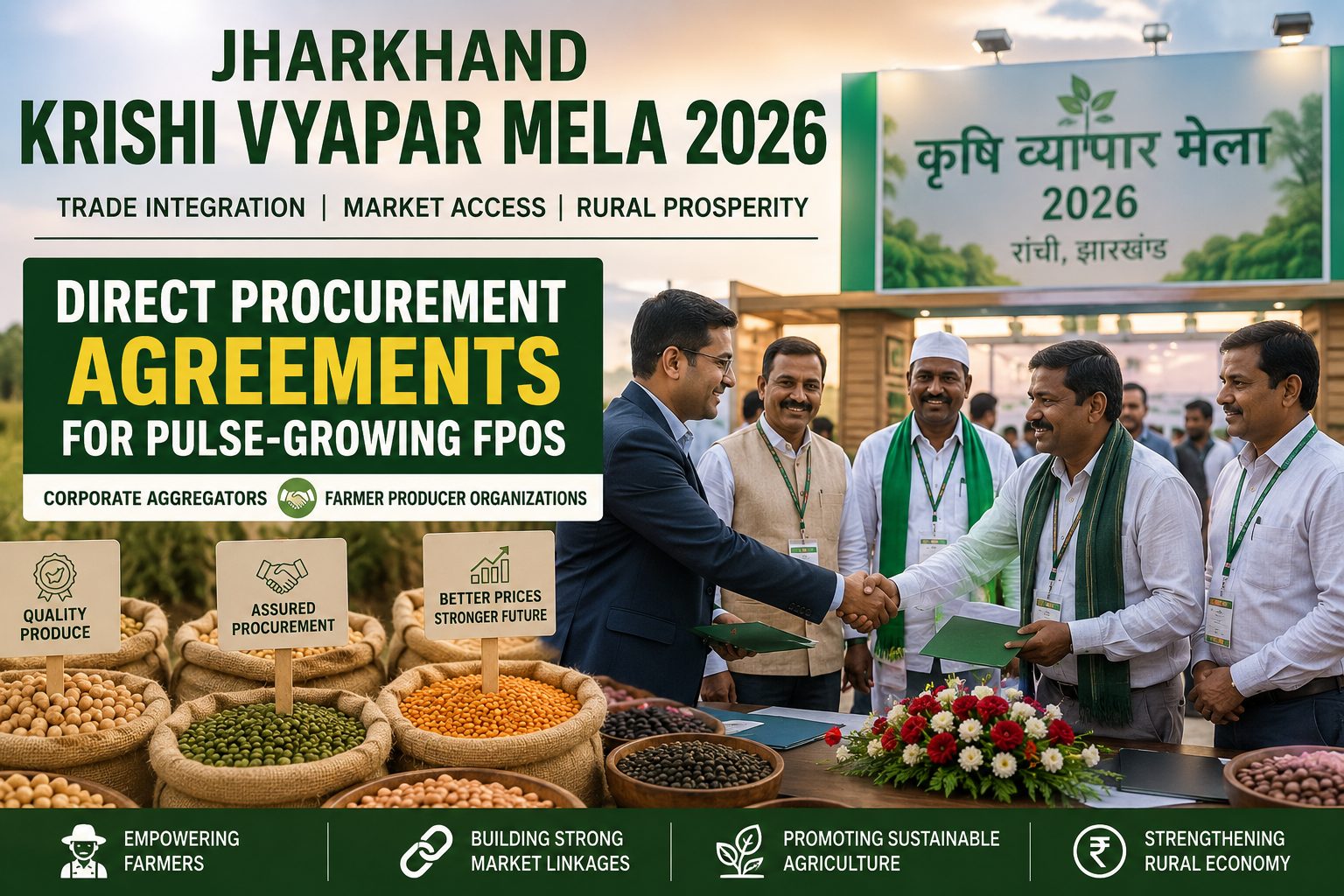
Trade Integration Accelerates in Bharat: Jharkhand’s Krishi Vyapar Mela 2026 Drives Direct Procurement Deals for Pulse-Growing FPOs
A New Signal for Bharat’s Agricultural Markets
Agricultural transformation is no longer driven only by production. Increasingly, it is being driven by market access.
The conclusion of Jharkhand’s Krishi Vyapar Mela 2026 has highlighted this reality by facilitating direct procurement agreements between corporate aggregators and regional pulse-growing Farmer Producer Organizations (FPOs).
For many farmers, this development represents more than a trade event. It represents a pathway toward predictable buyers, better price discovery, and reduced dependence on fragmented market channels.
If you want to stay updated on emerging agricultural opportunities, market trends, and farmer-focused initiatives, explore AGRIBOZ: https://www.agriboz.com
---
The Traditional Challenge Facing Pulse Farmers
Pulse cultivation remains a critical component of Bharat’s agricultural economy.
However, many pulse growers continue to face challenges such as:
- Limited market connectivity
- Dependence on intermediaries
- Price fluctuations
- Lack of storage infrastructure
- Inconsistent procurement systems
Even when productivity improves, income growth often remains constrained because market integration is weak.
This is where structured trade platforms become important.
---
Why the Krishi Vyapar Mela Matters
Trade fairs are increasingly becoming strategic agricultural infrastructure.
The Jharkhand Krishi Vyapar Mela 2026 served as a meeting point between:
- Farmer Producer Organizations
- Corporate aggregators
- Processors
- Institutional buyers
- Input suppliers
- Agricultural entrepreneurs
Instead of operating in isolated ecosystems, stakeholders engaged directly to identify procurement opportunities and long-term supply relationships.
Such interactions help move agriculture from transaction-based selling toward partnership-based commerce.
---
Bharat’s Market Reality: Scale Requires Aggregation
One of the biggest challenges for corporate buyers is sourcing consistent quality and volume.
At the same time, small and marginal farmers struggle to access large buyers individually.
FPOs bridge this gap.
When organized effectively, FPOs can:
- Aggregate production
- Standardize quality
- Improve bargaining power
- Reduce transaction costs
- Enable traceability
This makes them attractive partners for corporate procurement systems.
The agreements emerging from Jharkhand's trade platform demonstrate the growing maturity of this model.
---
Opportunity Breakdown: What These Procurement Agreements Can Deliver
1. Better Price Realization
Direct engagement with buyers often reduces intermediary layers.
This can potentially improve farmer earnings and create more transparent pricing mechanisms.
2. Assured Market Access
Procurement agreements can provide confidence before harvest.
Farmers gain visibility into demand expectations and market opportunities.
3. Improved Quality Standards
Corporate procurement systems generally encourage:
- Better grading
- Standardization
- Post-harvest management
- Quality assurance
These improvements increase competitiveness.
4. Stronger Rural Economies
When FPO revenues improve, the benefits often extend across rural communities through employment, logistics, processing, and local entrepreneurship.
---
MID-CONTENT CTA
Farmers, FPO leaders, agri-entrepreneurs, and agricultural professionals looking to build stronger market connections can explore AGRIBOZ opportunities, workshops, and ecosystem initiatives:
https://www.agriboz.com
Learning how markets work is becoming just as important as learning how to farm.
---
Strategic Insights for the Next Five Years
Several long-term trends are becoming visible:
FPO-Centric Procurement Models
Corporates increasingly prefer organized farmer groups over fragmented sourcing channels.
Data-Driven Agriculture
Digital records, traceability systems, and production planning will become procurement requirements.
Regional Value Chain Development
States like Jharkhand can strengthen their position by building crop-specific trade ecosystems around pulses and other high-demand commodities.
Market-Led Farming Decisions
Future farm profitability may depend more on market intelligence than on production volume alone.
---
Practical Lessons for FPO Leaders
Organizations seeking similar outcomes can focus on:
- Quality standardization
- Collective marketing
- Digital record management
- Buyer relationship development
- Contract understanding
- Supply consistency
- Storage and logistics planning
The FPOs that master these capabilities will likely capture the greatest opportunities in the evolving agricultural economy.
---
How AGRIBOZ Can Support This Transition
Agriculture is moving toward integrated ecosystems where knowledge, market access, technology, and collaboration work together.
AGRIBOZ aims to support this transformation through:
- Agricultural workshops
- Industry networking opportunities
- Knowledge-sharing platforms
- Trainer partnerships
- Farm retreats
- Rural innovation initiatives
As more farmers and FPOs engage with organized markets, access to practical knowledge becomes a strategic advantage.
Explore the ecosystem: https://www.agriboz.com
---
The Bigger Transformation Vision
Jharkhand’s Krishi Vyapar Mela 2026 demonstrates a larger shift taking place across Bharat.
The future of agriculture will not be defined solely by what is grown.
It will be defined by:
- Who buys it
- How efficiently it moves
- How transparently it is traded
- How effectively producers participate in value creation
Direct procurement agreements between corporate aggregators and pulse-growing FPOs are a sign that agriculture is becoming more connected, organized, and opportunity-driven.
For farmers, FPO leaders, and agricultural entrepreneurs, this is not merely a trade story.
It is a glimpse into the future of Bharat’s agricultural economy.
The future belongs to farmers and FPOs that combine production excellence with market intelligence.
Join the AGRIBOZ ecosystem to access opportunities, partnerships, workshops, industry insights, and growth-focused agricultural initiatives:
https://www.agriboz.com
Start building your next agricultural opportunity today.
1. What was the key outcome of Jharkhand’s Krishi Vyapar Mela 2026?
The event concluded with direct procurement agreements between corporate aggregators and pulse-growing Farmer Producer Organizations (FPOs), improving market integration.
2. How do direct procurement agreements benefit farmers?
They can improve price realization, reduce intermediary dependence, create predictable demand, and strengthen long-term buyer relationships.
3. Why are FPOs important in agricultural trade?
FPOs aggregate production, improve bargaining power, standardize quality, and help farmers access larger institutional buyers.
4. What role do agricultural trade fairs play in market development?
Trade fairs connect producers, buyers, processors, and service providers, creating opportunities for business partnerships and procurement agreements.
5. How can farmers prepare for direct procurement opportunities?
Farmers and FPOs should focus on quality standards, collective marketing, traceability, logistics planning, and market intelligence.