

2026-27 Kharif MSP Approved: Major Incentives for Oilseeds and Cotton Farmers
The Union Cabinet has approved higher MSPs for 14 Kharif crops for the 2026-27 marketing season. Oilseeds and cotton received the largest increases, signaling a strategic push toward crop diversification, import reduction, and stronger farm incomes. The decision could reshape cropping patterns across India.
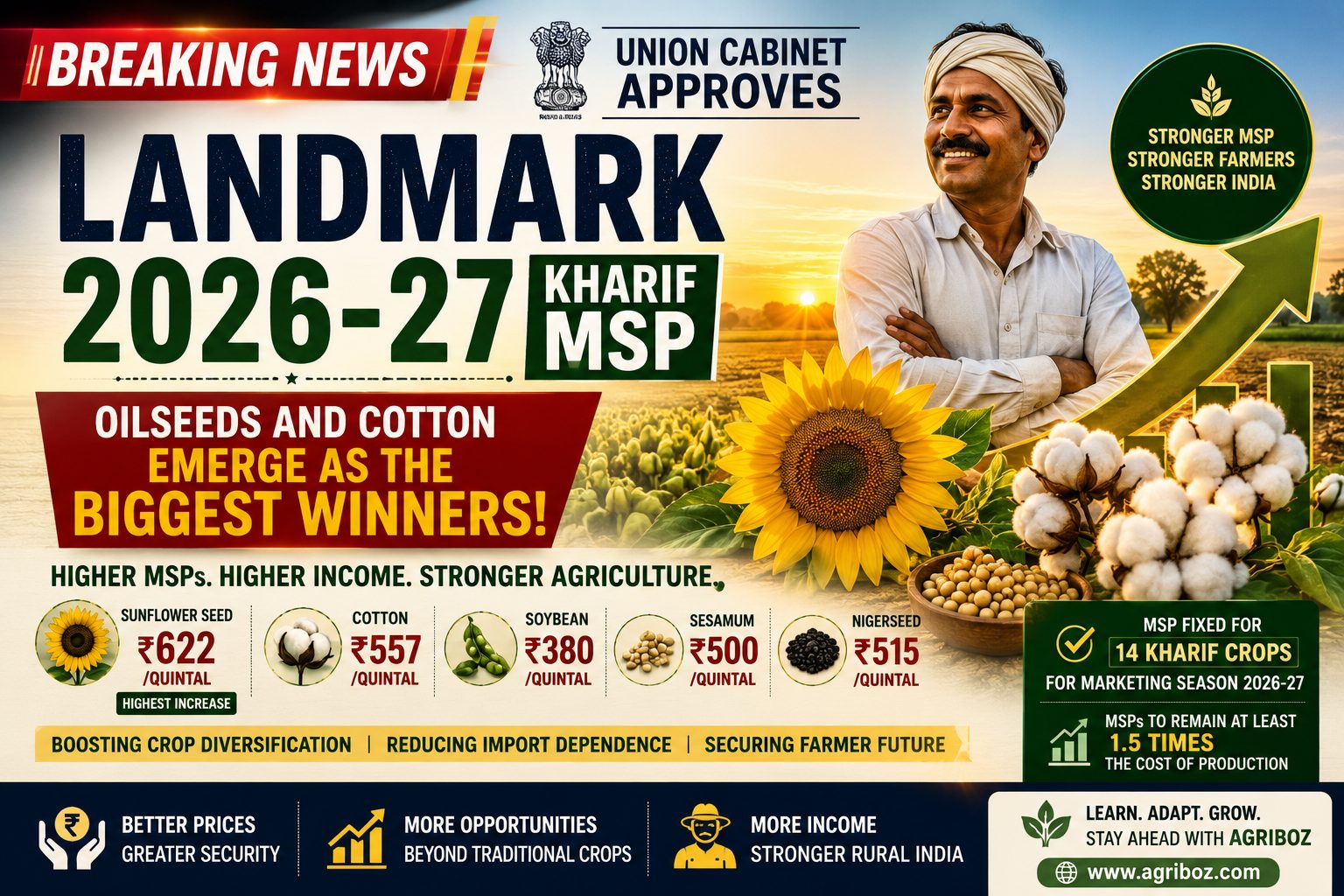
Union Cabinet Approves Landmark 2026-27 Kharif MSP: Oilseeds and Cotton Emerge as the Biggest Winners
A Major Policy Signal for Indian Agriculture
The Union Cabinet's approval of the Minimum Support Prices (MSP) for Kharif Marketing Season 2026-27 is more than a routine annual announcement.
It sends a powerful message about the future direction of Indian agriculture.
While MSPs have increased across 14 Kharif crops, the biggest gains have gone to oilseeds and cotton. Sunflower seed received the highest absolute increase of ₹622 per quintal, followed by cotton at ₹557, nigerseed at ₹515, and sesamum at ₹500. :contentReference[oaicite:0]{index=0}
For farmers, agribusinesses, and rural entrepreneurs, this may be one of the most important market signals of the year.
Those looking to understand emerging crop opportunities can explore AGRIBOZ:
https://www.agriboz.com
---
What Changed in the New MSP Announcement?
The Cabinet approved MSP increases for 14 Kharif crops for Marketing Season 2026-27. The largest gains were concentrated in crops that India wants to promote strategically. :contentReference[oaicite:1]{index=1}
Major MSP Increases
| Crop | MSP Increase | |--------|-------------| | Sunflower Seed | ₹622/quintal | | Cotton | ₹557/quintal | | Nigerseed | ₹515/quintal | | Sesamum | ₹500/quintal | | Soybean | ₹380/quintal |
The government has maintained its policy of ensuring MSPs remain at least 1.5 times the weighted average cost of production. :contentReference[oaicite:2]{index=2}
---
Why Oilseeds Are Receiving Special Attention
India remains heavily dependent on edible oil imports.
This dependence creates:
- Foreign exchange pressure
- Supply chain risks
- Price volatility
- Food security concerns
By offering stronger MSP incentives for oilseed crops, policymakers are encouraging farmers to allocate more acreage toward domestic oil production.
The message is clear:
India wants more oilseeds grown domestically.
This could create long-term opportunities for:
- Sunflower growers
- Soybean producers
- Groundnut farmers
- Sesamum cultivators
- Oil processing businesses
---
Cotton Receives a Strong Push
Cotton's substantial MSP increase reflects its strategic importance.
Cotton supports:
- Textile manufacturing
- Export earnings
- Rural employment
- Value-added industries
The new MSP for medium staple cotton has been fixed at ₹8,267 per quintal, while long staple cotton reaches ₹8,667 per quintal. :contentReference[oaicite:3]{index=3}
This increase may strengthen farmer confidence heading into the Kharif season.
---
The Bigger Strategy: Crop Diversification
Perhaps the most important story is not the MSP increase itself.
It is the direction of the increase.
For years, Indian agriculture has remained heavily dependent on rice and wheat.
The latest MSP structure encourages diversification toward:
- Oilseeds
- Pulses
- Cotton
- Nutri-cereals
This strategy aims to improve:
- Resource efficiency
- Farm profitability
- National self-reliance
- Climate resilience
---
MID-CONTENT CTA
Government policy often creates opportunities before markets fully react.
Farmers who understand emerging trends in crop diversification, value addition, and agribusiness development are better positioned to benefit.
Explore AGRIBOZ workshops and practical agricultural learning programs:
https://www.agriboz.com/workshops
---
What This Means for Farmers
1. Reevaluate Crop Planning
Higher MSPs may improve the economics of oilseed and cotton cultivation.
2. Explore Value Addition
Oil extraction, cotton processing, and aggregation models may gain traction.
3. Monitor Regional Suitability
Not every crop fits every agro-climatic zone.
Profitability starts with suitability.
4. Think Beyond One Season
The strongest opportunities often emerge when policy support aligns with market demand.
---
The Bharat Market Reality
Consumer demand for edible oils continues to grow.
India's textile sector continues to expand.
Export opportunities remain significant.
At the same time, policymakers are actively encouraging crop diversification.
This combination creates a rare alignment between:
- Government incentives
- Market demand
- National priorities
- Farmer income goals
Such alignments often create long-term agricultural opportunities.
---
How AGRIBOZ Helps Farmers Navigate Policy Shifts
Agricultural success increasingly depends on information.
AGRIBOZ helps farmers and agripreneurs stay connected to:
- Agricultural workshops
- Market intelligence
- Government schemes
- Farm retreats
- Expert trainers
- Agribusiness opportunities
As agricultural policies evolve, access to knowledge becomes a competitive advantage.
Explore AGRIBOZ:
https://www.agriboz.com
---
A New Chapter for Indian Agriculture
The 2026-27 Kharif MSP announcement is not simply about higher prices.
It is about directing the future of Indian agriculture.
The strong incentives for oilseeds and cotton indicate where policymakers see growth, resilience, and strategic value.
Farmers who recognize these signals early may find themselves better positioned for the next phase of agricultural transformation.
The question is no longer whether Indian agriculture is changing.
The question is whether farmers are prepared to capitalize on that change.
The 2026-27 MSP announcement may create new opportunities in oilseeds, cotton, and value-added agriculture. Join AGRIBOZ to access workshops, market intelligence, training, partnerships, and future-ready agricultural opportunities.
https://www.agriboz.com
Q1. Which crop received the highest MSP increase in 2026-27? Sunflower seed received the highest absolute MSP increase of ₹622 per quintal.
Q2. Why are oilseeds receiving greater MSP support? The government aims to reduce edible oil import dependence and increase domestic oilseed production.
Q3. What is the new MSP for cotton? Medium staple cotton MSP has been fixed at ₹8,267 per quintal and long staple cotton at ₹8,667 per quintal.
Q4. How does MSP affect farmers? MSP provides a price assurance mechanism that helps protect farmers from sharp market price declines.
Q5. Does the MSP announcement encourage crop diversification? Yes. The stronger increases for oilseeds, pulses, and cotton indicate a policy push toward diversified and higher-value crop systems.