
New 13% PSF Premium Rate: How Tech-Enabled FPOs Can Profit from the ₹2,125/Quintal Onion Procurement Opportunity
The Government of India has increased the onion procurement price under the Price Stabilisation Fund (PSF) by 13%, raising it from ₹1,875 to ₹2,125 per quintal effective July 4, 2026. This policy shift creates a significant opportunity for Farmer Producer Organizations (FPOs) with storage infrastructure, digital inventory systems, and market intelligence capabilities to capture higher margins through strategic procurement, storage, and lean-season releases.
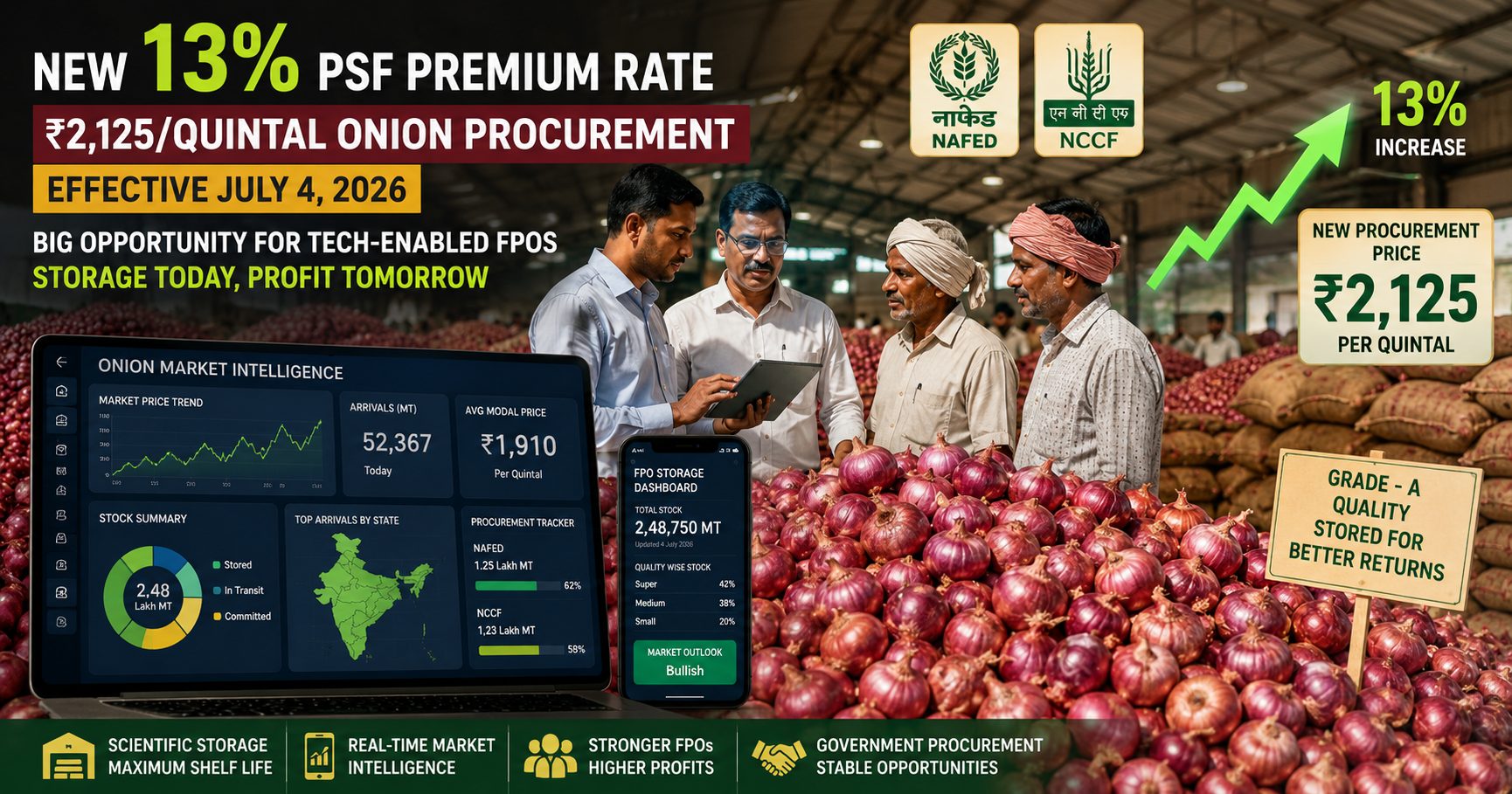
New 13% PSF Premium Rate: How Tech-Enabled FPOs Can Unlock Onion Storage Profits in 2026
Introduction
India's onion market has always been characterized by extreme price volatility. Farmers often face distress sales during harvest periods, while consumers experience sharp price spikes during lean months.
On July 4, 2026, the Ministry of Consumer Affairs announced a 13% increase in the onion procurement price for the National Buffer Stock, raising it from ₹1,875 to ₹2,125 per quintal through NAFED and NCCF. This policy adjustment is designed to strengthen buffer stock procurement while improving farmer returns. The revised rate is effective immediately. :contentReference[oaicite:0]{index=0}
For technology-enabled FPOs, this is more than a policy announcement.
It is a business opportunity.
Why This Announcement Matters
The Procurement Price Has Increased Significantly
The revised procurement rate of ₹2,125 per quintal represents a 13% increase over the previous rate of ₹1,875 per quintal. Government procurement through NAFED and NCCF is currently underway to build the national onion buffer stock. :contentReference[oaicite:1]{index=1}
Government Needs Strong Buffer Stocks
The central government is actively procuring onions for buffer stock creation to stabilize future market prices and manage seasonal supply fluctuations. Reports indicate a procurement target of approximately 2 lakh tonnes through NAFED and NCCF. :contentReference[oaicite:2]{index=2}
Market Conditions Favor Organized Players
While onion production remains stable, delayed monsoon conditions and speculative trading activities are creating uncertainty in market sentiment. Quality stored onions are expected to become increasingly valuable during lean-season demand cycles. :contentReference[oaicite:3]{index=3}
The Arbitrage Opportunity for Tech-Enabled FPOs
What Is Agricultural Arbitrage?
Agricultural arbitrage occurs when organizations buy produce during low-price periods, store it efficiently, and sell it later at higher prices or into institutional procurement channels.
For onions, success depends on:
- Scientific storage
- Quality preservation
- Market intelligence
- Digital inventory management
- Demand forecasting
Why FPOs Are Better Positioned Than Individual Farmers
Individual farmers often lack:
- Storage infrastructure
- Working capital
- Market visibility
- Procurement intelligence
FPOs can aggregate produce from hundreds of farmers and create scale advantages.
This enables:
- Bulk procurement
- Lower storage costs per unit
- Better negotiation power
- Access to institutional buyers
- Improved logistics efficiency
The New Business Model Emerging in 2026
Step 1: Aggregate During Peak Arrivals
Current mandi arrivals remain robust, exceeding 50,000 metric tonnes nationally each day. High arrivals generally create procurement opportunities for organized buyers. :contentReference[oaicite:4]{index=4}
Step 2: Store Scientifically
Modern storage practices can dramatically reduce:
- Weight loss
- Rotting
- Sprouting
- Quality deterioration
Technology adoption becomes the difference between profit and loss.
Step 3: Monitor Government Procurement Signals
The revised PSF rate establishes a new benchmark for institutional procurement.
FPOs tracking:
- NAFED procurement drives
- NCCF procurement announcements
- Regional buffer stock requirements
can position inventory strategically.
Step 4: Release During Lean Periods
The highest value often emerges during:
- Supply gaps
- Weather disruptions
- Delayed sowing cycles
- Seasonal demand spikes
Organizations with real-time market intelligence can optimize timing.
Why Digital Intelligence Is Becoming Essential
Data Is Replacing Guesswork
The most profitable FPOs are increasingly using:
- Price forecasting tools
- Market intelligence platforms
- Demand analytics
- Storage monitoring systems
- Procurement tracking dashboards
The future of agricultural marketing is data-driven.
Inventory Visibility Creates Competitive Advantage
Knowing:
- Stock availability
- Quality grades
- Location-wise inventory
- Potential buyers
allows faster decision-making than traditional trading methods.
Risks FPOs Must Manage
Storage Losses
Improper storage can destroy margins.
Working Capital Constraints
Long-term holding requires adequate financing.
Market Timing Errors
Holding inventory too long can reduce profitability.
Quality Degradation
Institutional buyers demand consistency.
The solution is combining infrastructure with intelligence.
Strategic Recommendations for FPO Leaders
Build Onion-Specific Storage Plans
Develop seasonal storage strategies before procurement begins.
Create Procurement Dashboards
Track:
- Mandi arrivals
- PSF procurement announcements
- Wholesale prices
- Retail prices
Strengthen Farmer Aggregation
Larger aggregation volumes improve bargaining power.
Use Data-Driven Release Decisions
Avoid emotional market decisions.
Rely on market intelligence.
What This Means for the Future of Indian FPOs
The July 2026 PSF price increase signals an important shift.
Government agencies are willing to strengthen procurement economics to ensure adequate buffer stock creation and better farmer participation. :contentReference[oaicite:5]{index=5}
FPOs that combine:
- Scientific storage
- Digital inventory management
- Market intelligence
- Farmer aggregation
will be positioned to capture the largest value opportunities.
The era of simply producing crops is ending.
The era of managing agricultural assets intelligently has begun.
Conclusion
The new ₹2,125 per quintal PSF procurement rate has created a valuable opportunity for forward-looking FPOs. Organizations that invest in storage, technology, and market intelligence can transform onion marketing from a seasonal activity into a strategic profit center.
As agricultural markets become increasingly data-driven, FPOs that act early will build long-term competitive advantages.
Explore the Agriculture Intelligence Platform of Bharat - AGRIBOZ.
Register on https://www.agriboz.com
CTA Section
Explore the Agriculture Intelligence Platform of Bharat - AGRIBOZ.
Use AGRIBOZ to access market intelligence, agricultural opportunities, training programs, ecosystem partnerships, and business growth insights designed for modern FPOs, agripreneurs, and progressive farmers.
Register on https://www.agriboz.com
FAQ Section
What is the new onion procurement price under PSF?
The Government has increased the onion procurement price from ₹1,875 to ₹2,125 per quintal effective July 4, 2026.
Which agencies are procuring onions for the buffer stock?
NAFED and NCCF are responsible for procurement under the Price Stabilisation Fund.
Why was the procurement price increased?
The increase aims to improve farmer returns and accelerate national buffer stock creation.
How can FPOs benefit from this policy?
FPOs can aggregate, store, and strategically market onions while leveraging institutional procurement opportunities.
Why is technology important for onion storage businesses?
Technology improves inventory visibility, reduces storage losses, supports forecasting, and helps optimize market timing.
Explore the Agriculture Intelligence Platform of Bharat - AGRIBOZ
Discover market intelligence, procurement opportunities, FPO growth strategies, agri-business insights, workshops, trainer partnerships, and ecosystem networking opportunities.
Register on https://www.agriboz.com
Q1. What is the revised onion procurement rate under the PSF?
The revised rate is ₹2,125 per quintal, effective July 4, 2026.
Q2. Who procures onions under the National Buffer Stock program?
NAFED and NCCF procure onions on behalf of the Government of India.
Q3. What is the purpose of the Price Stabilisation Fund?
The PSF helps stabilize prices by creating buffer stocks that can be released during shortages or price spikes.
Q4. How can FPOs generate profits from this policy?
By aggregating onions, storing them scientifically, monitoring procurement trends, and selling strategically during lean periods.
Q5. Why are tech-enabled FPOs expected to benefit more?
Because they can use data, inventory management systems, forecasting tools, and market intelligence to improve timing and reduce risk.